THE ADVENTURE COLLECTIVE® · Independent discovery and booking for outdoor travel

Stand on the lip of one of the planet’s most dramatic waterfalls: walk the Zambian edge to Livingstone Island, then swim in Devil’s Pool—a supervised plunge at the Victoria Falls’ rim. This short, intense safari combines geology, history, and a guided swim that rewards careful preparation.
Stand on the lip of one of the planet’s most dramatic waterfalls: walk the Zambian edge to Livingstone Island, then swim in Devil’s Pool—a supervised plunge at the Victoria Falls’ rim. This short, intense safari combines geology, history, and a guided swim that rewards careful preparation.
The walk begins at the Zambian park entrance with the Zambezi’s roar growing from distant thunder to a living wall of spray as you move toward the lip. Footsteps fall on wet rock while mist beads on your jacket; your guide threads a path along the cliff edge, pausing at viewpoints so the falls can open up in sudden, thunderous panoramas. On Livingstone Island the river pulls tight around a patch of basalt and the current dares you to the pool perched on the rim—Devil’s Pool—where you can float within arm’s reach of the plunge.
Verified experiences and guided adventures in the surrounding area.
The walk begins at the Zambian park entrance with the Zambezi’s roar growing from distant thunder to a living wall of spray as you move toward the lip. Footsteps fall on wet rock while mist beads on your jacket; your guide threads a path along the cliff edge, pausing at viewpoints so the falls can open up in sudden, thunderous panoramas. On Livingstone Island the river pulls tight around a patch of basalt and the current dares you to the pool perched on the rim—Devil’s Pool—where you can float within arm’s reach of the plunge.
Geology here is honest and visible: ancient basalt steps tilted and worn by the Zambezi, channels cut over millennia that create the cataract’s segmented curtain. David Livingstone first reported the falls to Victorian Europe in 1855; today the site remains a cultural crossroads for Tonga communities and international visitors. Guides interpret both natural history and local stories, keeping the experience grounded in place and time.
Practically, the walk is short (about 2–3 hours total) but physically immediate: expect slippery rock, close quarters on the island, and a current that rewards respect. You must be comfortable entering fast-moving water and follow your guide’s directions exactly; the crossing to the pool is supervised and buoyed by experience. Bring a waterproof camera or case, non-slip footwear, and a lightweight layer for mist-chill. Morning departures give calmer water and softer light for photos; afternoon light can be spectacular but wind and spray rise. The Livingstone Island and Devil’s Pool safari is both a geological encounter and a focused adventure—brief, intense, and unforgettable if approached with preparation and respect.
moderate.
2–3 hours.
Moderate fitness: able to walk short distances on slippery, uneven rock and enter moving water; not suitable for those with mobility limitations.
When operated by licensed guides and during permitted months, the crossing and swim are supervised with established safety procedures; follow your guide’s instructions at all times.
Yes—participants should be comfortable in moving water; guides assess swimmers and can advise if the activity is suitable before the crossing.
Devil’s Pool swims are conducted from the Zambian side on Livingstone Island; access and tour logistics differ between Zambia and Zimbabwe so choose the correct operator and visa arrangements.
Morning departures usually offer calmer currents and softer light for photography; afternoons can be windier with heavier spray.
Victoria Falls was first recorded in Western accounts by David Livingstone in 1855; the site lies within lands long inhabited by Tonga and other regional communities.
The falls sit within protected parkland; visitors are expected to follow strict paths and waste rules to minimize erosion and protect riparian habitats and tourist infrastructure.
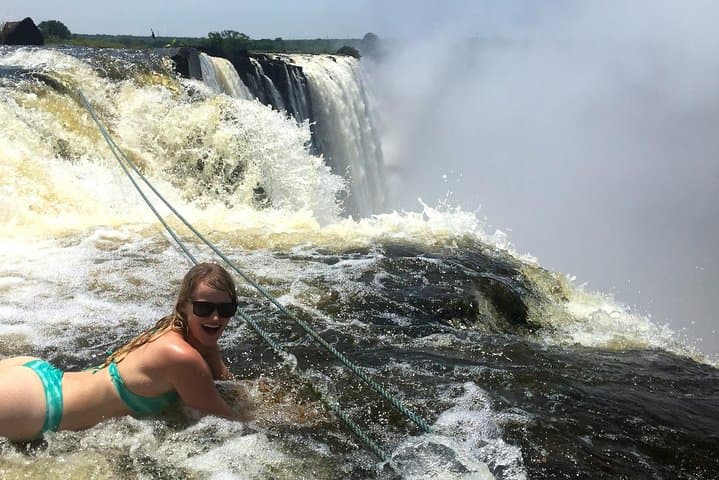
The walk begins at the Zambian park entrance with the Zambezi’s roar growing from distant thunder to a living wall of spray as you move toward the lip. Footsteps fall on wet rock while mist beads on your jacket; your guide threads a path along the cliff edge, pausing at viewpoints so the falls can open up in sudden, thunderous panoramas. On Livingstone Island the river pulls tight around a patch of basalt and the current dares you to the pool perched on the rim—Devil’s Pool—where you can float within arm’s reach of the plunge.
The walk begins at the Zambian park entrance with the Zambezi’s roar growing from distant thunder to a living wall of spray as you move toward the lip. Footsteps fall on wet rock while mist beads on your jacket; your guide threads a path along the cliff edge, pausing at viewpoints so the falls can open up in sudden, thunderous panoramas. On Livingstone Island the river pulls tight around a patch of basalt and the current dares you to the pool perched on the rim—Devil’s Pool—where you can float within arm’s reach of the plunge.
Geology here is honest and visible: ancient basalt steps tilted and worn by the Zambezi, channels cut over millennia that create the cataract’s segmented curtain. David Livingstone first reported the falls to Victorian Europe in 1855; today the site remains a cultural crossroads for Tonga communities and international visitors. Guides interpret both natural history and local stories, keeping the experience grounded in place and time.
Practically, the walk is short (about 2–3 hours total) but physically immediate: expect slippery rock, close quarters on the island, and a current that rewards respect. You must be comfortable entering fast-moving water and follow your guide’s directions exactly; the crossing to the pool is supervised and buoyed by experience. Bring a waterproof camera or case, non-slip footwear, and a lightweight layer for mist-chill. Morning departures give calmer water and softer light for photos; afternoon light can be spectacular but wind and spray rise. The Livingstone Island and Devil’s Pool safari is both a geological encounter and a focused adventure—brief, intense, and unforgettable if approached with preparation and respect.