THE ADVENTURE COLLECTIVE® · Independent discovery and booking for outdoor travel

Spend a full day moving from Denpasar’s historic museum to the towering Garuda Wisnu Kencana and finish at Uluwatu’s cliffside amphitheatre for a Kecak sunset. This practical guide covers what to expect and how to plan the day.
Spend a full day moving from Denpasar’s historic museum to the towering Garuda Wisnu Kencana and finish at Uluwatu’s cliffside amphitheatre for a Kecak sunset. This practical guide covers what to expect and how to plan the day.
The day opens in the heat and bustle of Denpasar’s market lanes—mango stalls and motorbikes negotiating tight turns—before the road climbs toward Bali’s southern rim. By midafternoon the island’s heat gives way to a salty wind as you crest the Bukit Peninsula and the Garuda Wisnu Kencana statue comes into view, a monumental silhouette against the sky.
Verified experiences and guided adventures in the surrounding area.
Operated by Bali Savaya Tours · Denpasar, Bali
The day opens in the heat and bustle of Denpasar’s market lanes—mango stalls and motorbikes negotiating tight turns—before the road climbs toward Bali’s southern rim. By midafternoon the island’s heat gives way to a salty wind as you crest the Bukit Peninsula and the Garuda Wisnu Kencana statue comes into view, a monumental silhouette against the sky.
This loop pairs civic history and high-drama coastline. Start at the Bali Museum in Taman Puputan, a 1931 building that records royal courts, textile traditions and the Dutch intervention that reshaped modern Denpasar. At GWK Cultural Park you’ll cover paved slopes across roughly 60 hectares to reach viewing platforms around Indonesia’s towering Wisnu-and-Garuda monument—expect stairs and exposed sun with panoramic island vistas.
Late in the day the tour winds to Pura Luhur Uluwatu, perched about 70 metres above the Indian Ocean. The temple’s cliff edge and the amphitheatre below host the Kecak fire dance at sunset; beware of the cheeky macaques that know how to unclip a camera strap.
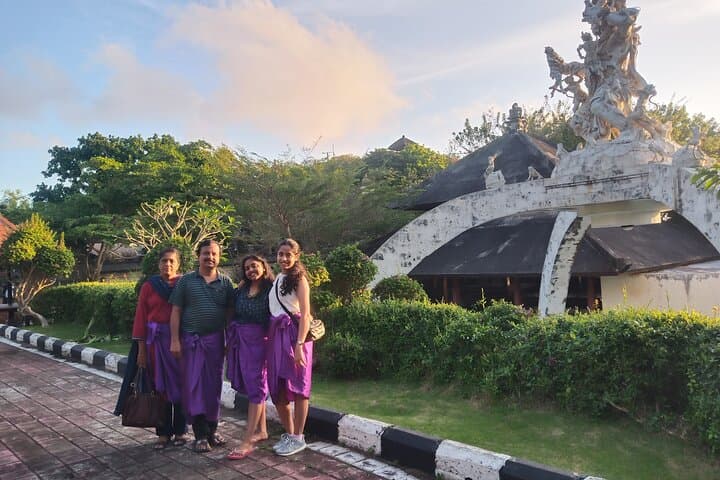
Practicalities: it’s a mostly low-intensity day but you’ll be on your feet for several short walks and stairs; total outing is about 8–9 hours door-to-door. Carry sun protection, a sarong or modest covering for temple entrances, and a refillable water bottle. Plan the schedule so you arrive at Uluwatu about 45–60 minutes before sunset for the best light and seating for the Kecak performance.
The route balances culture, geology and theatrical coastline—an easy, full-day introduction to southern Bali that rewards punctuality and modest dress.
easy.
8–9 hours.
Suitable for most fitness levels; requires standing and walking on paved paths and stairs throughout the day.
There are options; some tour packages include entrance fees (GWK and Bali Museum) while basic transport-only options do not—confirm at booking.
Photography is generally allowed outside the temple; flash or tripods may be restricted during performances—follow local signage and guide instructions.
Yes—physical demands are light, but there are stairs at Uluwatu and uneven surfaces; travelers with mobility issues should advise the operator ahead of time.
Yes—GWK and the Uluwatu area have cafes and restrooms; bring cash for small purchases but many venues accept cards.
The Bali Museum reflects the colonial-era reconstruction after the 1906 intervention; Uluwatu is one of Bali’s six directional temples guarding the southern sea.
Visitors should avoid single-use plastics, follow temple rules, and not feed or approach macaques to reduce human-wildlife conflict.
Bali Savaya Tours operates guided outdoor trips and adventures with an emphasis on safety, stewardship, and memorable experiences.


The day opens in the heat and bustle of Denpasar’s market lanes—mango stalls and motorbikes negotiating tight turns—before the road climbs toward Bali’s southern rim. By midafternoon the island’s heat gives way to a salty wind as you crest the Bukit Peninsula and the Garuda Wisnu Kencana statue comes into view, a monumental silhouette against the sky.
The day opens in the heat and bustle of Denpasar’s market lanes—mango stalls and motorbikes negotiating tight turns—before the road climbs toward Bali’s southern rim. By midafternoon the island’s heat gives way to a salty wind as you crest the Bukit Peninsula and the Garuda Wisnu Kencana statue comes into view, a monumental silhouette against the sky.
This loop pairs civic history and high-drama coastline. Start at the Bali Museum in Taman Puputan, a 1931 building that records royal courts, textile traditions and the Dutch intervention that reshaped modern Denpasar. At GWK Cultural Park you’ll cover paved slopes across roughly 60 hectares to reach viewing platforms around Indonesia’s towering Wisnu-and-Garuda monument—expect stairs and exposed sun with panoramic island vistas.
Late in the day the tour winds to Pura Luhur Uluwatu, perched about 70 metres above the Indian Ocean. The temple’s cliff edge and the amphitheatre below host the Kecak fire dance at sunset; beware of the cheeky macaques that know how to unclip a camera strap.
Practicalities: it’s a mostly low-intensity day but you’ll be on your feet for several short walks and stairs; total outing is about 8–9 hours door-to-door. Carry sun protection, a sarong or modest covering for temple entrances, and a refillable water bottle. Plan the schedule so you arrive at Uluwatu about 45–60 minutes before sunset for the best light and seating for the Kecak performance.
The route balances culture, geology and theatrical coastline—an easy, full-day introduction to southern Bali that rewards punctuality and modest dress.