THE ADVENTURE COLLECTIVE® · Independent discovery and booking for outdoor travel

Travel from Luxor to the Temple of Hathor for a private half-day exploration of Ptolemaic reliefs and the famed astronomical ceiling. This short guided tour blends comfortable transport with focused time at one of Upper Egypt’s best-preserved temples.
Travel from Luxor to the Temple of Hathor for a private half-day exploration of Ptolemaic reliefs and the famed astronomical ceiling. This short guided tour blends comfortable transport with focused time at one of Upper Egypt’s best-preserved temples.
The road north from Luxor flattens into the broad ribbon of the Nile valley, and Dendarah’s stone columns come into view like a deliberate concert hall carved from the earth. You step from an air-conditioned vehicle into a sunlit courtyard where six towering columns wear Hathor’s face as both crown and chorus.
Verified experiences and guided adventures in the surrounding area.
Operated by NORTH AFRICAN SHIPPING AND TOURISM COMPANY (NASCO TOURS) · Dendera, Qena Governorate
The road north from Luxor flattens into the broad ribbon of the Nile valley, and Dendarah’s stone columns come into view like a deliberate concert hall carved from the earth. You step from an air-conditioned vehicle into a sunlit courtyard where six towering columns wear Hathor’s face as both crown and chorus.
Built and finished largely in the Ptolemaic era, the Temple of Hathor at Dendera is one of Egypt’s best-preserved Greco-Roman period sanctuaries. Its façades trumpet images of ritual music and motherhood; inside, the astronomical ceiling — the so-called Dendera zodiac — maps millennia of sky lore. Geologically the site sits on the Nile’s alluvial plain: flat, dusty approaches, compacted sand underfoot and stone floors that slope and step in places.
Culturally, Dendera bridges Pharaonic ritual and later Hellenistic tastes — you’ll see Egyptian motifs reinterpreted through Ptolemaic stonework. Local guides often point out small, easily missed details: sistrum carvings, votive graffiti, and a shallow sacred lake once used for purification.
Practical guidance: the visit typically allows about 90 minutes inside the temple and is part of a 5–6 hour private tour from Luxor; expect roughly 60–90 minutes each way by road (about 60–70 km). Wear sun protection and comfortable shoes; temple floors are uneven and some areas require modest dress. Bring bottled water and small bills for museum donations or local vendors. Photography is generally allowed but avoid flash in painted chambers and follow your guide’s directions. Early morning or late afternoon visits are cooler and catch reliefs in better light.
easy.
5–6 hours.
Light activity; suitable for most travelers who can walk short distances on uneven surfaces
The drive is about 60–70 km and typically takes 1–1.5 hours each way depending on traffic and stops.
This private tour’s itinerary notes that admission to the Temple of Hathor is included; confirm on booking details.
Photography is generally allowed, but avoid flash in painted chambers and follow any posted restrictions or guide instructions.
The complex has uneven stone surfaces and steps; while the courtyard is relatively level, some areas and the roof require climbing—request accessibility info when booking.
The Temple of Hathor at Dendera was largely completed in the Ptolemaic and Roman periods; its reliefs mix Egyptian religious tradition with Hellenistic-era artistic details, and the famous zodiac ceiling is a later astronomical panel carved into the sanctuary.
Ongoing conservation focuses on stabilizing painted reliefs and limiting wear; visitors should avoid touching carvings, follow designated paths, and support licensed guides and local conservation fees when offered.
NORTH AFRICAN SHIPPING AND TOURISM COMPANY (NASCO TOURS) operates guided outdoor trips and adventures with an emphasis on safety, stewardship, and memorable experiences.


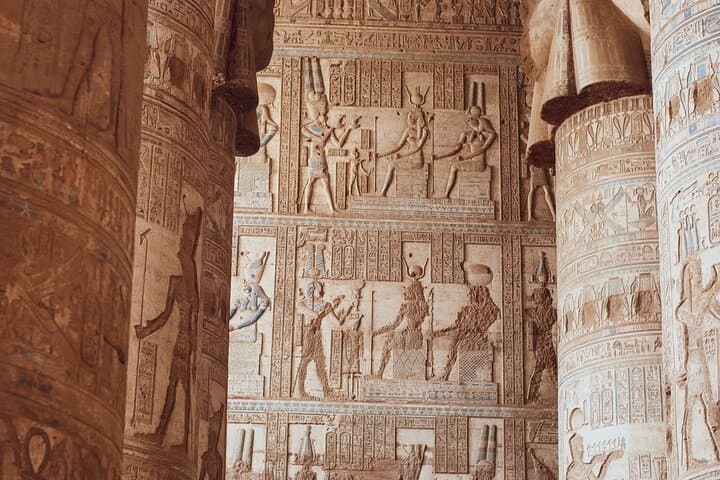
The road north from Luxor flattens into the broad ribbon of the Nile valley, and Dendarah’s stone columns come into view like a deliberate concert hall carved from the earth. You step from an air-conditioned vehicle into a sunlit courtyard where six towering columns wear Hathor’s face as both crown and chorus.
The road north from Luxor flattens into the broad ribbon of the Nile valley, and Dendarah’s stone columns come into view like a deliberate concert hall carved from the earth. You step from an air-conditioned vehicle into a sunlit courtyard where six towering columns wear Hathor’s face as both crown and chorus.
Built and finished largely in the Ptolemaic era, the Temple of Hathor at Dendera is one of Egypt’s best-preserved Greco-Roman period sanctuaries. Its façades trumpet images of ritual music and motherhood; inside, the astronomical ceiling — the so-called Dendera zodiac — maps millennia of sky lore. Geologically the site sits on the Nile’s alluvial plain: flat, dusty approaches, compacted sand underfoot and stone floors that slope and step in places.
Culturally, Dendera bridges Pharaonic ritual and later Hellenistic tastes — you’ll see Egyptian motifs reinterpreted through Ptolemaic stonework. Local guides often point out small, easily missed details: sistrum carvings, votive graffiti, and a shallow sacred lake once used for purification.
Practical guidance: the visit typically allows about 90 minutes inside the temple and is part of a 5–6 hour private tour from Luxor; expect roughly 60–90 minutes each way by road (about 60–70 km). Wear sun protection and comfortable shoes; temple floors are uneven and some areas require modest dress. Bring bottled water and small bills for museum donations or local vendors. Photography is generally allowed but avoid flash in painted chambers and follow your guide’s directions. Early morning or late afternoon visits are cooler and catch reliefs in better light.