THE ADVENTURE COLLECTIVE® · Independent discovery and booking for outdoor travel

Step onto the slopes of Delphi and follow the Sacred Way to the Temple of Apollo. This private day tour from Athens pairs scenic mountain driving with expert local commentary and time to explore the archaeological site, museum, and nearby Arachova.
Step onto the slopes of Delphi and follow the Sacred Way to the Temple of Apollo. This private day tour from Athens pairs scenic mountain driving with expert local commentary and time to explore the archaeological site, museum, and nearby Arachova.
You arrive to a high terrace where wind carries a thin dust of centuries and the valley below opens like an old, readable map. Stone ruins gate the slope, and the Temple of Apollo—its columns fractured but defiant—looks out over olive groves and a blue-greened gulf far beyond.
Verified experiences and guided adventures in the surrounding area.
Operated by Bucket List Tours · Delphi, Phocis
You arrive to a high terrace where wind carries a thin dust of centuries and the valley below opens like an old, readable map. Stone ruins gate the slope, and the Temple of Apollo—its columns fractured but defiant—looks out over olive groves and a blue-greened gulf far beyond.
Delphi sits on the south-western slope of Mount Parnassus, once considered the navel of the world in ancient Greek religion. The site’s geology—steep limestone slopes and karstic formations—helped define its sacred atmosphere and the natural gases that ancient writers claimed animated the oracle. The archaeology and the museum trace Delphi’s arc from an 8th-century BC sanctum to a bustling Panhellenic center where the Pythian Games and votive offerings shaped Greek politics and art.
Local life still orbits seasonality: Arachova, a short drive away, serves as a winter village with active ski runs; in summer the town calms and tavernas focus on mountain cheese and lamb. Expect informed commentary from your driver, a roughly two-hour scenic drive from Athens across farmland, lakes, and terraces.
Practicalities: the private tour runs about nine hours including travel; wear sturdy shoes for uneven marble and dirt paths, bring sun protection and a light jacket for breezy exposed terraces. Museum entry and archaeological site tickets are handled independently—carry cash or card. Aim for morning departures to avoid midday heat and crowds; the climb toward the stadium rewards steady pacing and offers the clearest views for photos and quiet reflection.
easy.
9 hours.
Suitable for most fitness levels; involves moderate walking on uneven surfaces and some short uphill sections.
Expect roughly 2 to 2.5 hours each way depending on traffic and chosen pickup point in Athens.
No—the driver provides commentary and transport only; entry and viewing are independent once you arrive.
No; tickets for the Archaeological Museum and the Sanctuary are typically paid on-site by visitors.
Transport can be wheelchair-accessible but the archaeological terraces and museum have uneven surfaces and steps; accessibility is limited at some ruins.
Delphi was considered the spiritual center of the Greek world; city-states and pilgrims sent votive offerings to Apollo and consulted the Pythia for political and personal decisions for centuries.
The site is managed to protect fragile marble and mosaics—stay on marked paths, avoid touching sculptures, and support local museums and small businesses to sustain conservation efforts.
Bucket List Tours operates guided outdoor trips and adventures with an emphasis on safety, stewardship, and memorable experiences.
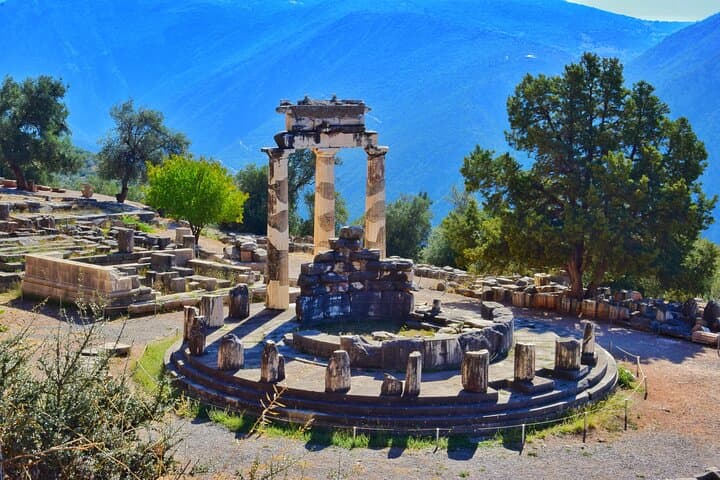


You arrive to a high terrace where wind carries a thin dust of centuries and the valley below opens like an old, readable map. Stone ruins gate the slope, and the Temple of Apollo—its columns fractured but defiant—looks out over olive groves and a blue-greened gulf far beyond.
You arrive to a high terrace where wind carries a thin dust of centuries and the valley below opens like an old, readable map. Stone ruins gate the slope, and the Temple of Apollo—its columns fractured but defiant—looks out over olive groves and a blue-greened gulf far beyond.
Delphi sits on the south-western slope of Mount Parnassus, once considered the navel of the world in ancient Greek religion. The site’s geology—steep limestone slopes and karstic formations—helped define its sacred atmosphere and the natural gases that ancient writers claimed animated the oracle. The archaeology and the museum trace Delphi’s arc from an 8th-century BC sanctum to a bustling Panhellenic center where the Pythian Games and votive offerings shaped Greek politics and art.
Local life still orbits seasonality: Arachova, a short drive away, serves as a winter village with active ski runs; in summer the town calms and tavernas focus on mountain cheese and lamb. Expect informed commentary from your driver, a roughly two-hour scenic drive from Athens across farmland, lakes, and terraces.
Practicalities: the private tour runs about nine hours including travel; wear sturdy shoes for uneven marble and dirt paths, bring sun protection and a light jacket for breezy exposed terraces. Museum entry and archaeological site tickets are handled independently—carry cash or card. Aim for morning departures to avoid midday heat and crowds; the climb toward the stadium rewards steady pacing and offers the clearest views for photos and quiet reflection.