THE ADVENTURE COLLECTIVE® · Independent discovery and booking for outdoor travel

Travel from Athens to Delphi for a full-day private tour that pairs mountainous views with one of Greece’s most important archaeological sites. Explore the Temple of Apollo, the ancient stadium, and the museum, then refuel in Arachova.
Travel from Athens to Delphi for a full-day private tour that pairs mountainous views with one of Greece’s most important archaeological sites. Explore the Temple of Apollo, the ancient stadium, and the museum, then refuel in Arachova.
You step off the air-conditioned car and the slope of Mount Parnassus rises behind you, granite ribs and wind-scarred pines pressing close as the valley drops away. The air tastes faintly of dust and thyme; below, the ruins sit like a record of argument — columns, carved seats, and a stadium cut into the rock that once held the Pythian Games.
Verified experiences and guided adventures in the surrounding area.
Operated by Greek Heritage: Private Tours & Transfers · Delphi, Phocis
You step off the air-conditioned car and the slope of Mount Parnassus rises behind you, granite ribs and wind-scarred pines pressing close as the valley drops away. The air tastes faintly of dust and thyme; below, the ruins sit like a record of argument — columns, carved seats, and a stadium cut into the rock that once held the Pythian Games.
Delphi was the spiritual compass of the ancient Greek world. Pilgrims crossed the Hellenic world to consult the Oracle of Apollo; the Temple of Apollo, the treasuries, and the 180‑meter stadium still map the rituals of a city that mixed religion, politics, and spectacle. Geologically, the site is a fold of limestone on the western flank of Parnassus; the steep terraces and natural springs dictated where buildings were placed and what views they commanded.
Local culture remains mountain-forward: Arachova’s stone streets, local goat cheeses, and textile shops reflect a highland rhythm that contrasts with Athens. Smaller details — the Castalian Spring where ritual purification occurred, the museum’s Charioteer statue — give texture to the visit.
Practically: expect an 8–9 hour day from Athens with several stops for photos, the archaeological site, the museum, and a tavern lunch. The driver provides transport, water, and local orientation but not an official site guide; buy tickets or reserve museum access in advance during high season. Wear sturdy shoes for terraces and steps, layer for wind and sun, and plan for limited shade at peak midday. Move deliberately through the ruins: the stone is fragile and the views reward a moment of quiet attention.
moderate.
8–9 hours.
Light to moderate fitness; includes walking on uneven ancient steps and short ascents between ruins
Entrance fees are typically not included with transport-only tours; check booking details and be prepared to buy tickets at the site or book online in advance.
Drive time is roughly 2.5 to 3 hours each way depending on traffic; plan for an 8–9 hour day including stops.
Drivers often provide historical orientation but may not be licensed site guides; consider hiring a licensed archaeologist or audio guide for detailed interpretation.
Yes — Arachova offers mountain tavernas with local cheeses and lamb dishes and is a common lunch stop on Delphi day trips.
Delphi was the religious center for the Oracle of Apollo and hosted the Pythian Games; its political and spiritual influence reached across the ancient Mediterranean.
The site is UNESCO-listed; visitors should stay on marked paths, avoid touching carved surfaces, and support local businesses to minimize impact.
Greek Heritage: Private Tours & Transfers operates guided outdoor trips and adventures with an emphasis on safety, stewardship, and memorable experiences.


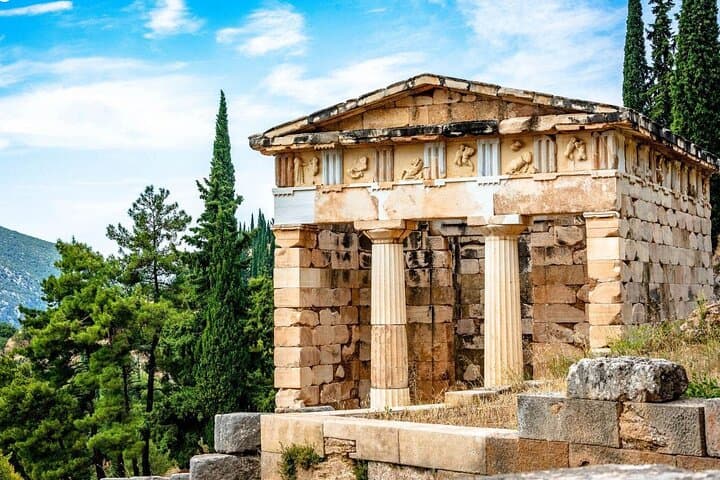

You step off the air-conditioned car and the slope of Mount Parnassus rises behind you, granite ribs and wind-scarred pines pressing close as the valley drops away. The air tastes faintly of dust and thyme; below, the ruins sit like a record of argument — columns, carved seats, and a stadium cut into the rock that once held the Pythian Games.
You step off the air-conditioned car and the slope of Mount Parnassus rises behind you, granite ribs and wind-scarred pines pressing close as the valley drops away. The air tastes faintly of dust and thyme; below, the ruins sit like a record of argument — columns, carved seats, and a stadium cut into the rock that once held the Pythian Games.
Delphi was the spiritual compass of the ancient Greek world. Pilgrims crossed the Hellenic world to consult the Oracle of Apollo; the Temple of Apollo, the treasuries, and the 180‑meter stadium still map the rituals of a city that mixed religion, politics, and spectacle. Geologically, the site is a fold of limestone on the western flank of Parnassus; the steep terraces and natural springs dictated where buildings were placed and what views they commanded.
Local culture remains mountain-forward: Arachova’s stone streets, local goat cheeses, and textile shops reflect a highland rhythm that contrasts with Athens. Smaller details — the Castalian Spring where ritual purification occurred, the museum’s Charioteer statue — give texture to the visit.
Practically: expect an 8–9 hour day from Athens with several stops for photos, the archaeological site, the museum, and a tavern lunch. The driver provides transport, water, and local orientation but not an official site guide; buy tickets or reserve museum access in advance during high season. Wear sturdy shoes for terraces and steps, layer for wind and sun, and plan for limited shade at peak midday. Move deliberately through the ruins: the stone is fragile and the views reward a moment of quiet attention.