THE ADVENTURE COLLECTIVE® · Independent discovery and booking for outdoor travel

A full-day private safari from Arusha to Tarangire National Park, where large elephant herds, baobab-studded plains and concentrated game along the Tarangire River make for reliable viewing. Includes private 4x4 transport, park fees, lunch box and water.
A full-day private safari from Arusha to Tarangire National Park, where large elephant herds, baobab-studded plains and concentrated game along the Tarangire River make for reliable viewing. Includes private 4x4 transport, park fees, lunch box and water.
You step out of Arusha’s morning hush and into a highland road that eases toward open savanna—acacia crowns thin, baobab silhouettes grow larger, and the engine hum becomes a countdown to wildlife.
Verified experiences and guided adventures in the surrounding area.
Operated by Mali Kale Africa Safari's · Arusha, Manyara Region
You step out of Arusha’s morning hush and into a highland road that eases toward open savanna—acacia crowns thin, baobab silhouettes grow larger, and the engine hum becomes a countdown to wildlife.
Tarangire is defined by its river: a narrow, permanent waterline that corrals wildlife through the dry months and concentrates sightings. Geologically the park sits on a gently undulating plain ringed by ancient volcanic ridges; soils and seasonal floodplains feed grasses that attract grazing herds. Culturally, the park’s edge intersects Maasai grazing land—local pastoralism has shaped access routes and seasonal movement across the landscape.
Established as a protected area in the 1970s, Tarangire today is best known for unusually large elephant herds, towering baobabs, and mobile predator-prey dynamics that change with the rains. Game viewing is most reliable along the Tarangire River and in the Silale Swamp network where wildlife gathers.
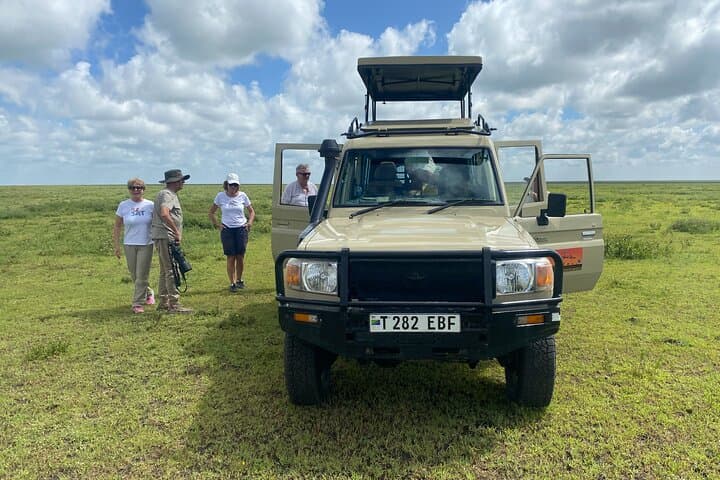
Practicalities: this private, full-day safari runs about 10 hours with roundtrip drive time of roughly two hours each way from Arusha, using a 4x4 safari vehicle with pop-up roof. A boxed lunch and water are provided; park entry fees are included. Expect uneven dirt roads, early-morning chill and strong midday sun—bring layers, sun protection, binoculars, and a charged camera.
Timing your visit for the dry season (June–October) improves concentrated wildlife sightings; the green season offers dramatic landscapes and birding. Respect wildlife distances, follow your guide’s instructions, and carry spare water—Tarangire’s river invites observation, not disturbance.
easy.
10 hours.
Suitable for most fitness levels; requires ability to get in/out of a safari vehicle and tolerate long periods seated
Expect roughly 1.5–2.5 hours each way depending on traffic and road conditions; the full tour is about 10 hours.
Yes—this tour includes park entry fees, a boxed lunch and bottled water as listed in the inclusions.
Tarangire is known for large elephant concentrations, plus giraffe, zebra, wildebeest, buffalo, and predators such as lion and leopard—sightings vary by season.
The tour is labeled physically easy and suitable for most ages, but it requires boarding a safari vehicle and sitting for several hours; infants must sit on an adult’s lap per provider rules.
Tarangire was designated a protected area in the 1970s and has long been a key corridor for seasonal migrations tied to the Tarangire River.
Protecting migration corridors and water sources is critical; stick to vehicle tracks and support operators that practice low-impact viewing to reduce disturbance.
Mali Kale Africa Safari's operates guided outdoor trips and adventures with an emphasis on safety, stewardship, and memorable experiences.
You step out of Arusha’s morning hush and into a highland road that eases toward open savanna—acacia crowns thin, baobab silhouettes grow larger, and the engine hum becomes a countdown to wildlife.
You step out of Arusha’s morning hush and into a highland road that eases toward open savanna—acacia crowns thin, baobab silhouettes grow larger, and the engine hum becomes a countdown to wildlife.
Tarangire is defined by its river: a narrow, permanent waterline that corrals wildlife through the dry months and concentrates sightings. Geologically the park sits on a gently undulating plain ringed by ancient volcanic ridges; soils and seasonal floodplains feed grasses that attract grazing herds. Culturally, the park’s edge intersects Maasai grazing land—local pastoralism has shaped access routes and seasonal movement across the landscape.
Established as a protected area in the 1970s, Tarangire today is best known for unusually large elephant herds, towering baobabs, and mobile predator-prey dynamics that change with the rains. Game viewing is most reliable along the Tarangire River and in the Silale Swamp network where wildlife gathers.
Practicalities: this private, full-day safari runs about 10 hours with roundtrip drive time of roughly two hours each way from Arusha, using a 4x4 safari vehicle with pop-up roof. A boxed lunch and water are provided; park entry fees are included. Expect uneven dirt roads, early-morning chill and strong midday sun—bring layers, sun protection, binoculars, and a charged camera.
Timing your visit for the dry season (June–October) improves concentrated wildlife sightings; the green season offers dramatic landscapes and birding. Respect wildlife distances, follow your guide’s instructions, and carry spare water—Tarangire’s river invites observation, not disturbance.