THE ADVENTURE COLLECTIVE® · Independent discovery and booking for outdoor travel

A long, full-day journey from Sharm El Sheikh delivers the Giza pyramids, the Sphinx and the Egyptian Museum in one intense sweep. Expect early departures, a lot of coach time and front-row access to Egypt's oldest monuments.
A long, full-day journey from Sharm El Sheikh delivers the Giza pyramids, the Sphinx and the Egyptian Museum in one intense sweep. Expect early departures, a lot of coach time and front-row access to Egypt's oldest monuments.
You step off an early-morning coach as the desert thins and the Giza plateau rises out of dust and light.
The pyramids dominate the skyline like stone ships anchored to the Nile’s western edge; camels eye you from shaded ledgers while vendors call softly. For a day, Cairo pushes and pulls at every sense — the river dares you to slow down while the monuments insist you pay attention.
Verified experiences and guided adventures in the surrounding area.
Operated by Flower of Egypt Travel · Cairo, Cairo Governorate
You step off an early-morning coach as the desert thins and the Giza plateau rises out of dust and light.
The pyramids dominate the skyline like stone ships anchored to the Nile’s western edge; camels eye you from shaded ledgers while vendors call softly. For a day, Cairo pushes and pulls at every sense — the river dares you to slow down while the monuments insist you pay attention.
This itinerary threads through three millennia: the Old Kingdom tombs of Khufu, Khafre and Menkaure on the plateau; the enigmatic Sphinx carved from living bedrock; and the Egyptian Museum’s dense rooms of funerary masks, obelisks and carved reliefs that map a civilization’s burial customs. Geologically, the Giza limestone plateau preserves quarry scars that tell the same story as hieroglyphs — how builders read and shaped stone.
Culturally, expect layered rhythms: prayer calls from nearby neighborhoods, merchants selling papyrus and perfumes, and the Nile’s steady commerce a few miles away. Local guides condense complex histories into clear scenes: funerary beliefs, construction theories, and the role of the Nile in sustaining cities.
Practical guidance: the day is long — roughly 22–23 hours door to door — so pack water, comfortable shoes, sun protection and your passport. Expect multiple checkpoints and short walking sections across uneven sand and paved causeways. Photography is allowed in many areas but follow your guide’s instructions in sensitive zones. Plan for early starts, moderate walking, and a full day of sensory overload that rewards curiosity and patience.
easy.
22–23 hours.
Minimal fitness required for walking and standing; be prepared for long bus travel and intermittent walking over uneven terrain.
The full excursion including round-trip road transfer takes roughly 22–23 hours—departure is very early and return is late evening.
The tour itinerary lists admissions to the Egyptian Museum and Giza plateau as included; confirm specifics with the operator when booking.
The tour is labeled suitable for all fitness levels; infants must sit on an adult’s lap and long travel times may be tiring for young children.
A short 30–40 minute Nile boat trip is offered as an optional extra for a small fee—check availability and bring local currency.
The Giza pyramids date to the Fourth Dynasty (c. 2600–2500 BCE) and were built as monumental tombs reflecting ancient Egypt’s religious beliefs and engineering skill.
Preserve fragile sites by not climbing monuments, following your guide’s access rules, and supporting licensed local shops and guides to help fund conservation.
Flower of Egypt Travel operates guided outdoor trips and adventures with an emphasis on safety, stewardship, and memorable experiences.

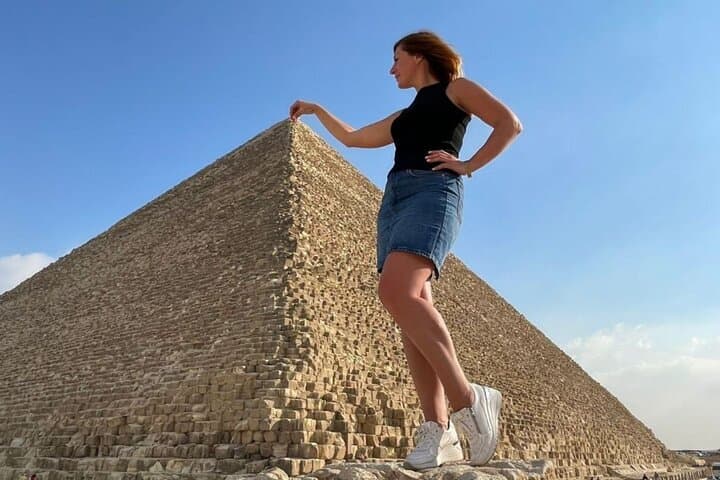


You step off an early-morning coach as the desert thins and the Giza plateau rises out of dust and light.
The pyramids dominate the skyline like stone ships anchored to the Nile’s western edge; camels eye you from shaded ledgers while vendors call softly. For a day, Cairo pushes and pulls at every sense — the river dares you to slow down while the monuments insist you pay attention.
You step off an early-morning coach as the desert thins and the Giza plateau rises out of dust and light.
The pyramids dominate the skyline like stone ships anchored to the Nile’s western edge; camels eye you from shaded ledgers while vendors call softly. For a day, Cairo pushes and pulls at every sense — the river dares you to slow down while the monuments insist you pay attention.
This itinerary threads through three millennia: the Old Kingdom tombs of Khufu, Khafre and Menkaure on the plateau; the enigmatic Sphinx carved from living bedrock; and the Egyptian Museum’s dense rooms of funerary masks, obelisks and carved reliefs that map a civilization’s burial customs. Geologically, the Giza limestone plateau preserves quarry scars that tell the same story as hieroglyphs — how builders read and shaped stone.
Culturally, expect layered rhythms: prayer calls from nearby neighborhoods, merchants selling papyrus and perfumes, and the Nile’s steady commerce a few miles away. Local guides condense complex histories into clear scenes: funerary beliefs, construction theories, and the role of the Nile in sustaining cities.
Practical guidance: the day is long — roughly 22–23 hours door to door — so pack water, comfortable shoes, sun protection and your passport. Expect multiple checkpoints and short walking sections across uneven sand and paved causeways. Photography is allowed in many areas but follow your guide’s instructions in sensitive zones. Plan for early starts, moderate walking, and a full day of sensory overload that rewards curiosity and patience.