THE ADVENTURE COLLECTIVE® · Independent discovery and booking for outdoor travel

Spend a long day touring Mammoth Cave’s cool limestone passages, crossing Hidden River Cave’s dramatic suspension bridge, and hand-feeding kangaroos at Kentucky Down Under. This full-day excursion blends subterranean geology with up-close wildlife moments—ideal for curious travelers based in Nashville.
Spend a long day touring Mammoth Cave’s cool limestone passages, crossing Hidden River Cave’s dramatic suspension bridge, and hand-feeding kangaroos at Kentucky Down Under. This full-day excursion blends subterranean geology with up-close wildlife moments—ideal for curious travelers based in Nashville.
You step off the shuttle into a pocket of cool, humid air—the kind that slips past your jacket collar and carries the smell of limestone and river water. The surface light fades as you enter Mammoth Cave National Park, where passages have been eating away at Kentucky’s Mississippian limestone for hundreds of thousands of years. Stalactites and flowstone drip in slow time; the cave exhales a steady, ancient chill that follows you along carved stone corridors.
Verified experiences and guided adventures in the surrounding area.
You step off the shuttle into a pocket of cool, humid air—the kind that slips past your jacket collar and carries the smell of limestone and river water. The surface light fades as you enter Mammoth Cave National Park, where passages have been eating away at Kentucky’s Mississippian limestone for hundreds of thousands of years. Stalactites and flowstone drip in slow time; the cave exhales a steady, ancient chill that follows you along carved stone corridors.
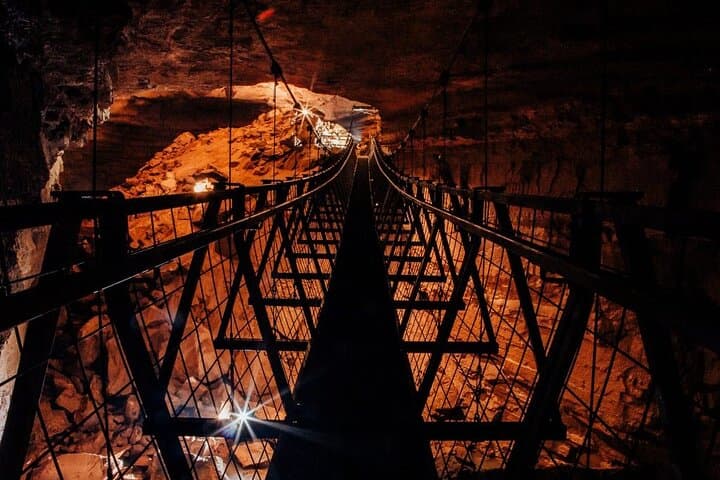
Mammoth Cave is the longest known cave system on Earth, its mapped miles threading through human history from Indigenous use to 19th-century tourism and the era of cave guides like Stephen Bishop. Geologically, the park is classic karst—sinkholes, underground rivers and caverns formed where acidic water dissolved soluble rock. Later in the day, Hidden River Cave offers contrast: a subterranean river that moves and murmurs, and a crossing on the world’s longest cave suspension bridge that literally lets you walk above an underground current.
The tour finishes with Kentucky Down Under in Horse Cave, where quiet paddocks host kangaroos and emus you can hand-feed—an unexpected closeness that feels theatrical against the cave-dulled quiet of the morning.
Practicalities: expect a long day (about 10–12 hours total), moderate walking on uneven cave floors and boardwalks, and repeated entering/exiting vehicles. Wear grippy shoes, bring a layered jacket (caves stay cool year-round), carry water and a small daypack, and respect rope lines and lighting rules—flash photography may be restricted. Keep an eye on bat-protection rules and follow your guide’s timing to make the most of both underground passage and open-air wildlife encounters.
easy.
10–12 hours.
Suitable for people comfortable with several hours of walking and standing; not strenuous but includes uneven surfaces and stairs.
Expect a 10–12 hour day including transportation from Nashville, guided tours at Mammoth Cave and Hidden River Cave, a local lunch, and admission to Kentucky Down Under for animal encounters.
Most guided tours are easy to moderate with some stairs and uneven ground; families and older visitors commonly participate, but check accessibility options for limited-mobility guests before booking.
Yes—Kentucky Down Under permits supervised hand-feeding in designated areas; staff provide guidance and food to ensure safe interactions for both guests and animals.
Photography policies vary by site—some cave sections restrict flash to protect formations and wildlife, so follow guide instructions at each stop.
Mammoth Cave is a UNESCO World Heritage Site and has been used by Indigenous peoples for thousands of years; 19th-century guides like Stephen Bishop played a prominent role in early cave tours.
Caves are sensitive environments—avoid touching formations, follow bat protection rules, and stick to marked trails to minimize human impact.
You step off the shuttle into a pocket of cool, humid air—the kind that slips past your jacket collar and carries the smell of limestone and river water. The surface light fades as you enter Mammoth Cave National Park, where passages have been eating away at Kentucky’s Mississippian limestone for hundreds of thousands of years. Stalactites and flowstone drip in slow time; the cave exhales a steady, ancient chill that follows you along carved stone corridors.
You step off the shuttle into a pocket of cool, humid air—the kind that slips past your jacket collar and carries the smell of limestone and river water. The surface light fades as you enter Mammoth Cave National Park, where passages have been eating away at Kentucky’s Mississippian limestone for hundreds of thousands of years. Stalactites and flowstone drip in slow time; the cave exhales a steady, ancient chill that follows you along carved stone corridors.
Mammoth Cave is the longest known cave system on Earth, its mapped miles threading through human history from Indigenous use to 19th-century tourism and the era of cave guides like Stephen Bishop. Geologically, the park is classic karst—sinkholes, underground rivers and caverns formed where acidic water dissolved soluble rock. Later in the day, Hidden River Cave offers contrast: a subterranean river that moves and murmurs, and a crossing on the world’s longest cave suspension bridge that literally lets you walk above an underground current.
The tour finishes with Kentucky Down Under in Horse Cave, where quiet paddocks host kangaroos and emus you can hand-feed—an unexpected closeness that feels theatrical against the cave-dulled quiet of the morning.
Practicalities: expect a long day (about 10–12 hours total), moderate walking on uneven cave floors and boardwalks, and repeated entering/exiting vehicles. Wear grippy shoes, bring a layered jacket (caves stay cool year-round), carry water and a small daypack, and respect rope lines and lighting rules—flash photography may be restricted. Keep an eye on bat-protection rules and follow your guide’s timing to make the most of both underground passage and open-air wildlife encounters.