THE ADVENTURE COLLECTIVE® · Independent discovery and booking for outdoor travel

A full-day guided hike from Puerto Natales to the base of the Torres del Paine towers. Expect forested singletrack, steep scree, and close-up views of the granite spires — a long day with high photographic payoff.
A full-day guided hike from Puerto Natales to the base of the Torres del Paine towers. Expect forested singletrack, steep scree, and close-up views of the granite spires — a long day with high photographic payoff.
A cold wind pushes across the open steppe as the minivan drops you at Laguna Amarga before dawn. The trail threads into Magellanic forest, branches slick with mist, and the path climbs steadily toward the scree where granite towers pierce the sky. By mid-afternoon the three iconic spires — carved by millennia of glacial action — sit above a turquoise lagoon, their faces worn and bright against the Patagonian light.
Verified experiences and guided adventures in the surrounding area.
Operated by 2Patagonia Travel · Puerto Natales, Magallanes Region
A cold wind pushes across the open steppe as the minivan drops you at Laguna Amarga before dawn. The trail threads into Magellanic forest, branches slick with mist, and the path climbs steadily toward the scree where granite towers pierce the sky. By mid-afternoon the three iconic spires — carved by millennia of glacial action — sit above a turquoise lagoon, their faces worn and bright against the Patagonian light.
Torres del Paine National Park, created in 1959 and shaped by successive ice ages, exposes raw geology: granite towers raised through faulting and revealed by retreating glaciers. The route passes through lenga and ñire woodland, across moraine fields and steep scree slopes that demand attention on the ascent and descent. Along the way a bilingual guide points out local history: the park’s estancias, early explorers, and the conservation efforts that later designated much of the area for protection.
Expect a full-day outing: an early hotel pickup from Puerto Natales, registration at Laguna Amarga, roughly 4–6 hours of hiking round-trip depending on pace, and a late return to town. Conditions change fast — wind and rain are as likely as clear sky — so layer for cold and damp weather and budget time for photo stops at Refugio Chileno and the lagoon. The trail is primarily singletrack with rocky and scree sections; trekking poles and firm-ankle boots make the steep hour to the mirador more manageable.
Bring snacks, water, and patience: the reward is a close-up confrontation with one of Patagonia’s most dramatic formations and a day that feels remote despite arriving and returning to town the same evening.
challenging.
Approx. 13 hours (full day).
Good aerobic fitness; comfortable with sustained uphill hiking, steep scree and long singletrack sections
The full experience is a roughly 13‑hour day including transfers; expect pickup early morning and return to accommodations around 8:00 PM depending on conditions.
No technical experience is required, but participants should have moderate to good fitness for several hours of uphill hiking and stable footing on scree.
This tour typically includes transport in an air‑conditioned vehicle, a bilingual guide and trekking poles; snacks and park entrance fees are usually not included.
The operator can cancel for severe weather or insufficient travelers; dress for wind and rain and expect timing adjustments for safety.
Torres del Paine became a national park in 1959; the dramatic towers are granite cores exposed and sculpted by repeated glacial advances and retreats.
The park manages heavy visitor use through trail maintenance, strict camping rules and entrance fees — stay on marked trails, pack out waste and follow ranger guidance to limit erosion and disturbance.
2Patagonia Travel operates guided outdoor trips and adventures with an emphasis on safety, stewardship, and memorable experiences.
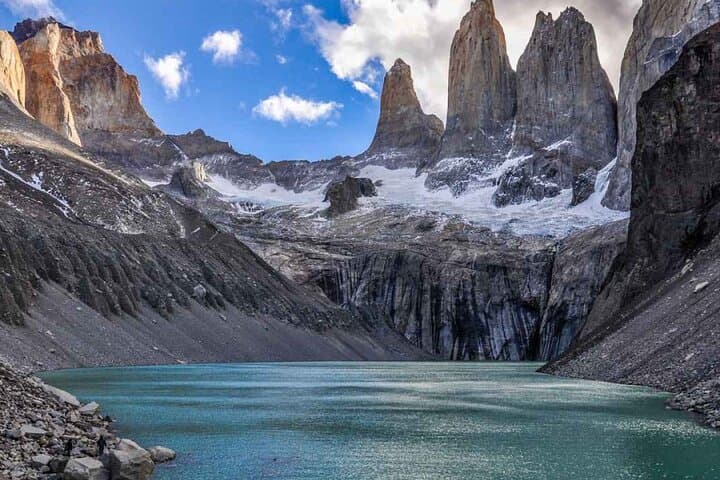


A cold wind pushes across the open steppe as the minivan drops you at Laguna Amarga before dawn. The trail threads into Magellanic forest, branches slick with mist, and the path climbs steadily toward the scree where granite towers pierce the sky. By mid-afternoon the three iconic spires — carved by millennia of glacial action — sit above a turquoise lagoon, their faces worn and bright against the Patagonian light.
A cold wind pushes across the open steppe as the minivan drops you at Laguna Amarga before dawn. The trail threads into Magellanic forest, branches slick with mist, and the path climbs steadily toward the scree where granite towers pierce the sky. By mid-afternoon the three iconic spires — carved by millennia of glacial action — sit above a turquoise lagoon, their faces worn and bright against the Patagonian light.
Torres del Paine National Park, created in 1959 and shaped by successive ice ages, exposes raw geology: granite towers raised through faulting and revealed by retreating glaciers. The route passes through lenga and ñire woodland, across moraine fields and steep scree slopes that demand attention on the ascent and descent. Along the way a bilingual guide points out local history: the park’s estancias, early explorers, and the conservation efforts that later designated much of the area for protection.
Expect a full-day outing: an early hotel pickup from Puerto Natales, registration at Laguna Amarga, roughly 4–6 hours of hiking round-trip depending on pace, and a late return to town. Conditions change fast — wind and rain are as likely as clear sky — so layer for cold and damp weather and budget time for photo stops at Refugio Chileno and the lagoon. The trail is primarily singletrack with rocky and scree sections; trekking poles and firm-ankle boots make the steep hour to the mirador more manageable.
Bring snacks, water, and patience: the reward is a close-up confrontation with one of Patagonia’s most dramatic formations and a day that feels remote despite arriving and returning to town the same evening.