THE ADVENTURE COLLECTIVE® · Independent discovery and booking for outdoor travel

Walk Darwin’s layered history on this 2‑hour private guided tour—see wartime ruins, colonial buildings, and Star Village while learning practical tips for the tropical climate. Ideal for history fans who want a compact, accessible urban exploration.
Walk Darwin’s layered history on this 2‑hour private guided tour—see wartime ruins, colonial buildings, and Star Village while learning practical tips for the tropical climate. Ideal for history fans who want a compact, accessible urban exploration.
A humid morning breeze from Darwin Harbour carries the scent of salt and tropical green as the private group steps away from the waterfront and toward the John McDouall Stuart statue. Pavement gives way to shady fig trees, then to the open expanse of Bicentennial Park where the harbour dares you to look farther out to sea.
Verified experiences and guided adventures in the surrounding area.
Operated by Opatrip.com Australia · Darwin, Northern Territory
A humid morning breeze from Darwin Harbour carries the scent of salt and tropical green as the private group steps away from the waterfront and toward the John McDouall Stuart statue. Pavement gives way to shady fig trees, then to the open expanse of Bicentennial Park where the harbour dares you to look farther out to sea.
This two-hour walking tour threads key chapters of Darwin’s story: the Larrakia people’s long connection to the coastline, colonial government buildings, the wartime Town Hall Ruins scarred by the 1942 air raids, and the resilient streets of Star Village that rebuilt after Cyclone Tracy. Geologically, the city sits on low-lying coastal plains with tidal flats and mangrove edges that shape both views and weather—expect flat, paved terrain, roughly 2–3 km covered and under 30 m of elevation change.
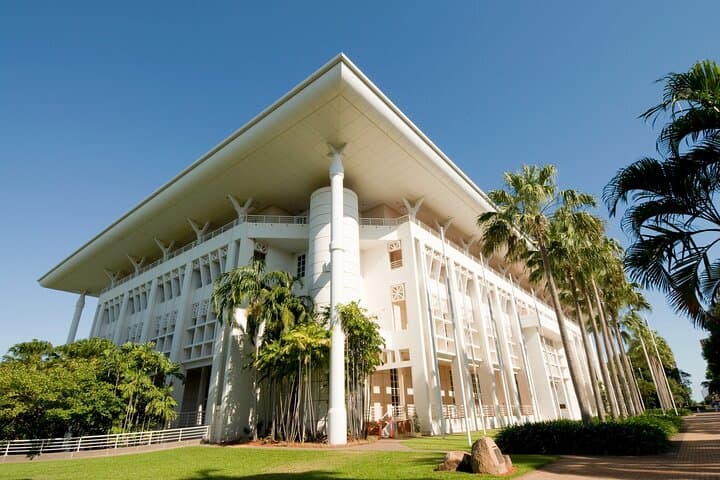
Culturally the route samples a compact arts district, heritage architecture like Brown’s Mart and the Legislative Assembly precinct, and public sculpture that nods to Darwin’s multicultural past. A local guide brings these layers to life with concise stories and practical context.
Practical guidance: wear breathable shoes and a hat, carry at least 1 L of water, and time the tour for morning or late afternoon to avoid the midday heat. In the wet season (summer) expect brief squalls and more mosquitoes; in the dry season (winter) mornings are cooler and clearer. Public transport and central hotels are within easy reach of the meeting point; the private format keeps pace flexible for short photo stops and questions.
easy.
2 hours.
Suitable for most fitness levels; requires about 2–3 km of easy walking on flat, paved surfaces.
Meeting location is typically central Darwin near the waterfront; your operator confirms an exact point on booking.
Most paths are paved and flat, but check with the operator in advance about specific accessibility needs, as some heritage sites have uneven surfaces.
Full refund available if cancelled at least 24 hours before the scheduled departure time.
Tipping is appreciated but optional; small cash tips are customary for excellent service.
Darwin’s centre bears marks of Larrakia heritage, wartime bombing in 1942, and rebuilding after Cyclone Tracy in 1974—sites on the route reflect those episodes.
Stay on designated paths near mangroves and avoid feeding wildlife; minimizing single-use plastics helps protect harbour and park ecosystems.
Opatrip.com Australia operates guided outdoor trips and adventures with an emphasis on safety, stewardship, and memorable experiences.


A humid morning breeze from Darwin Harbour carries the scent of salt and tropical green as the private group steps away from the waterfront and toward the John McDouall Stuart statue. Pavement gives way to shady fig trees, then to the open expanse of Bicentennial Park where the harbour dares you to look farther out to sea.
A humid morning breeze from Darwin Harbour carries the scent of salt and tropical green as the private group steps away from the waterfront and toward the John McDouall Stuart statue. Pavement gives way to shady fig trees, then to the open expanse of Bicentennial Park where the harbour dares you to look farther out to sea.
This two-hour walking tour threads key chapters of Darwin’s story: the Larrakia people’s long connection to the coastline, colonial government buildings, the wartime Town Hall Ruins scarred by the 1942 air raids, and the resilient streets of Star Village that rebuilt after Cyclone Tracy. Geologically, the city sits on low-lying coastal plains with tidal flats and mangrove edges that shape both views and weather—expect flat, paved terrain, roughly 2–3 km covered and under 30 m of elevation change.
Culturally the route samples a compact arts district, heritage architecture like Brown’s Mart and the Legislative Assembly precinct, and public sculpture that nods to Darwin’s multicultural past. A local guide brings these layers to life with concise stories and practical context.
Practical guidance: wear breathable shoes and a hat, carry at least 1 L of water, and time the tour for morning or late afternoon to avoid the midday heat. In the wet season (summer) expect brief squalls and more mosquitoes; in the dry season (winter) mornings are cooler and clearer. Public transport and central hotels are within easy reach of the meeting point; the private format keeps pace flexible for short photo stops and questions.