THE ADVENTURE COLLECTIVE® · Independent discovery and booking for outdoor travel

Move from Da Nang’s modern riverfront to the carved caves of Marble Mountain and the lantern-lit lanes of Hoi An in a single day. This shore excursion pairs skyline photos and coastal geology with centuries of trading-house architecture and hands-on local culture.
Move from Da Nang’s modern riverfront to the carved caves of Marble Mountain and the lantern-lit lanes of Hoi An in a single day. This shore excursion pairs skyline photos and coastal geology with centuries of trading-house architecture and hands-on local culture.
The city opens up as the ferry slides into port: a long steel dragon stretches over the Han River, neon scales catching the morning light, while limestone summits rise inland like quiet islands of rock. On this shore excursion travelers move quickly from Da Nang’s modern waterfront to the carved passages of Marble Mountain and the slow river rhythm of Hoi An’s old town.
Verified experiences and guided adventures in the surrounding area.
Operated by Da Nang Hoi An Private Tours & Shore Excursion · Da Nang, Da Nang
The city opens up as the ferry slides into port: a long steel dragon stretches over the Han River, neon scales catching the morning light, while limestone summits rise inland like quiet islands of rock. On this shore excursion travelers move quickly from Da Nang’s modern waterfront to the carved passages of Marble Mountain and the slow river rhythm of Hoi An’s old town.
Marble Mountain (Ngu Hanh Son) are five marble and limestone hills whose caves and pagodas have drawn pilgrims and stone carvers for centuries; the stone was quarried and shaped by local artisans and wartime histories left traces in the tunnels. Hoi An grew as an international trading port between the 15th–19th centuries — Japanese and Chinese merchants left the covered bridge, assembly halls and timber merchants’ houses that define the town’s streets. Geologically, Marble Mountains are karst limestone—sharp ridges and cave chambers that channel sea-breezes and light. Culture here is tactile: lantern-lit evenings, incense at small altars, and woodshop doors open to the street.
Practical guidance: expect about eight hours total with moderate walking, stair climbs at Marble Mountain and mostly flat paved paths in Hoi An. Wear grippy shoes for volcanic limestone steps and light sun protection for the midday market. Plan to carry local currency for small purchases and tips; bring a refillable bottle—the tour supplies bottled water but hydration between stops matters. Timing matters: mornings are cooler for photo stops at Dragon Bridge and late afternoons are best for Hoi An’s lantern-lit streets.
moderate.
8 hours.
Moderate fitness; able to climb stairs and walk 2–4 miles over uneven surfaces.
Pickup is arranged from Chan May or Tien Sa cruise terminals with return timed to your ship’s departure; provide exact arrival/departure times when booking.
Yes—entrance tickets and a local restaurant lunch are included as part of the tour price.
Children can join but the tour requires stair-climbing at Marble Mountains; travelers with limited mobility should advise the operator in advance to assess accessibility.
The itinerary allows roughly 60–90 minutes in Hoi An to visit the Japanese Bridge and assembly halls, with additional time for shopping depending on pacing.
Hoi An prospered as a multicultural trade port from the 15th–19th centuries; Marble Mountains have long been a pilgrimage site and source for sculptors’ stone.
Rising visitor numbers strain fragile cave formations and old-town streets—stick to marked paths, avoid touching carvings, and support businesses that practice responsible tourism.
Da Nang Hoi An Private Tours & Shore Excursion operates guided outdoor trips and adventures with an emphasis on safety, stewardship, and memorable experiences.

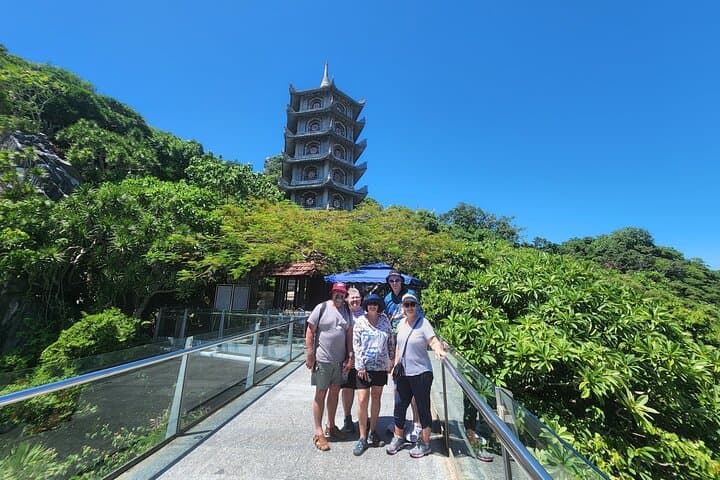


The city opens up as the ferry slides into port: a long steel dragon stretches over the Han River, neon scales catching the morning light, while limestone summits rise inland like quiet islands of rock. On this shore excursion travelers move quickly from Da Nang’s modern waterfront to the carved passages of Marble Mountain and the slow river rhythm of Hoi An’s old town.
The city opens up as the ferry slides into port: a long steel dragon stretches over the Han River, neon scales catching the morning light, while limestone summits rise inland like quiet islands of rock. On this shore excursion travelers move quickly from Da Nang’s modern waterfront to the carved passages of Marble Mountain and the slow river rhythm of Hoi An’s old town.
Marble Mountain (Ngu Hanh Son) are five marble and limestone hills whose caves and pagodas have drawn pilgrims and stone carvers for centuries; the stone was quarried and shaped by local artisans and wartime histories left traces in the tunnels. Hoi An grew as an international trading port between the 15th–19th centuries — Japanese and Chinese merchants left the covered bridge, assembly halls and timber merchants’ houses that define the town’s streets. Geologically, Marble Mountains are karst limestone—sharp ridges and cave chambers that channel sea-breezes and light. Culture here is tactile: lantern-lit evenings, incense at small altars, and woodshop doors open to the street.
Practical guidance: expect about eight hours total with moderate walking, stair climbs at Marble Mountain and mostly flat paved paths in Hoi An. Wear grippy shoes for volcanic limestone steps and light sun protection for the midday market. Plan to carry local currency for small purchases and tips; bring a refillable bottle—the tour supplies bottled water but hydration between stops matters. Timing matters: mornings are cooler for photo stops at Dragon Bridge and late afternoons are best for Hoi An’s lantern-lit streets.