THE ADVENTURE COLLECTIVE® · Independent discovery and booking for outdoor travel

Experience a compact coastal-to-riverday in central Vietnam: seaside views at Lady Buddha, carved caves of the Marble Mountains and Hoi An’s lantern-lit old town, all in one guided evening tour.
Experience a compact coastal-to-riverday in central Vietnam: seaside views at Lady Buddha, carved caves of the Marble Mountains and Hoi An’s lantern-lit old town, all in one guided evening tour.
A late afternoon drive up Monkey Mountain delivers a different Da Nang: salt air, a broad coastal arc and the Lady Buddha looming above the city—an imposing statue of roughly 70 meters that watches over the bay. The road curls past pineapple farms and rocky headlands; at the pagoda, incense and the crash of surf create a quietly kinetic skyline.
Verified experiences and guided adventures in the surrounding area.
Operated by Authentic Travel in Vietnam · Da Nang, Da Nang
A late afternoon drive up Monkey Mountain delivers a different Da Nang: salt air, a broad coastal arc and the Lady Buddha looming above the city—an imposing statue of roughly 70 meters that watches over the bay. The road curls past pineapple farms and rocky headlands; at the pagoda, incense and the crash of surf create a quietly kinetic skyline.
From there the tour moves inland to the Marble Mountains, five limestone-and-marble outcrops rising from rice paddies. Trails cut into the hills lead up short flights of steps, through shaded grottoes and past small pagodas; expect uneven stone stairs and viewpoints that reward a 30–60 minute climb with coastal panoramas. Geologically, the hills are coral-limestone karst with centuries-old stone-carving workshops at their base—Non Nuoc village still shapes marble into household and temple art.
As night falls the rhythm changes: Hoi An’s old town lights up with silk lanterns reflecting on the Hoài River. Walkable streets, the Japanese Covered Bridge, assembly halls and waterside markets compact hundreds of years of trade and Chinese–Japanese–Vietnamese cultural layers into a few illuminated blocks. Dinner showcases regional dishes—cao lầu and wonton soup—best sampled at small family restaurants or riverside stalls.
Practical notes: the full itinerary runs about 6–7 hours by coach with blocks of walking (short climbs and cobbled streets). Wear grippy shoes for stairs, bring a light rain jacket in monsoon season, carry cash for market purchases, and allow time for photography at each stop. The tour suits travelers comfortable with short hikes and urban walking after dark.
moderate.
6–7 hours.
Comfortable walking fitness; able to climb multiple short stair sections and walk on cobbles for extended periods
The tour runs about 6–7 hours total, typically departing late afternoon and returning to Da Nang after dinner in Hoi An.
Yes—it's generally suitable for all fitness levels, though those with mobility issues should note there are stairs and uneven surfaces at the Marble Mountains and pagodas.
Entrance fees, mineral water and a dinner featuring local specialties are included; bring extra cash for souvenirs and additional snacks.
Yes—both sites allow photography; tripods may be restricted in busy areas, so be prepared to shoot handheld.
Hoi An was a major port from the 15th–19th centuries and the Marble Mountains have been pilgrimage and quarry sites for centuries, producing religious statuary and household stonework.
Respect signage in caves and pagodas; stick to marked paths to protect fragile limestone formations and local temples, and avoid single-use plastics in the old town to reduce litter.
Authentic Travel in Vietnam operates guided outdoor trips and adventures with an emphasis on safety, stewardship, and memorable experiences.

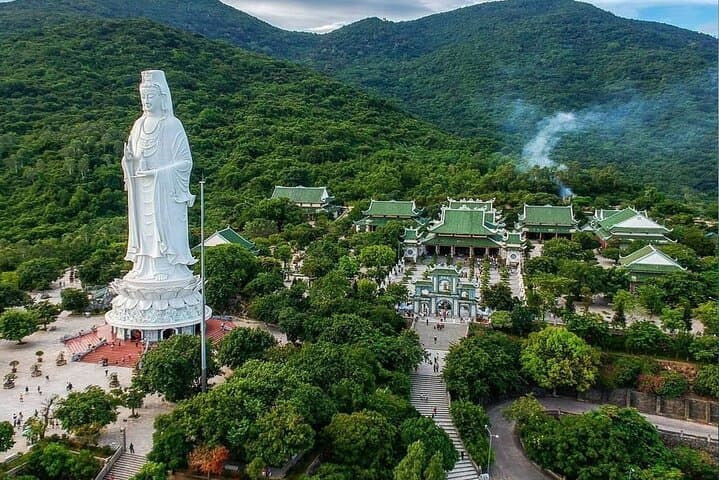


A late afternoon drive up Monkey Mountain delivers a different Da Nang: salt air, a broad coastal arc and the Lady Buddha looming above the city—an imposing statue of roughly 70 meters that watches over the bay. The road curls past pineapple farms and rocky headlands; at the pagoda, incense and the crash of surf create a quietly kinetic skyline.
A late afternoon drive up Monkey Mountain delivers a different Da Nang: salt air, a broad coastal arc and the Lady Buddha looming above the city—an imposing statue of roughly 70 meters that watches over the bay. The road curls past pineapple farms and rocky headlands; at the pagoda, incense and the crash of surf create a quietly kinetic skyline.
From there the tour moves inland to the Marble Mountains, five limestone-and-marble outcrops rising from rice paddies. Trails cut into the hills lead up short flights of steps, through shaded grottoes and past small pagodas; expect uneven stone stairs and viewpoints that reward a 30–60 minute climb with coastal panoramas. Geologically, the hills are coral-limestone karst with centuries-old stone-carving workshops at their base—Non Nuoc village still shapes marble into household and temple art.
As night falls the rhythm changes: Hoi An’s old town lights up with silk lanterns reflecting on the Hoài River. Walkable streets, the Japanese Covered Bridge, assembly halls and waterside markets compact hundreds of years of trade and Chinese–Japanese–Vietnamese cultural layers into a few illuminated blocks. Dinner showcases regional dishes—cao lầu and wonton soup—best sampled at small family restaurants or riverside stalls.
Practical notes: the full itinerary runs about 6–7 hours by coach with blocks of walking (short climbs and cobbled streets). Wear grippy shoes for stairs, bring a light rain jacket in monsoon season, carry cash for market purchases, and allow time for photography at each stop. The tour suits travelers comfortable with short hikes and urban walking after dark.