THE ADVENTURE COLLECTIVE® · Independent discovery and booking for outdoor travel

Bike through dawn or dusk as Angkor Wat and its jungle-set neighbors reveal layered histories and cinematic stonework. This guided day tour combines cultural context with easy cycling on quiet park roads, ideal for active travelers seeking an immersive temple run.
Bike through dawn or dusk as Angkor Wat and its jungle-set neighbors reveal layered histories and cinematic stonework. This guided day tour combines cultural context with easy cycling on quiet park roads, ideal for active travelers seeking an immersive temple run.
You start before dawn, pedaling into a cool, humid sky as lantern-lighted paths give way to the temple silhouette of Angkor Wat. The air smells of damp earth and lotus; temple stones hold the night's cool like an old coin. If you choose sunset, the last light drapes over Phnom Bakheng and the forest pushes its shadows across carved faces.
Verified experiences and guided adventures in the surrounding area.
Operated by Angkor Wat Shared Tours · Siem Reap, Siem Reap Province
You start before dawn, pedaling into a cool, humid sky as lantern-lighted paths give way to the temple silhouette of Angkor Wat. The air smells of damp earth and lotus; temple stones hold the night's cool like an old coin. If you choose sunset, the last light drapes over Phnom Bakheng and the forest pushes its shadows across carved faces.
These ruins are the visible remains of the Khmer Empire (9th–15th centuries), built primarily from sandstone that erodes into rounded, human-scale blocks. The routes thread paved causeways, raised temple platforms and compacted dirt tracks across Angkor Archaeological Park—an expanse once fed by an elaborate hydraulic system that supported one of history's largest preindustrial cities.
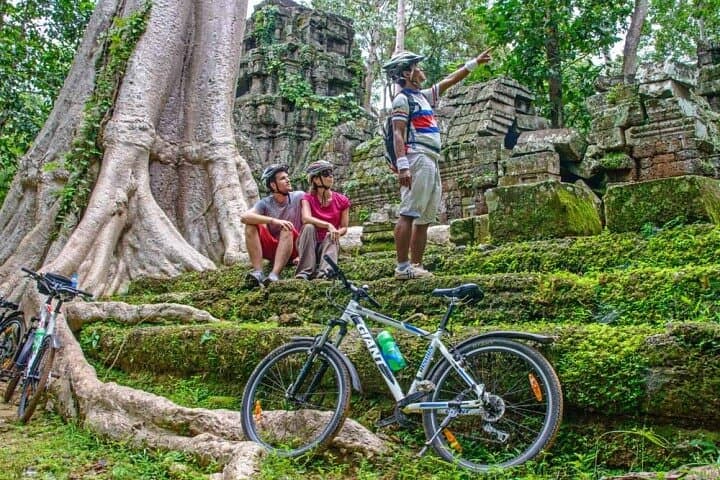
Guided by a Khmer expert, you move at a gentle pace past Bayon's enigmatic stone faces, Ta Prohm’s root-splayed corridors and the layered terraces of Ta Keo. The guide offers cultural context—Hindu-Buddhist motifs, royal histories—and points out conservation challenges: visitor impact, fragile masonry and seasonal flooding.
Practical guidance: expect 7–8 hours of mostly flat cycling with intermittent walking at temple precincts. Wear padded shorts and closed shoes for uneven steps; bring 2 liters of water (bottled water is provided but carry a refill if possible), sun protection and insect repellent. Morning runs coolest for photography; sunset on Phnom Bakheng is crowded—arrive early. Respect restricted zones and silence during worship; permits (Angkor Pass) are required and can be purchased before or during pickup. This tour balances pace, history and the living jungle that keeps reclaiming these stone stories.
moderate.
7–8 hours.
Moderate fitness required: comfortable cycling for several hours with short walks and stair climbs.
Yes—an Angkor Pass is required for temple entry. The operator can stop at the ticket office for you to purchase one if you don't already have it.
The route is mostly flat with short temple climbs on foot; riders should be comfortable cycling 25–40 km spread over a 7–8 hour day.
Yes—standard bicycles are provided along with bottled water; you may request an upgrade if available when booking.
Tours may be canceled or rescheduled for heavy rain or unsafe conditions; check cancellation policies and local forecasts before your trip.
Angkor was the center of the Khmer Empire; many temples shifted from Hindu to Buddhist use over centuries, reflected in layered iconography.
High visitor numbers strain fragile stone and root-prone structures; follow paths and avoid touching carvings to support preservation efforts.
Angkor Wat Shared Tours operates guided outdoor trips and adventures with an emphasis on safety, stewardship, and memorable experiences.


You start before dawn, pedaling into a cool, humid sky as lantern-lighted paths give way to the temple silhouette of Angkor Wat. The air smells of damp earth and lotus; temple stones hold the night's cool like an old coin. If you choose sunset, the last light drapes over Phnom Bakheng and the forest pushes its shadows across carved faces.
You start before dawn, pedaling into a cool, humid sky as lantern-lighted paths give way to the temple silhouette of Angkor Wat. The air smells of damp earth and lotus; temple stones hold the night's cool like an old coin. If you choose sunset, the last light drapes over Phnom Bakheng and the forest pushes its shadows across carved faces.
These ruins are the visible remains of the Khmer Empire (9th–15th centuries), built primarily from sandstone that erodes into rounded, human-scale blocks. The routes thread paved causeways, raised temple platforms and compacted dirt tracks across Angkor Archaeological Park—an expanse once fed by an elaborate hydraulic system that supported one of history's largest preindustrial cities.
Guided by a Khmer expert, you move at a gentle pace past Bayon's enigmatic stone faces, Ta Prohm’s root-splayed corridors and the layered terraces of Ta Keo. The guide offers cultural context—Hindu-Buddhist motifs, royal histories—and points out conservation challenges: visitor impact, fragile masonry and seasonal flooding.
Practical guidance: expect 7–8 hours of mostly flat cycling with intermittent walking at temple precincts. Wear padded shorts and closed shoes for uneven steps; bring 2 liters of water (bottled water is provided but carry a refill if possible), sun protection and insect repellent. Morning runs coolest for photography; sunset on Phnom Bakheng is crowded—arrive early. Respect restricted zones and silence during worship; permits (Angkor Pass) are required and can be purchased before or during pickup. This tour balances pace, history and the living jungle that keeps reclaiming these stone stories.