THE ADVENTURE COLLECTIVE® · Independent discovery and booking for outdoor travel

Walk the thin, shifting edge between the Baltic Sea and Curonian Lagoon on a 7-day self-guided itinerary that threads pine forests, white-sand dunes, and sleepy fishing villages. Flexible routes, luggage transfers, and UNESCO-listed scenery make this a practical coastal adventure for moderately fit walkers.
Walk the thin, shifting edge between the Baltic Sea and Curonian Lagoon on a 7-day self-guided itinerary that threads pine forests, white-sand dunes, and sleepy fishing villages. Flexible routes, luggage transfers, and UNESCO-listed scenery make this a practical coastal adventure for moderately fit walkers.
A narrow ribbon of sand cuts between grey Baltic surf and the still Curonian Lagoon; wind-creased dunes rise like shifting walls while pine stands scent the air with resin and salt. On a morning walk from Klaipėda you’ll cross ferries and causeways, trade the clatter of a port for the hush of villages where wooden houses lean toward the sea.
Verified experiences and guided adventures in the surrounding area.
Operated by Travel Addicts Club · Nida, Klaipėda County
A narrow ribbon of sand cuts between grey Baltic surf and the still Curonian Lagoon; wind-creased dunes rise like shifting walls while pine stands scent the air with resin and salt. On a morning walk from Klaipėda you’ll cross ferries and causeways, trade the clatter of a port for the hush of villages where wooden houses lean toward the sea.
The Curonian Spit is a geologic and human landscape: dunes formed by millennia of wind and drift, settled by people since the Late Stone Age and now protected as a UNESCO World Heritage site. Small fishing communities—Nida, Pervalka, Juodkrantė—still show the region’s amber-gathering and maritime past. Birdlife and a major cormorant colony punctuate the route; you’ll pass Grey Dunes and the Hill of Witches, where carved figures mark folk tales at the tree line.
Practically, expect uncomplicated terrain—sand, packed tracks, pine-needled forest—with daily walks of roughly 8–15 km and minimal elevation (most days under 60 m gain). The itinerary is flexible: walk from either end, use taxis or ferries for transfers, and rely on provided route descriptions and luggage transfers between guesthouses. Bring sturdy walking shoes for dunes, a windproof layer, sun protection, and enough water for multi-hour stretches. Note the local ecological fee and respect fenced dune areas—staying on marked trails keeps this fragile landscape intact.
moderate.
7 days (daily walks 3–6 hours).
Good aerobic fitness for consecutive days of walking on sand and tracks; able to walk 8–15 km comfortably.
Yes—terrain is non-technical and elevation is low, but you should be comfortable walking multiple days in a row and on sand.
Yes; luggage transfers between Curonian Spit accommodations are included so you can walk with a daypack.
An ecological fee for the Curonian Spit is included in the package; some nature reserves may require small entrance fees (e.g., ranger ticket for Grey Dunes).
Options include regular ferries to Smiltynė, local taxis, and scheduled buses; transfers to specific villages are arranged per itinerary.
The spit has been occupied since the Late Stone Age; shifting dunes and human adaptation created distinct fishing settlements and amber-trading traditions, now preserved under UNESCO protection.
The dune ecosystems are highly sensitive—stay on trails, respect nesting colonies, and the included ecological fee supports local protection and ranger services.
Travel Addicts Club operates guided outdoor trips and adventures with an emphasis on safety, stewardship, and memorable experiences.
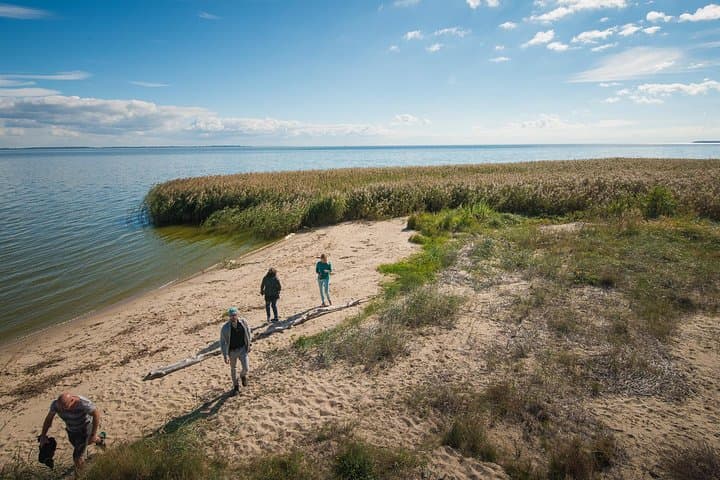


A narrow ribbon of sand cuts between grey Baltic surf and the still Curonian Lagoon; wind-creased dunes rise like shifting walls while pine stands scent the air with resin and salt. On a morning walk from Klaipėda you’ll cross ferries and causeways, trade the clatter of a port for the hush of villages where wooden houses lean toward the sea.
A narrow ribbon of sand cuts between grey Baltic surf and the still Curonian Lagoon; wind-creased dunes rise like shifting walls while pine stands scent the air with resin and salt. On a morning walk from Klaipėda you’ll cross ferries and causeways, trade the clatter of a port for the hush of villages where wooden houses lean toward the sea.
The Curonian Spit is a geologic and human landscape: dunes formed by millennia of wind and drift, settled by people since the Late Stone Age and now protected as a UNESCO World Heritage site. Small fishing communities—Nida, Pervalka, Juodkrantė—still show the region’s amber-gathering and maritime past. Birdlife and a major cormorant colony punctuate the route; you’ll pass Grey Dunes and the Hill of Witches, where carved figures mark folk tales at the tree line.
Practically, expect uncomplicated terrain—sand, packed tracks, pine-needled forest—with daily walks of roughly 8–15 km and minimal elevation (most days under 60 m gain). The itinerary is flexible: walk from either end, use taxis or ferries for transfers, and rely on provided route descriptions and luggage transfers between guesthouses. Bring sturdy walking shoes for dunes, a windproof layer, sun protection, and enough water for multi-hour stretches. Note the local ecological fee and respect fenced dune areas—staying on marked trails keeps this fragile landscape intact.