THE ADVENTURE COLLECTIVE® · Independent discovery and booking for outdoor travel

A compact, four‑hour city tour that stitches Curitiba’s best parks, modernist landmarks and cultural neighborhoods into a single loop. Perfect for visitors wanting an efficient overview with local context and short walks.
A compact, four‑hour city tour that stitches Curitiba’s best parks, modernist landmarks and cultural neighborhoods into a single loop. Perfect for visitors wanting an efficient overview with local context and short walks.
The tour begins with the cool glass curve of the Botanical Garden greenhouse sliding into view — an art‑nouveau roof framed by neatly clipped parterres and a steady stream of walkers and cyclists. For four hours a guide leads a compact circuit through Curitiba’s urban lungs and architectural oddities, moving from Flower Street’s pedestrian bustle to the steel ribs of the Wire Opera House.
Verified experiences and guided adventures in the surrounding area.
Operated by Gray Line Brazil · Curitiba, Paraná
The tour begins with the cool glass curve of the Botanical Garden greenhouse sliding into view — an art‑nouveau roof framed by neatly clipped parterres and a steady stream of walkers and cyclists. For four hours a guide leads a compact circuit through Curitiba’s urban lungs and architectural oddities, moving from Flower Street’s pedestrian bustle to the steel ribs of the Wire Opera House.
Curitiba’s layout reflects pragmatic urban planning born in the 20th century; parks were carved out of floodplains and quarries, public transport was redesigned into a model copied globally, and waves of immigrants — German, Ukrainian, Polish, and Italian — left visible marks in churches, cuisine and park names. Geology shows in the city’s repurposed quarries: carved rock faces and artificial lakes at Parque das Pedreiras and Tanguá recall the basalt and Paraná sediment beneath the city.
Expect a mix of short walks and comfortable coach transfers; key stops typically include the Botanical Garden, Parque Tanguá, Bosque Alemão viewpoint, Rua XV de Novembro and the cathedral area. Guides speak English, Spanish or Portuguese and round‑trip hotel transfer is usually included.
Practical notes: wear sturdy walking shoes for uneven park paths, bring a light rain layer (Curitiba’s weather is changeable), and carry water — there are cafés but stops can be brief. Morning departures avoid afternoon showers in summer and give clearer light for photography. The route is family‑friendly but watch narrow footpaths in busy squares.
easy.
4 hours.
Suitable for most fitness levels; involves several short walks and some stairs in parks
The tour runs about 4 hours and typically includes the Botanical Garden, Parque Tanguá, Bosque Alemão, Rua XV de Novembro, the cathedral area and viewpoints at repurposed quarries.
Round‑trip transfer to most Curitiba hotels is usually included—confirm pickup details when booking.
Guides are available in English, Spanish and Portuguese; indicate your preference when booking.
Yes—it's rated physically easy and small children can use strollers, but some park paths have steps.
Curitiba grew from a 17th‑century settlement into a planned modern capital; 19th and 20th‑century immigrant communities shaped many neighborhoods and public buildings.
Curitiba is known for proactive urban planning—many parks occupy former floodplains and quarries designed to manage water and preserve green space; visitors are encouraged to stick to trails and avoid feeding wildlife.
Gray Line Brazil operates guided outdoor trips and adventures with an emphasis on safety, stewardship, and memorable experiences.
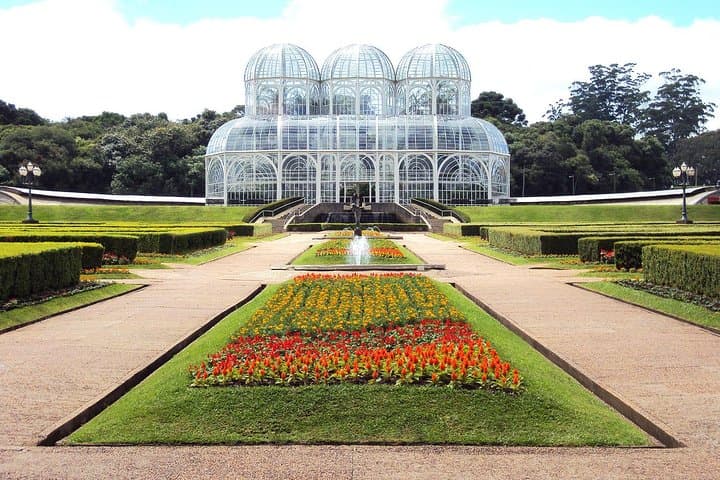


The tour begins with the cool glass curve of the Botanical Garden greenhouse sliding into view — an art‑nouveau roof framed by neatly clipped parterres and a steady stream of walkers and cyclists. For four hours a guide leads a compact circuit through Curitiba’s urban lungs and architectural oddities, moving from Flower Street’s pedestrian bustle to the steel ribs of the Wire Opera House.
The tour begins with the cool glass curve of the Botanical Garden greenhouse sliding into view — an art‑nouveau roof framed by neatly clipped parterres and a steady stream of walkers and cyclists. For four hours a guide leads a compact circuit through Curitiba’s urban lungs and architectural oddities, moving from Flower Street’s pedestrian bustle to the steel ribs of the Wire Opera House.
Curitiba’s layout reflects pragmatic urban planning born in the 20th century; parks were carved out of floodplains and quarries, public transport was redesigned into a model copied globally, and waves of immigrants — German, Ukrainian, Polish, and Italian — left visible marks in churches, cuisine and park names. Geology shows in the city’s repurposed quarries: carved rock faces and artificial lakes at Parque das Pedreiras and Tanguá recall the basalt and Paraná sediment beneath the city.
Expect a mix of short walks and comfortable coach transfers; key stops typically include the Botanical Garden, Parque Tanguá, Bosque Alemão viewpoint, Rua XV de Novembro and the cathedral area. Guides speak English, Spanish or Portuguese and round‑trip hotel transfer is usually included.
Practical notes: wear sturdy walking shoes for uneven park paths, bring a light rain layer (Curitiba’s weather is changeable), and carry water — there are cafés but stops can be brief. Morning departures avoid afternoon showers in summer and give clearer light for photography. The route is family‑friendly but watch narrow footpaths in busy squares.