THE ADVENTURE COLLECTIVE® · Independent discovery and booking for outdoor travel

Motor up from Cusco into the high Andean plateaus on a full-day ATV to the circular terraces of Moray and the thousands of salt pans at Maras. This guided tour mixes short technical riding, high-altitude views, and hands-on cultural context.
Motor up from Cusco into the high Andean plateaus on a full-day ATV to the circular terraces of Moray and the thousands of salt pans at Maras. This guided tour mixes short technical riding, high-altitude views, and hands-on cultural context.
The morning light along the Andean ridge bites the air as riders leave Cusco for Maras, engines ticking beneath wool layers. Within an hour the city’s stone noise falls away and the trail opens — dusty switchbacks, puna grass, and the occasional alpaca eyeing the convoy. The cuatrimoto (ATV) hums into the shallow bowl of Moray, where concentric Inca terraces curve into the earth like an amphitheater of climate zones.
Verified experiences and guided adventures in the surrounding area.
Operated by Andino Tours Peru · Maras, Cusco
The morning light along the Andean ridge bites the air as riders leave Cusco for Maras, engines ticking beneath wool layers. Within an hour the city’s stone noise falls away and the trail opens — dusty switchbacks, puna grass, and the occasional alpaca eyeing the convoy. The cuatrimoto (ATV) hums into the shallow bowl of Moray, where concentric Inca terraces curve into the earth like an amphitheater of climate zones.
Moray’s terraces are geological and agricultural experiments: concentric depressions that create microclimates used by the Incas to trial crops. Nearby, the Salineras de Maras scatter over the slope — more than 4,000 salt pans that glitter like a broken mirror and drain mineral-rich streams into shallow evaporation pools. Both places sit high on the altiplano, generally between about 3,300–3,600 meters, so the air is thin and the landscape feels sharp and honest.
Cultural notes come from local guides who explain communal salt harvesting and pre-Columbian farming logic; the salt pools still feed families and local markets. Geology is visible in the terracing and the mineral-streaked runoff that feeds the salineras.
Practical guidance: this is a full-day, guided ATV route over unpaved Andean trails — expect intermittent steep sections and loose gravel rather than technical rock climbs. Operators provide helmets, gloves, and a vehicle per rider. Acclimatize in Cusco for 24–48 hours if possible, bring layered clothing, sun protection, and at least 1–2 liters of water. The trip blends adrenaline with close-range history and a strong sense of place: wind that nudges you along switchbacks, salt pans that hold the sun like coins.
easy.
6–8 hours.
No special fitness required beyond the ability to handle uneven terrain and mount an ATV; be comfortable standing on pegs and bracing on rough sections.
No formal license is required; guides provide instruction and the route is designed for mixed-ability riders, but basic coordination and comfort on uneven trails help.
Yes — operators furnish helmets and gloves; bring your own sunglasses and layers for comfort.
The transfer to the base is roughly one hour each way depending on traffic; the full activity runs as a day trip (approximately 6–8 hours on-site including riding and visiting sites).
The tour is not recommended for pregnant travelers or those with spinal injuries; acclimatize beforehand and consult a physician if you have altitude-sensitive conditions.
Moray’s concentric terraces were used by the Incas as experimental agricultural labs to simulate different climates; the Salineras have been harvested communally since pre-Columbian times.
Salt extraction at Maras is managed by local communities; visitors should avoid disturbing pans and stick to designated paths to protect fragile microhabitats.
Andino Tours Peru operates guided outdoor trips and adventures with an emphasis on safety, stewardship, and memorable experiences.

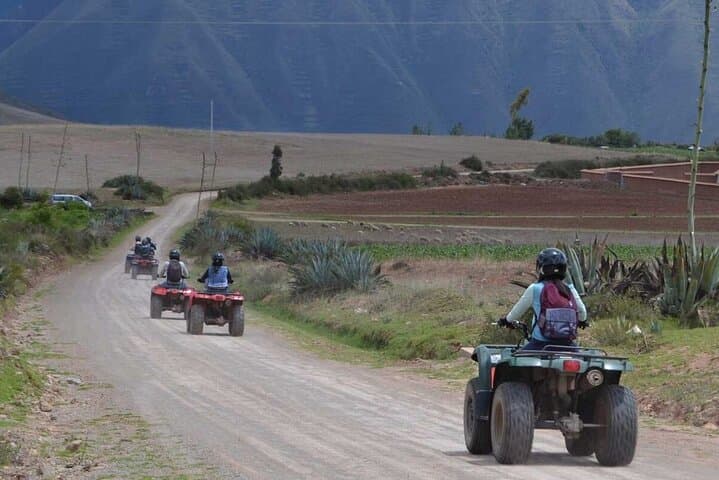
The morning light along the Andean ridge bites the air as riders leave Cusco for Maras, engines ticking beneath wool layers. Within an hour the city’s stone noise falls away and the trail opens — dusty switchbacks, puna grass, and the occasional alpaca eyeing the convoy. The cuatrimoto (ATV) hums into the shallow bowl of Moray, where concentric Inca terraces curve into the earth like an amphitheater of climate zones.
The morning light along the Andean ridge bites the air as riders leave Cusco for Maras, engines ticking beneath wool layers. Within an hour the city’s stone noise falls away and the trail opens — dusty switchbacks, puna grass, and the occasional alpaca eyeing the convoy. The cuatrimoto (ATV) hums into the shallow bowl of Moray, where concentric Inca terraces curve into the earth like an amphitheater of climate zones.
Moray’s terraces are geological and agricultural experiments: concentric depressions that create microclimates used by the Incas to trial crops. Nearby, the Salineras de Maras scatter over the slope — more than 4,000 salt pans that glitter like a broken mirror and drain mineral-rich streams into shallow evaporation pools. Both places sit high on the altiplano, generally between about 3,300–3,600 meters, so the air is thin and the landscape feels sharp and honest.
Cultural notes come from local guides who explain communal salt harvesting and pre-Columbian farming logic; the salt pools still feed families and local markets. Geology is visible in the terracing and the mineral-streaked runoff that feeds the salineras.
Practical guidance: this is a full-day, guided ATV route over unpaved Andean trails — expect intermittent steep sections and loose gravel rather than technical rock climbs. Operators provide helmets, gloves, and a vehicle per rider. Acclimatize in Cusco for 24–48 hours if possible, bring layered clothing, sun protection, and at least 1–2 liters of water. The trip blends adrenaline with close-range history and a strong sense of place: wind that nudges you along switchbacks, salt pans that hold the sun like coins.