THE ADVENTURE COLLECTIVE® · Independent discovery and booking for outdoor travel

Explore the Cu Chi Tunnels on a guided half-day trip from Ho Chi Minh City. Crawl short tunnel sections, learn guerrilla tactics, and visit preserved wartime sites with commentary that brings the underground network to life.
Explore the Cu Chi Tunnels on a guided half-day trip from Ho Chi Minh City. Crawl short tunnel sections, learn guerrilla tactics, and visit preserved wartime sites with commentary that brings the underground network to life.
You step off the air-conditioned van into a scorched scrub of rubber trees and low palms, the heat pressing like a reminder of why this ground mattered.
Verified experiences and guided adventures in the surrounding area.
Operated by Authentic HALONG · Ho Chi Minh City, Ho Chi Minh
You step off the air-conditioned van into a scorched scrub of rubber trees and low palms, the heat pressing like a reminder of why this ground mattered.
The Cu Chi Tunnels are part open-air museum, part living memory — a labyrinth cut into lateritic clay where ingenuity met necessity. Built and expanded by Viet Cong fighters, the tunnels threaded beneath villages and rice paddies to create hidden kitchens, meeting rooms, and field hospitals. Geologically, the soil here is sticky red clay that holds tunnels well but can be narrow and uneven; you’ll crouch through short, reinforced passages and pass replicas of booby traps that once guarded these networks.
Alongside military history, the area reflects rural Vietnamese life: small tea stalls outside the park, wartime-era photos, and veterans’ stories in English on-site. Ben Dinh and Ben Duoc sections differ — Ben Duoc is larger and less altered, while Ben Dinh is reconstructed for easy visitor access.
Practical note: the visit is mostly easy on fitness but involves confined spaces, low tunnels, and uneven paths. Wear sturdy shoes, bring sun protection for outdoor exhibits, and carry water — bottles are often allowed. Guided commentary contextualizes artifacts and points out preserved tunnel entrances, so you’ll leave with both facts and a palpable sense of the human scale of guerrilla war.
Timing: morning departures avoid late-afternoon storms and heat. If you’re staying in District 1, pickup is common; outside the zone may carry an extra fee. The experience is as much about listening and looking as it is about crawling — plan for a sober, informative half-day that reframes your view of modern Vietnam.
easy.
5–6 hours.
Suitable for most fitness levels; involves light walking and short crouched crawls through low tunnel sections.
Expect about 5–6 hours door-to-door including round-trip transport and time at both tunnel sites.
Visitors can enter reinforced, widened sections designed for tourists; original narrow lines are preserved but not accessible for safety.
Older children generally handle it well; very young kids may find crawling sections and heat challenging.
Admission is included on this tour and pickup/drop-off is provided for District 1 hotels; pickups outside District 1 may incur an extra fee.
The tunnel networks were dug and maintained by local villagers and Viet Cong units during the Vietnam War to support guerrilla operations, communication and medical care.
Site management focuses on preserving structural tunnels while limiting wear from visitors; stay on marked paths and avoid disturbing exhibits to help protect the site.
Authentic HALONG operates guided outdoor trips and adventures with an emphasis on safety, stewardship, and memorable experiences.



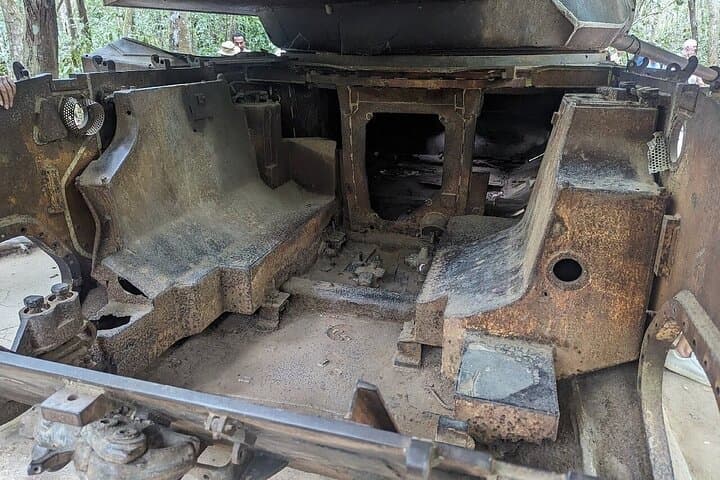
You step off the air-conditioned van into a scorched scrub of rubber trees and low palms, the heat pressing like a reminder of why this ground mattered.
You step off the air-conditioned van into a scorched scrub of rubber trees and low palms, the heat pressing like a reminder of why this ground mattered.
The Cu Chi Tunnels are part open-air museum, part living memory — a labyrinth cut into lateritic clay where ingenuity met necessity. Built and expanded by Viet Cong fighters, the tunnels threaded beneath villages and rice paddies to create hidden kitchens, meeting rooms, and field hospitals. Geologically, the soil here is sticky red clay that holds tunnels well but can be narrow and uneven; you’ll crouch through short, reinforced passages and pass replicas of booby traps that once guarded these networks.
Alongside military history, the area reflects rural Vietnamese life: small tea stalls outside the park, wartime-era photos, and veterans’ stories in English on-site. Ben Dinh and Ben Duoc sections differ — Ben Duoc is larger and less altered, while Ben Dinh is reconstructed for easy visitor access.
Practical note: the visit is mostly easy on fitness but involves confined spaces, low tunnels, and uneven paths. Wear sturdy shoes, bring sun protection for outdoor exhibits, and carry water — bottles are often allowed. Guided commentary contextualizes artifacts and points out preserved tunnel entrances, so you’ll leave with both facts and a palpable sense of the human scale of guerrilla war.
Timing: morning departures avoid late-afternoon storms and heat. If you’re staying in District 1, pickup is common; outside the zone may carry an extra fee. The experience is as much about listening and looking as it is about crawling — plan for a sober, informative half-day that reframes your view of modern Vietnam.