THE ADVENTURE COLLECTIVE® · Independent discovery and booking for outdoor travel

Travel an hour and a half from Ho Chi Minh City to walk the hardened edges of the Cu Chi Tunnels: an underground guerrilla base, wartime kitchens, and an optional tunnel crawl paired with a supervised shooting range. This half-day tour blends history, hands-on context, and practical logistics for a layered visit.
Travel an hour and a half from Ho Chi Minh City to walk the hardened edges of the Cu Chi Tunnels: an underground guerrilla base, wartime kitchens, and an optional tunnel crawl paired with a supervised shooting range. This half-day tour blends history, hands-on context, and practical logistics for a layered visit.
You step off the air-conditioned van into a pocket of lowland forest sixty kilometres northwest of Ho Chi Minh City, where the air carries dust, damp leaf, and a quiet that feels like a held breath. The canopy draws a cool shadow over paths that lead to thin concrete bunkers and camouflaged entrances — the visible edges of a vast underground network that once threaded through this land.
Verified experiences and guided adventures in the surrounding area.
Operated by Viet Kolors Tour · Ho Chi Minh City, Ho Chi Minh Province
You step off the air-conditioned van into a pocket of lowland forest sixty kilometres northwest of Ho Chi Minh City, where the air carries dust, damp leaf, and a quiet that feels like a held breath. The canopy draws a cool shadow over paths that lead to thin concrete bunkers and camouflaged entrances — the visible edges of a vast underground network that once threaded through this land.
Built and expanded during the First Indochina War and the Vietnam War, the Cu Chi tunnels are both an engineering response and a cultural artifact: hand-dug galleries, hidden kitchens and trap systems that reveal daily life under siege. Geologically the area is flat alluvial plain; soils are loam and sand, easy to dig but quick to drain, which shaped the tunnel construction and their ventilation galleries. Local guides link the structures to community memory — they show wartime foodstuffs like cassava and pour tea that speaks to resilience rather than romanticism.
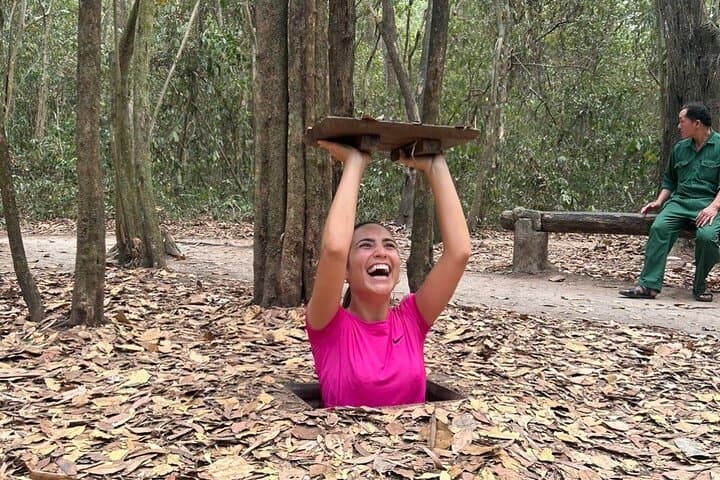
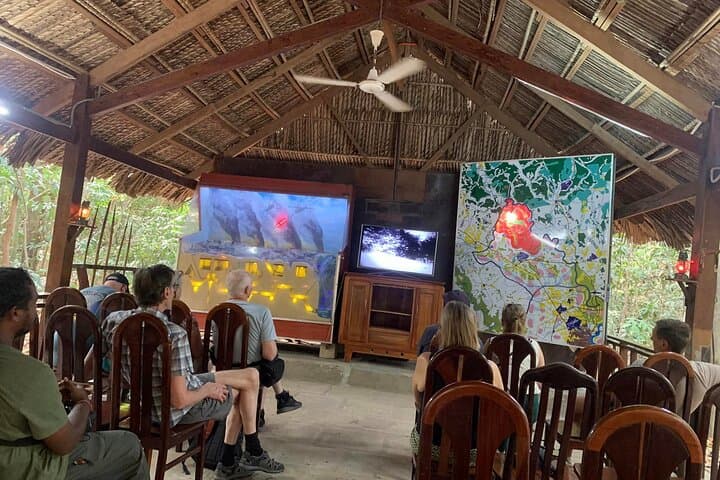
On this half-day trip you get context and access: a 1.5-hour ride from District 1, a historical briefing, a walk past cannon posts and booby-trap replicas, an optional short walking-tunnel (tour sections are widened for safety), and a chance to try wartime snacks. A supervised shooting range is offered separately at the site for those wanting to test marksmanship with period-style rifles. Practical note: much of the visit is flat walking with stooping into low spaces if you choose the tunnel crawl; the site is not suited to people with serious heart or mobility issues.
Plan for sun, dust, and short, close-quarters movement; go early to beat crowds and let the place speak for itself.
moderate.
5–6 hours.
Reasonable walking fitness; able to stoop or briefly crouch for the optional tunnel experience and walk on uneven dirt paths.
Expect about 60 km and 1–1.5 hours each way depending on traffic; the tour schedule accounts for the transfer within its half-day duration.
Yes — there is an optional walking-tunnel experience; tourist sections are widened and shorter than original galleries, but participants should be able to crouch and squeeze through tight spaces.
Shooting at the range is typically offered as an add-on at the site and may have extra fees; it is supervised and follows local safety protocols.
Infants and small children can join, but infants must sit on an adult’s lap; the tunnels and shooting range may not be suitable for very young children or those with cardiovascular or mobility issues.
The tunnels were developed by local villagers and Viet Cong units from the 1940s through the Vietnam War era as living quarters, weapons caches and command centers, later preserved as historical sites.
Tour operators and site managers balance visitor access with preservation by using reinforced, widened tunnel sections and restricting off-path exploration to protect fragile archaeology and local vegetation.
Viet Kolors Tour operates guided outdoor trips and adventures with an emphasis on safety, stewardship, and memorable experiences.

You step off the air-conditioned van into a pocket of lowland forest sixty kilometres northwest of Ho Chi Minh City, where the air carries dust, damp leaf, and a quiet that feels like a held breath. The canopy draws a cool shadow over paths that lead to thin concrete bunkers and camouflaged entrances — the visible edges of a vast underground network that once threaded through this land.
You step off the air-conditioned van into a pocket of lowland forest sixty kilometres northwest of Ho Chi Minh City, where the air carries dust, damp leaf, and a quiet that feels like a held breath. The canopy draws a cool shadow over paths that lead to thin concrete bunkers and camouflaged entrances — the visible edges of a vast underground network that once threaded through this land.
Built and expanded during the First Indochina War and the Vietnam War, the Cu Chi tunnels are both an engineering response and a cultural artifact: hand-dug galleries, hidden kitchens and trap systems that reveal daily life under siege. Geologically the area is flat alluvial plain; soils are loam and sand, easy to dig but quick to drain, which shaped the tunnel construction and their ventilation galleries. Local guides link the structures to community memory — they show wartime foodstuffs like cassava and pour tea that speaks to resilience rather than romanticism.
On this half-day trip you get context and access: a 1.5-hour ride from District 1, a historical briefing, a walk past cannon posts and booby-trap replicas, an optional short walking-tunnel (tour sections are widened for safety), and a chance to try wartime snacks. A supervised shooting range is offered separately at the site for those wanting to test marksmanship with period-style rifles. Practical note: much of the visit is flat walking with stooping into low spaces if you choose the tunnel crawl; the site is not suited to people with serious heart or mobility issues.
Plan for sun, dust, and short, close-quarters movement; go early to beat crowds and let the place speak for itself.