THE ADVENTURE COLLECTIVE® · Independent discovery and booking for outdoor travel

Explore Corfu’s Archaeological Museum and Old Town on a focused three-hour walk that pairs a private museum visit with a seaside promenade and historic streets. A licensed guide connects artifacts, fortresses and local life for a compact cultural immersion.
Explore Corfu’s Archaeological Museum and Old Town on a focused three-hour walk that pairs a private museum visit with a seaside promenade and historic streets. A licensed guide connects artifacts, fortresses and local life for a compact cultural immersion.
The tour begins where stone meets sea: early morning light skims the blue-green Ionian and the pediment of an ancient temple watches from the Archaeological Museum of Corfu.
Verified experiences and guided adventures in the surrounding area.
Operated by Corfuting · Corfu (Kerkyra), Ionian Islands
The tour begins where stone meets sea: early morning light skims the blue-green Ionian and the pediment of an ancient temple watches from the Archaeological Museum of Corfu.
Inside, a licensed guide lays out the island’s long arc—from prehistoric shards to the monumental pediment of Artemis with its Gorgoneion, the oldest surviving stone pediment of Greek architecture. The narrative shifts outward as you step back into the Old Town: Venetian ramparts, the Old Fortress’s limestone walls, the Liston’s arcades and the low lighthouse by the promenade.
Geology here is quiet but telling—limestone bedrock shaped by tectonic uplift and maritime erosion has given Corfu its cliffs, bays and the sheltered harbor that attracted settlers across epochs. Culturally, the island reads like a layered map: Greek sanctuaries, Byzantine churches, Venetian fortifications and British-era promenades all stitched together by daily life in cafes and market stalls.
Practical guidance: this is a three-hour walking experience suitable for most fitness levels, with roughly one hour inside the museum and the remainder on mostly flat, cobbled streets and seaside promenades. Wear non-slip shoes for uneven paving, carry water and a sun layer for exposed sections along the seawall. The guide handles admissions and offers context—ask about the pediment, the Orthodox relics of Agios Spyridon and the nearby Museum of Asian Art.
Timing matters: mornings or late afternoons avoid the hottest hours and improve light for photos. Respect site rules—no touching artifacts—and use local cafes along Liston to sample Corfiot flavors after the walk.
easy.
3 hours.
Suitable for most visitors who can stand and walk for 2–3 hours on mostly flat but cobbled terrain
Yes — admission to the Archaeological Museum of Corfu is included as part of the itinerary and handled by your guide.
The tour notes wheelchair accessibility and stroller access, but some historic streets and cobbles may present challenges; contact the operator with specifics to confirm arrangements.
This shared tour allows up to 15 travelers per departure, providing an intimate yet social experience with an English-speaking licensed guide.
The meeting point is in Corfu Old Town near the Archaeological Museum; confirmation details are provided after booking—there is no additional pickup service.
Corfu’s collections reflect continuous occupation from prehistoric times through classical Greece; the museum houses the island’s iconic temple pediment and artifacts that chart its Greek, Byzantine and Venetian phases.
These archaeological sites are fragile—avoid touching exhibits, follow pathways, and support local conservation by choosing licensed guides and minimizing single-use plastics.
Corfuting operates guided outdoor trips and adventures with an emphasis on safety, stewardship, and memorable experiences.

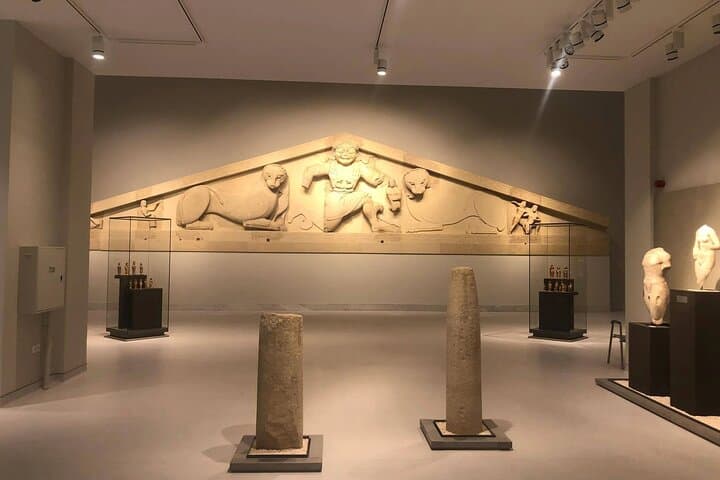


The tour begins where stone meets sea: early morning light skims the blue-green Ionian and the pediment of an ancient temple watches from the Archaeological Museum of Corfu.
The tour begins where stone meets sea: early morning light skims the blue-green Ionian and the pediment of an ancient temple watches from the Archaeological Museum of Corfu.
Inside, a licensed guide lays out the island’s long arc—from prehistoric shards to the monumental pediment of Artemis with its Gorgoneion, the oldest surviving stone pediment of Greek architecture. The narrative shifts outward as you step back into the Old Town: Venetian ramparts, the Old Fortress’s limestone walls, the Liston’s arcades and the low lighthouse by the promenade.
Geology here is quiet but telling—limestone bedrock shaped by tectonic uplift and maritime erosion has given Corfu its cliffs, bays and the sheltered harbor that attracted settlers across epochs. Culturally, the island reads like a layered map: Greek sanctuaries, Byzantine churches, Venetian fortifications and British-era promenades all stitched together by daily life in cafes and market stalls.
Practical guidance: this is a three-hour walking experience suitable for most fitness levels, with roughly one hour inside the museum and the remainder on mostly flat, cobbled streets and seaside promenades. Wear non-slip shoes for uneven paving, carry water and a sun layer for exposed sections along the seawall. The guide handles admissions and offers context—ask about the pediment, the Orthodox relics of Agios Spyridon and the nearby Museum of Asian Art.
Timing matters: mornings or late afternoons avoid the hottest hours and improve light for photos. Respect site rules—no touching artifacts—and use local cafes along Liston to sample Corfiot flavors after the walk.