THE ADVENTURE COLLECTIVE® · Independent discovery and booking for outdoor travel

Experience the Colosseum after dark with exclusive underground and arena access. This guided night tour combines dim-lit ruins, engineering history and a quieter view of Rome’s most famous amphitheater.
Experience the Colosseum after dark with exclusive underground and arena access. This guided night tour combines dim-lit ruins, engineering history and a quieter view of Rome’s most famous amphitheater.
Twilight slides across the stone tiers and the Colosseum takes on a different edge — shadows sharpen the arches and the city’s noise recedes. On a night tour visitors enter through a fast-track point, move below the arena into the hypogeum, and then stand on the reconstructed arena floor where gladiators once faced one another and beasts were staged.
Verified experiences and guided adventures in the surrounding area.
Operated by Discover Rome Tours · Rome, Lazio
Twilight slides across the stone tiers and the Colosseum takes on a different edge — shadows sharpen the arches and the city’s noise recedes. On a night tour visitors enter through a fast-track point, move below the arena into the hypogeum, and then stand on the reconstructed arena floor where gladiators once faced one another and beasts were staged.
The amphitheater was begun under Emperor Vespasian and completed by Titus around AD 80. Its structure — travertine blocks, volcanic tuff, Roman concrete and a network of vaults — reflects ancient engineering aimed at moving tens of thousands of spectators and animals quickly. By night, the stone reads like a ledger of Roman spectacle and civic ritual, and the undercroft reveals the pulley systems and holding cells that made those spectacles possible.
Culturally, the Colosseum was civic theater and propaganda: the empire showed itself through games, public feasts and staged hunts. How the monument has been used and reused over centuries — from quarry to shrine to tourist magnet — is visible in repaired masonry and conservation scaffolding.
Practical note: night access is limited and includes stairs, uneven surfaces and low-light passages in the underground. Visitors must present ID that matches booking details and pass security screening. Wear sturdy shoes, bring a light jacket for cool evenings, and allow roughly 80 minutes for the guided route. Photography is allowed but keep movement steady on the arena and follow the guide’s directions in restricted areas. For those who want the Colosseum without the daytime crowds, the after-hours tour delivers drama with historical context and hands-on access that most daytime tickets can’t match.
easy.
1–1.5 hours.
Suitable for most fitness levels; requires ability to climb stairs and stand for periods.
Access is limited and included on this night tour; however, the hypogeum has stairs and low-light areas and is not wheelchair accessible.
Meet the tour coordinator outside the Colosseum metro station, just across the street from the monument — arrive 15 minutes early for check-in.
Photography is generally allowed, but follow guide instructions in restricted zones and avoid flash or tripods if asked.
You must present a valid passport or government ID that matches the full name supplied at booking to gain entry.
Constructed under the Flavian emperors c. AD 70–80, the Colosseum hosted gladiatorial combats, public spectacles and staged hunts as a central feature of Roman civic life.
Ongoing restoration and strict visitor limits protect fragile masonry; choose guided access options that help fund conservation and follow stay-on-path rules to minimize wear.
Discover Rome Tours operates guided outdoor trips and adventures with an emphasis on safety, stewardship, and memorable experiences.
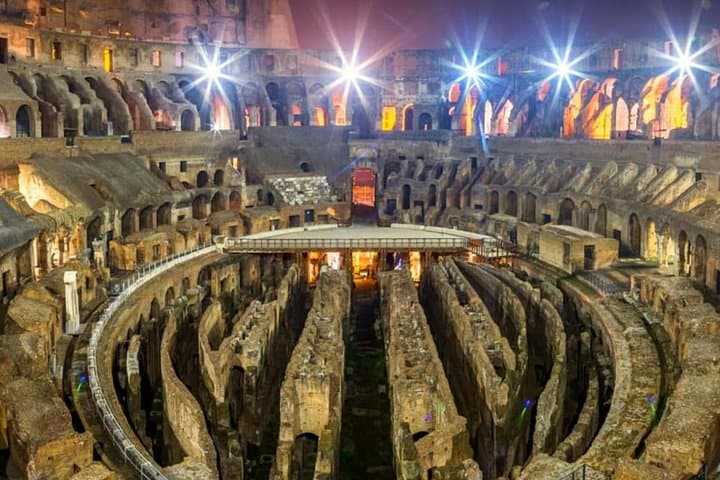


Twilight slides across the stone tiers and the Colosseum takes on a different edge — shadows sharpen the arches and the city’s noise recedes. On a night tour visitors enter through a fast-track point, move below the arena into the hypogeum, and then stand on the reconstructed arena floor where gladiators once faced one another and beasts were staged.
Twilight slides across the stone tiers and the Colosseum takes on a different edge — shadows sharpen the arches and the city’s noise recedes. On a night tour visitors enter through a fast-track point, move below the arena into the hypogeum, and then stand on the reconstructed arena floor where gladiators once faced one another and beasts were staged.
The amphitheater was begun under Emperor Vespasian and completed by Titus around AD 80. Its structure — travertine blocks, volcanic tuff, Roman concrete and a network of vaults — reflects ancient engineering aimed at moving tens of thousands of spectators and animals quickly. By night, the stone reads like a ledger of Roman spectacle and civic ritual, and the undercroft reveals the pulley systems and holding cells that made those spectacles possible.
Culturally, the Colosseum was civic theater and propaganda: the empire showed itself through games, public feasts and staged hunts. How the monument has been used and reused over centuries — from quarry to shrine to tourist magnet — is visible in repaired masonry and conservation scaffolding.
Practical note: night access is limited and includes stairs, uneven surfaces and low-light passages in the underground. Visitors must present ID that matches booking details and pass security screening. Wear sturdy shoes, bring a light jacket for cool evenings, and allow roughly 80 minutes for the guided route. Photography is allowed but keep movement steady on the arena and follow the guide’s directions in restricted areas. For those who want the Colosseum without the daytime crowds, the after-hours tour delivers drama with historical context and hands-on access that most daytime tickets can’t match.