THE ADVENTURE COLLECTIVE® · Independent discovery and booking for outdoor travel

Handle trained hawks and falcons in a 90-minute beginner falconry lesson outside Colorado Springs. Learn raptor biology, watch free-flight demos, and try holding a Saker Falcon under licensed supervision.
Handle trained hawks and falcons in a 90-minute beginner falconry lesson outside Colorado Springs. Learn raptor biology, watch free-flight demos, and try holding a Saker Falcon under licensed supervision.
You step into a small grassy paddock as a kestrel arcs overhead, its shadow skimming your forearm. The birds here move on their terms—curious, exact, and unhurried—and the licensed falconer’s voice cuts through the quiet, translating centuries of practice into plain language.
Verified experiences and guided adventures in the surrounding area.
Operated by Broadmoor Outfitters and Soaring Adventure · Colorado Springs, Colorado
You step into a small grassy paddock as a kestrel arcs overhead, its shadow skimming your forearm. The birds here move on their terms—curious, exact, and unhurried—and the licensed falconer’s voice cuts through the quiet, translating centuries of practice into plain language.
Falconry is one of the world’s oldest predator-prey partnerships, practiced across Eurasia for millennia and adapted in the American West to local raptors. Around Colorado Springs, high plains meet foothills—shortgrasses rolling toward the pines of Pikes Peak—providing ideal open air for hawks and falcons to fly and demonstrate hunt-like behaviors. The class introduces hawks, falcons and owls: their hunting strategies, wing shapes, and how handlers read a bird’s intent. Expect a short natural-history primer, a supervised free-flight demonstration in nearby open ground, and a hands-on moment where students don a leather glove to hold a trained Saker Falcon.
Culturally, this is as much about stewardship as spectacle; modern falconry blends conservation, rehabilitation and education. Practically, the experience runs about 90 minutes, is accessible to most fitness levels, and works outdoors in variable Colorado weather—sun, wind, and occasional prairie gusts play a role. Bring closed-toe shoes, long sleeves, a camera, and an openness to wildlife setting the pace. If you’re nervous about birds, mention it—presenters tailor interactions and the birds always choose whether to engage.
easy.
1.5 hours.
Suitable for most adults and older children in basic health; mostly standing and short walking on level ground.
Yes—many classes welcome older children, but check age minimums with the operator and supervise closely; handlers adapt interactions for safety.
Beginners usually get the chance to don a leather glove and hold the trained Saker Falcon under direct supervision, though final interaction depends on the bird’s behavior.
The birds are trained and overseen by a licensed falconer; they participate by choice and are accustomed to demonstrations and handler cues.
Sessions may be canceled or rescheduled in poor weather; confirm the operator’s cancellation policy and call if conditions look marginal.
Falconry in North America draws on centuries-old techniques imported and adapted by settlers and indigenous falconers; modern programs mix tradition with wildlife rehab and education.
Licensed falconry groups often participate in raptor monitoring and rehabilitation; follow guidance to minimize disturbance and support local conservation efforts.
Broadmoor Outfitters and Soaring Adventure operates guided outdoor trips and adventures with an emphasis on safety, stewardship, and memorable experiences.

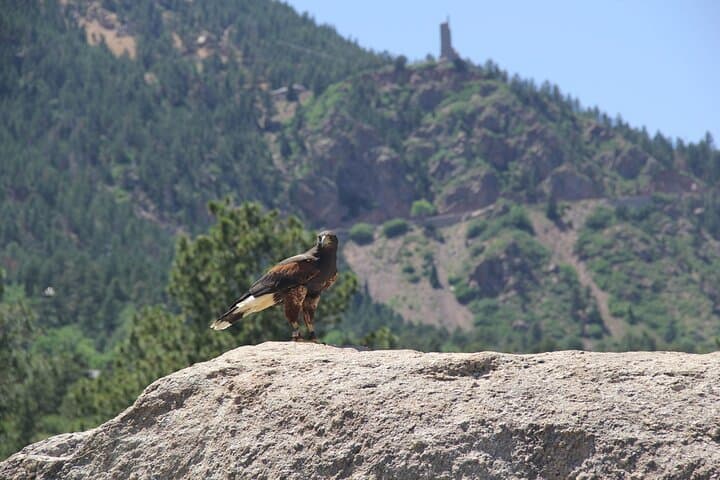


You step into a small grassy paddock as a kestrel arcs overhead, its shadow skimming your forearm. The birds here move on their terms—curious, exact, and unhurried—and the licensed falconer’s voice cuts through the quiet, translating centuries of practice into plain language.
You step into a small grassy paddock as a kestrel arcs overhead, its shadow skimming your forearm. The birds here move on their terms—curious, exact, and unhurried—and the licensed falconer’s voice cuts through the quiet, translating centuries of practice into plain language.
Falconry is one of the world’s oldest predator-prey partnerships, practiced across Eurasia for millennia and adapted in the American West to local raptors. Around Colorado Springs, high plains meet foothills—shortgrasses rolling toward the pines of Pikes Peak—providing ideal open air for hawks and falcons to fly and demonstrate hunt-like behaviors. The class introduces hawks, falcons and owls: their hunting strategies, wing shapes, and how handlers read a bird’s intent. Expect a short natural-history primer, a supervised free-flight demonstration in nearby open ground, and a hands-on moment where students don a leather glove to hold a trained Saker Falcon.
Culturally, this is as much about stewardship as spectacle; modern falconry blends conservation, rehabilitation and education. Practically, the experience runs about 90 minutes, is accessible to most fitness levels, and works outdoors in variable Colorado weather—sun, wind, and occasional prairie gusts play a role. Bring closed-toe shoes, long sleeves, a camera, and an openness to wildlife setting the pace. If you’re nervous about birds, mention it—presenters tailor interactions and the birds always choose whether to engage.