THE ADVENTURE COLLECTIVE® · Independent discovery and booking for outdoor travel

Ascend Brunelleschi’s Dome and walk Florence’s historic core on a guided tour that blends architecture, history, and sweeping city views. Perfect for travelers who want an up-close look at Renaissance ingenuity—and a few hundred steps to earn the panorama.
Ascend Brunelleschi’s Dome and walk Florence’s historic core on a guided tour that blends architecture, history, and sweeping city views. Perfect for travelers who want an up-close look at Renaissance ingenuity—and a few hundred steps to earn the panorama.
You step into Piazza del Duomo and the stone underfoot changes the rhythm of your walk: small, deliberate, attentive. The cathedral’s ribbed silhouette fills your view as your guide tugs a thread through centuries—Giotto’s bell tower, the Baptistery’s bronze doors, then Brunelleschi’s Dome rising above the city like an engineered challenge daring you to climb.
Verified experiences and guided adventures in the surrounding area.
You step into Piazza del Duomo and the stone underfoot changes the rhythm of your walk: small, deliberate, attentive. The cathedral’s ribbed silhouette fills your view as your guide tugs a thread through centuries—Giotto’s bell tower, the Baptistery’s bronze doors, then Brunelleschi’s Dome rising above the city like an engineered challenge daring you to climb.
The climb to the cupola is a lesson in Renaissance audacity. Filippo Brunelleschi solved a structural problem without scaffolding in the 15th century; the dome, completed in 1436, remains a study in brickwork and geometry. The complex’s architecture and the Opera del Duomo Museum nearby hold mosaics, sculptures, and original panels that trace Florence’s civic faith and wealth.
Walking the nearby streets, you’ll see traces of medieval workshops, marble inlay patterns, and market stalls selling lampredotto and leather goods—Florence’s living history. Expect narrow stairways, tight passageways inside the dome, and a final ascent that rewards you with an expansive view over terracotta roofs and the Arno river.
Practical guidance: allow roughly three hours for the combined walking tour and cupola climb; wear sturdy shoes and bring water; the ascent involves several hundred steps and uneven staircases. Photography is allowed in many areas but can be restricted inside the cupola. Book ahead for timed entry and arrive early to avoid peak crowds; modest dress is required for entry to the cathedral interior. This tour is as much about engineering and civic pride as it is about scenery—bring curiosity and a steady pace.
moderate.
3 hours.
Moderately fit—able to climb several hundred narrow stairs and stand for extended periods.
The climb involves several hundred steps (roughly 400–500 depending on route), with narrow staircases—plan for a strenuous ascent.
Photography is generally allowed in many parts of the complex but can be restricted in certain spaces; follow guide instructions and watch for signs.
No—the cupola and many parts of the cathedral complex require stair climbs and are not wheelchair accessible; contact providers for alternative options.
Yes—modest dress is required to enter the cathedral interior; bring a scarf or light layer to cover up.
The Cathedral of Santa Maria del Fiore was completed in the 15th century; Brunelleschi’s dome, finished in 1436, remains a milestone in engineering and Renaissance ambition.
Visitor limits and timed entries help protect fragile interiors; stick to marked paths, avoid touching frescoes, and support official sites and local guides.
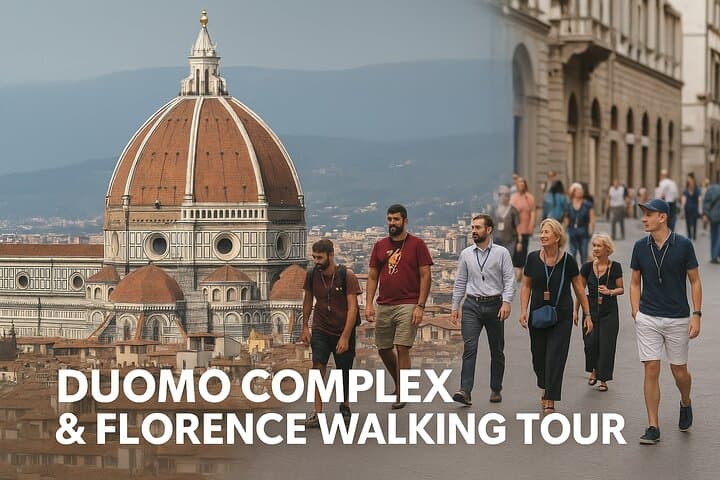
You step into Piazza del Duomo and the stone underfoot changes the rhythm of your walk: small, deliberate, attentive. The cathedral’s ribbed silhouette fills your view as your guide tugs a thread through centuries—Giotto’s bell tower, the Baptistery’s bronze doors, then Brunelleschi’s Dome rising above the city like an engineered challenge daring you to climb.
You step into Piazza del Duomo and the stone underfoot changes the rhythm of your walk: small, deliberate, attentive. The cathedral’s ribbed silhouette fills your view as your guide tugs a thread through centuries—Giotto’s bell tower, the Baptistery’s bronze doors, then Brunelleschi’s Dome rising above the city like an engineered challenge daring you to climb.
The climb to the cupola is a lesson in Renaissance audacity. Filippo Brunelleschi solved a structural problem without scaffolding in the 15th century; the dome, completed in 1436, remains a study in brickwork and geometry. The complex’s architecture and the Opera del Duomo Museum nearby hold mosaics, sculptures, and original panels that trace Florence’s civic faith and wealth.
Walking the nearby streets, you’ll see traces of medieval workshops, marble inlay patterns, and market stalls selling lampredotto and leather goods—Florence’s living history. Expect narrow stairways, tight passageways inside the dome, and a final ascent that rewards you with an expansive view over terracotta roofs and the Arno river.
Practical guidance: allow roughly three hours for the combined walking tour and cupola climb; wear sturdy shoes and bring water; the ascent involves several hundred steps and uneven staircases. Photography is allowed in many areas but can be restricted inside the cupola. Book ahead for timed entry and arrive early to avoid peak crowds; modest dress is required for entry to the cathedral interior. This tour is as much about engineering and civic pride as it is about scenery—bring curiosity and a steady pace.