THE ADVENTURE COLLECTIVE® · Independent discovery and booking for outdoor travel

Cover Rome’s major monuments in three hours on a guided city bike tour that moves from imperial ruins to Baroque fountains. Expect cobbles, short hills, and curated local insights—ideal for travelers who want fast orientation with context.
Cover Rome’s major monuments in three hours on a guided city bike tour that moves from imperial ruins to Baroque fountains. Expect cobbles, short hills, and curated local insights—ideal for travelers who want fast orientation with context.
You push off from a sun-warmed piazza and the city rearranges itself around your wheels: narrow alleys give way to wide avenues, ancient stone laps at modern rubber, and fountains seem to steer you toward the next story. Over three hours a guide paces the route, easing you through traffic-free lanes and brief pedestrian stretches so the city’s layers reveal themselves without the strain of long walks.
Verified experiences and guided adventures in the surrounding area.
Operated by Bici&Baci srl · Rome, Lazio
You push off from a sun-warmed piazza and the city rearranges itself around your wheels: narrow alleys give way to wide avenues, ancient stone laps at modern rubber, and fountains seem to steer you toward the next story. Over three hours a guide paces the route, easing you through traffic-free lanes and brief pedestrian stretches so the city’s layers reveal themselves without the strain of long walks.
This ride threads Imperial Rome and Baroque spectacle. Expect the shells of the Forums where politics and plumbing once converged, the Pantheon’s intact roman concrete dome, and Bernini’s fountains breathing theatrically from travertine basins. Streets that became Renaissance shopping boulevards still carry the footprint of earlier epochs; geology is visible in the local stone — travertine and tufa — cut and reused across eras.
Culturally the tour reads like a primer: papal plazas, marble stairways, open-air markets and artists’ streets that shaped modern Roman style. Local insights from guides point out quieter corners — a basilica doorway, a trattoria known for its cacio e pepe — that don’t make every guidebook.
Practically: the terrain is city pavement and cobblestones with a few small hills; cycling skill required is minimal and helmets are supplied. Bring a reusable water bottle, shoes that handle pedals and uneven stone, and a light jacket for late-afternoon breezes. Tours are small-group, roughly 12–15 riders, and cover major landmarks in a compact, steady loop—ideal for first-time visitors who want history on two wheels.
easy.
3 hours.
Lightly active: able to pedal continuously at a gentle pace for three hours with intermittent stops.
Yes—helmets are supplied and required for the duration of the ride.
Children can join but must be accompanied by an adult; infant seats may be available—check when booking.
This highlights tour passes major sites from the outside; admissions to interiors are not included.
The tour does not automatically cancel for poor weather; confirm specifics with the operator and dress appropriately.
Rome’s center is palimpsest: Roman imperial foundations were later capped by medieval, Renaissance and Baroque layers, often reusing the same stone.
Cycling reduces per-person emissions in a congested city; stay on designated lanes and respect protected monuments and traffic rules to limit impact.
Bici&Baci srl operates guided outdoor trips and adventures with an emphasis on safety, stewardship, and memorable experiences.

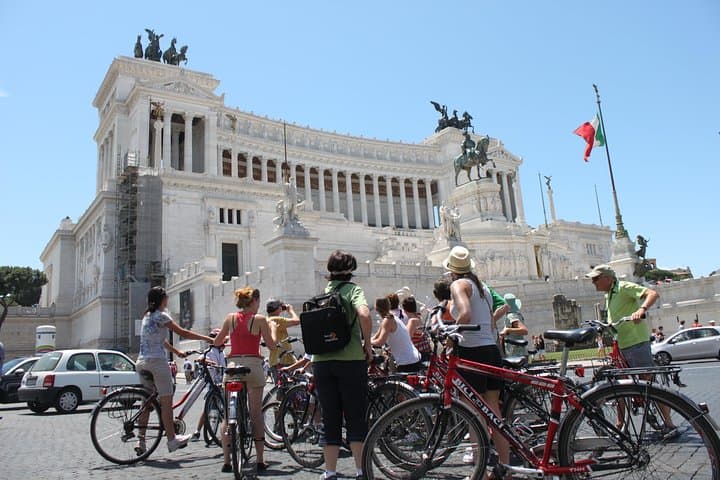


You push off from a sun-warmed piazza and the city rearranges itself around your wheels: narrow alleys give way to wide avenues, ancient stone laps at modern rubber, and fountains seem to steer you toward the next story. Over three hours a guide paces the route, easing you through traffic-free lanes and brief pedestrian stretches so the city’s layers reveal themselves without the strain of long walks.
You push off from a sun-warmed piazza and the city rearranges itself around your wheels: narrow alleys give way to wide avenues, ancient stone laps at modern rubber, and fountains seem to steer you toward the next story. Over three hours a guide paces the route, easing you through traffic-free lanes and brief pedestrian stretches so the city’s layers reveal themselves without the strain of long walks.
This ride threads Imperial Rome and Baroque spectacle. Expect the shells of the Forums where politics and plumbing once converged, the Pantheon’s intact roman concrete dome, and Bernini’s fountains breathing theatrically from travertine basins. Streets that became Renaissance shopping boulevards still carry the footprint of earlier epochs; geology is visible in the local stone — travertine and tufa — cut and reused across eras.
Culturally the tour reads like a primer: papal plazas, marble stairways, open-air markets and artists’ streets that shaped modern Roman style. Local insights from guides point out quieter corners — a basilica doorway, a trattoria known for its cacio e pepe — that don’t make every guidebook.
Practically: the terrain is city pavement and cobblestones with a few small hills; cycling skill required is minimal and helmets are supplied. Bring a reusable water bottle, shoes that handle pedals and uneven stone, and a light jacket for late-afternoon breezes. Tours are small-group, roughly 12–15 riders, and cover major landmarks in a compact, steady loop—ideal for first-time visitors who want history on two wheels.