THE ADVENTURE COLLECTIVE® · Independent discovery and booking for outdoor travel

Turn Budapest’s streets into a game: a smartphone-led city quest sends you from Parliament to the Ferris wheel solving riddles and discovering local history. Expect 2–3 hours of walking, observation-based puzzles, and an instant adventure summary at the end.
Turn Budapest’s streets into a game: a smartphone-led city quest sends you from Parliament to the Ferris wheel solving riddles and discovering local history. Expect 2–3 hours of walking, observation-based puzzles, and an instant adventure summary at the end.
You step off the tram into a wide plaza and the city rearranges itself into a map of puzzles — the Danube glints to your left, the Gothic silhouette of Parliament looms ahead, and cobbled lanes promise questions at every corner. City Quest Prague—no, Budapest—asks you to look closer: plaques to read, statues to interrogate, fountains that dare you to notice details most passersby miss.
Verified experiences and guided adventures in the surrounding area.
Operated by Cityflaere · Budapest, Budapest
You step off the tram into a wide plaza and the city rearranges itself into a map of puzzles — the Danube glints to your left, the Gothic silhouette of Parliament looms ahead, and cobbled lanes promise questions at every corner. City Quest Prague—no, Budapest—asks you to look closer: plaques to read, statues to interrogate, fountains that dare you to notice details most passersby miss.
Budapest's streets are a palimpsest of empires. Roman roads, Ottoman baths, and Austro-Hungarian boulevards overlap in stone and story; the game threads short history lessons through its riddles. Geology peeks out where the Buda hills meet the flat Pest plain; thermal springs beneath the surface explain the city’s famous baths, while the Danube has long shaped trade and movement through the twin cities.
Culturally the route grazes markets, cafés, and political monuments, offering quick local insights between clues. The experience is self-guided and smartphone-driven: you solve codes by observing façades and public art, then submit answers for instant feedback and an end-of-game summary.
Practically, plan 2–3 hours, charge your phone, and pick comfortable shoes—expect steady walking on mixed pavement and cobbles. Public transit makes quick returns easy if you want to bail early. The route is wheelchair and stroller accessible in core areas, but a few side streets can be uneven. Bring a portable battery pack, keep data enabled for maps, and start near mid-afternoon to avoid peak commuter flows; evening plays nicely too, when lights make Parliament and the Ferris wheel more atmospheric. For groups and families this private, mobile experience balances sightseeing with playful competition—no guide required, just curiosity and a charged device.
easy.
2–3 hours.
Light walking ability; suitable for most fitness levels including families and older adults
No — the experience is self-guided via smartphone; clues and maps are provided digitally for independent play.
Core areas and main checkpoints are wheelchair and stroller accessible, though some side streets may have uneven surfaces.
The itinerary is designed to last about 2–3 hours, but you can pause or shorten it using nearby public transit options.
All sales are final per the booking terms—cancellations are not refundable, so confirm dates before purchase.
Budapest formed from two cities, Buda and Pest, united in 1873; the city's architecture reflects Roman, Ottoman, and Austro-Hungarian layers.
Stay on public paths and avoid touching historic façades; support local businesses listed on the map to keep tourism distributed and sustainable.
Cityflaere operates guided outdoor trips and adventures with an emphasis on safety, stewardship, and memorable experiences.



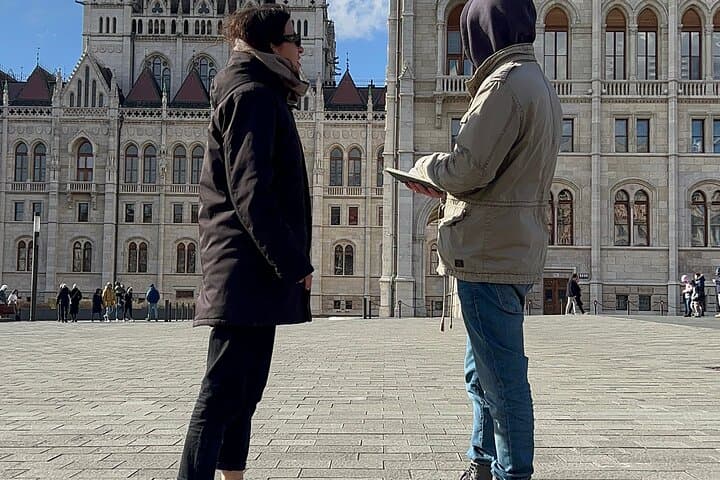
You step off the tram into a wide plaza and the city rearranges itself into a map of puzzles — the Danube glints to your left, the Gothic silhouette of Parliament looms ahead, and cobbled lanes promise questions at every corner. City Quest Prague—no, Budapest—asks you to look closer: plaques to read, statues to interrogate, fountains that dare you to notice details most passersby miss.
You step off the tram into a wide plaza and the city rearranges itself into a map of puzzles — the Danube glints to your left, the Gothic silhouette of Parliament looms ahead, and cobbled lanes promise questions at every corner. City Quest Prague—no, Budapest—asks you to look closer: plaques to read, statues to interrogate, fountains that dare you to notice details most passersby miss.
Budapest's streets are a palimpsest of empires. Roman roads, Ottoman baths, and Austro-Hungarian boulevards overlap in stone and story; the game threads short history lessons through its riddles. Geology peeks out where the Buda hills meet the flat Pest plain; thermal springs beneath the surface explain the city’s famous baths, while the Danube has long shaped trade and movement through the twin cities.
Culturally the route grazes markets, cafés, and political monuments, offering quick local insights between clues. The experience is self-guided and smartphone-driven: you solve codes by observing façades and public art, then submit answers for instant feedback and an end-of-game summary.
Practically, plan 2–3 hours, charge your phone, and pick comfortable shoes—expect steady walking on mixed pavement and cobbles. Public transit makes quick returns easy if you want to bail early. The route is wheelchair and stroller accessible in core areas, but a few side streets can be uneven. Bring a portable battery pack, keep data enabled for maps, and start near mid-afternoon to avoid peak commuter flows; evening plays nicely too, when lights make Parliament and the Ferris wheel more atmospheric. For groups and families this private, mobile experience balances sightseeing with playful competition—no guide required, just curiosity and a charged device.