THE ADVENTURE COLLECTIVE® · Independent discovery and booking for outdoor travel

Explore Chicago’s Loop on a focused 90-minute walk that highlights Art Deco landmarks like the Chicago Board of Trade and One LaSalle. Learn architectural motifs, local history, and practical tips for seeing carved reliefs, lobbies, and skyline views.
Explore Chicago’s Loop on a focused 90-minute walk that highlights Art Deco landmarks like the Chicago Board of Trade and One LaSalle. Learn architectural motifs, local history, and practical tips for seeing carved reliefs, lobbies, and skyline views.
You step off LaSalle Street into a canyon of stone and bronze; sunlight skitters across geometric ornament and the Chicago River wind dares you to look up. This 90‑minute loop threads the city’s financial core, where the roar of the 1920s left its fingerprint in stepped setbacks, polished metals, and carved flora. The Chicago Board of Trade, One LaSalle, and the Field/Bank of America Building stand as works of applied sculpture—architecture that talks back.
Verified experiences and guided adventures in the surrounding area.
You step off LaSalle Street into a canyon of stone and bronze; sunlight skitters across geometric ornament and the Chicago River wind dares you to look up. This 90‑minute loop threads the city’s financial core, where the roar of the 1920s left its fingerprint in stepped setbacks, polished metals, and carved flora. The Chicago Board of Trade, One LaSalle, and the Field/Bank of America Building stand as works of applied sculpture—architecture that talks back.
Art Deco in Chicago arrived as part of a national mood: optimism, mechanization and luxury converging after World War I. Locally, architects translated these ideals into tall, layered forms that responded to zoning, elevator technology, and a booming commodities market. The façades are limestone, granite, and terra cotta; look for zigzags, sunbursts, and stylized eagles—the city’s commerce expressed as ornament.
Culturally, the Loop has been both stage and engine: traders, clerks, and civic audiences flowed through these halls. Many buildings are landmarked, protected by preservation ordinances that keep details intact.
Practical guidance: wear sturdy walking shoes and a light wind layer—Lake Michigan channels gusts through the canyons. Tours usually pause at exteriors and lobbies; some interiors require ID or limited access. Bring a compact camera and binoculars for sculptural detail, and allow time to step into the Rookery’s light court if the group permits. Peak times are late morning and golden hour for best shadow definition on relief work. Hydrate, plan public-transit arrival, and arrive 10 minutes early to check in—this is dense urban walking with frequent stops and plenty of visual payoff.
easy.
1.5 hours.
Light walking fitness; participants should be comfortable standing and walking on city sidewalks for up to 90 minutes.
The tour runs about 90 minutes and covers roughly 1–1.5 miles of mostly flat, urban sidewalks with frequent stops for commentary and photos.
The route focuses on exteriors and accessible lobbies; interior access depends on building policies and security—carry ID if you hope to enter.
The loop is family-friendly but includes crowded sidewalks and occasional steps; folding strollers are workable but expect limited restroom access.
This specific tour is typically offered in English; check the operator for accessibility accommodations or private-guide options for non-English speakers.
Art Deco arrived in Chicago in the 1920s as the city rebuilt its commercial identity—skyscrapers became canvases for streamlined ornament tied to industry and optimism.
Many Loop buildings are landmarked and protected by preservation ordinances; visitors are encouraged to respect private property, avoid touching delicate surfaces, and support nonprofit education partnerships.
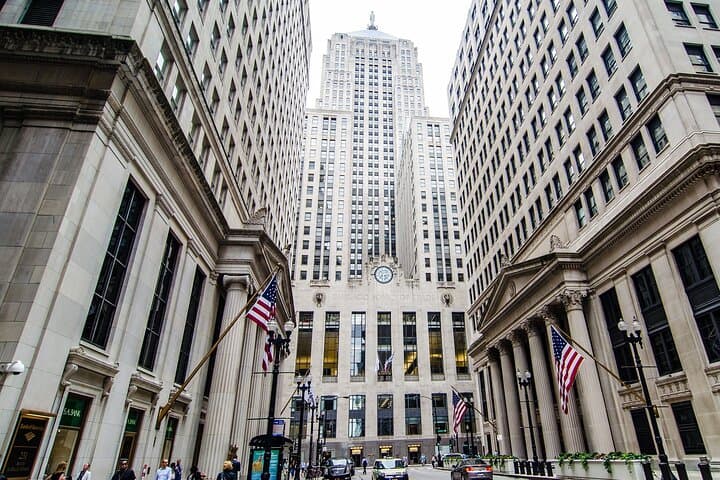
You step off LaSalle Street into a canyon of stone and bronze; sunlight skitters across geometric ornament and the Chicago River wind dares you to look up. This 90‑minute loop threads the city’s financial core, where the roar of the 1920s left its fingerprint in stepped setbacks, polished metals, and carved flora. The Chicago Board of Trade, One LaSalle, and the Field/Bank of America Building stand as works of applied sculpture—architecture that talks back.
You step off LaSalle Street into a canyon of stone and bronze; sunlight skitters across geometric ornament and the Chicago River wind dares you to look up. This 90‑minute loop threads the city’s financial core, where the roar of the 1920s left its fingerprint in stepped setbacks, polished metals, and carved flora. The Chicago Board of Trade, One LaSalle, and the Field/Bank of America Building stand as works of applied sculpture—architecture that talks back.
Art Deco in Chicago arrived as part of a national mood: optimism, mechanization and luxury converging after World War I. Locally, architects translated these ideals into tall, layered forms that responded to zoning, elevator technology, and a booming commodities market. The façades are limestone, granite, and terra cotta; look for zigzags, sunbursts, and stylized eagles—the city’s commerce expressed as ornament.
Culturally, the Loop has been both stage and engine: traders, clerks, and civic audiences flowed through these halls. Many buildings are landmarked, protected by preservation ordinances that keep details intact.
Practical guidance: wear sturdy walking shoes and a light wind layer—Lake Michigan channels gusts through the canyons. Tours usually pause at exteriors and lobbies; some interiors require ID or limited access. Bring a compact camera and binoculars for sculptural detail, and allow time to step into the Rookery’s light court if the group permits. Peak times are late morning and golden hour for best shadow definition on relief work. Hydrate, plan public-transit arrival, and arrive 10 minutes early to check in—this is dense urban walking with frequent stops and plenty of visual payoff.