THE ADVENTURE COLLECTIVE® · Independent discovery and booking for outdoor travel

Explore the latest additions to Chicago’s built environment on a focused 90-minute walking tour around the Chicago Architecture Center. Learn how new towers like 462 N. Park and the St. Regis alter neighborhood character, transit, and the riverfront.
Explore the latest additions to Chicago’s built environment on a focused 90-minute walking tour around the Chicago Architecture Center. Learn how new towers like 462 N. Park and the St. Regis alter neighborhood character, transit, and the riverfront.
You step off the Wacker Drive curb and the city leans in — glass planes and limestone faces angling toward the river, recent towers rubbing shoulders with turn-of-the-century façades. In 90 minutes the What’s New tour threads the blocks around the Chicago Architecture Center, examining how new construction reshapes sightlines, transit flow and the river’s edge.
Verified experiences and guided adventures in the surrounding area.
You step off the Wacker Drive curb and the city leans in — glass planes and limestone faces angling toward the river, recent towers rubbing shoulders with turn-of-the-century façades. In 90 minutes the What’s New tour threads the blocks around the Chicago Architecture Center, examining how new construction reshapes sightlines, transit flow and the river’s edge.
Chicago’s skyline is a story of reinvention. After the Great Fire of 1871 the city embraced steel-frame technology and, later, curtain-wall glazing; today’s arrivals — like 462 N. Park and the St. Regis — extend that lineage with mixed-use programs, glazed thermal envelopes and rooftop ecology. Beneath your shoes the river corridor tells another tale: engineered banks, reclaimed riverfront, and fill placed during early development sit atop dolomite bedrock that once dictated where heavy masonry could rise.
The guide points out structural choices, material tradeoffs and ornament that signals a building’s intended role in the neighborhood economy. Conversations touch culture too — how residential towers change retail patterns, how preservation ordinances protect key cornices, and how nonprofit architecture education supports public engagement.
Practical guidance: the route is flat city sidewalk with frequent stops; expect 90 minutes of walking and standing. Best times are morning or late afternoon light for façades and cooler temperatures in spring and fall. Bring comfortable shoes, a refillable water bottle and a phone for façade photos. Arrive 10–15 minutes early at the Chicago Architecture Center; tickets support the center’s educational programs, and flexible cancellation is usually available.
easy.
1–1.5 hours.
Basic urban fitness — able to walk and stand for 90 minutes on paved sidewalks
The tour runs approximately 90 minutes and covers several blocks of downtown architecture with multiple stops for commentary.
The route is primarily on flat sidewalks but accessibility can vary by building entry; contact the Chicago Architecture Center for specific accommodations.
The tour listing often offers free cancellation; check your booking details for exact refund windows and policies.
Yes — older children with interest in buildings or city history will enjoy it; the pace includes frequent stops for explanations.
Chicago rebuilt after the Great Fire by embracing steel-frame construction; that innovation led to the modern skyscraper and continuous reinvention visible today.
Recent developments emphasize green roofs, energy-efficient façades and riverbank restoration — preserving historic façades while upgrading building performance helps reduce urban impact.
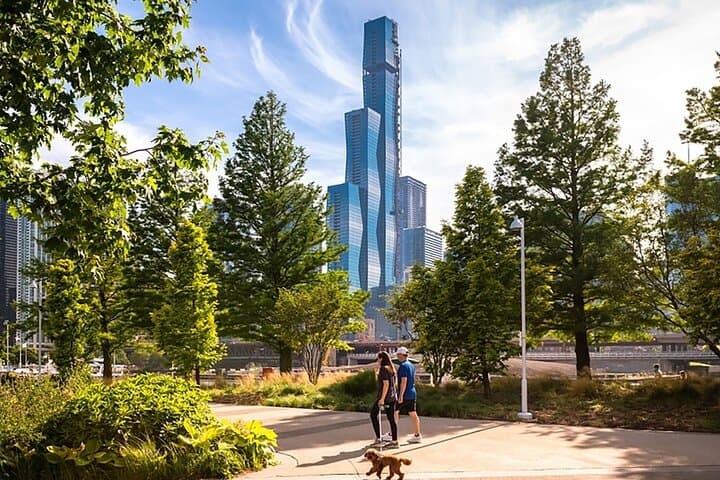
You step off the Wacker Drive curb and the city leans in — glass planes and limestone faces angling toward the river, recent towers rubbing shoulders with turn-of-the-century façades. In 90 minutes the What’s New tour threads the blocks around the Chicago Architecture Center, examining how new construction reshapes sightlines, transit flow and the river’s edge.
You step off the Wacker Drive curb and the city leans in — glass planes and limestone faces angling toward the river, recent towers rubbing shoulders with turn-of-the-century façades. In 90 minutes the What’s New tour threads the blocks around the Chicago Architecture Center, examining how new construction reshapes sightlines, transit flow and the river’s edge.
Chicago’s skyline is a story of reinvention. After the Great Fire of 1871 the city embraced steel-frame technology and, later, curtain-wall glazing; today’s arrivals — like 462 N. Park and the St. Regis — extend that lineage with mixed-use programs, glazed thermal envelopes and rooftop ecology. Beneath your shoes the river corridor tells another tale: engineered banks, reclaimed riverfront, and fill placed during early development sit atop dolomite bedrock that once dictated where heavy masonry could rise.
The guide points out structural choices, material tradeoffs and ornament that signals a building’s intended role in the neighborhood economy. Conversations touch culture too — how residential towers change retail patterns, how preservation ordinances protect key cornices, and how nonprofit architecture education supports public engagement.
Practical guidance: the route is flat city sidewalk with frequent stops; expect 90 minutes of walking and standing. Best times are morning or late afternoon light for façades and cooler temperatures in spring and fall. Bring comfortable shoes, a refillable water bottle and a phone for façade photos. Arrive 10–15 minutes early at the Chicago Architecture Center; tickets support the center’s educational programs, and flexible cancellation is usually available.