THE ADVENTURE COLLECTIVE® · Independent discovery and booking for outdoor travel

A focused 3-day birding loop from Chengdu to Balang Mountain and Wolong that targets Chinese Monal, golden pheasant and other high-altitude species. Early starts, alpine scenery, and practical logistics make this a concentrated wildlife experience.
A focused 3-day birding loop from Chengdu to Balang Mountain and Wolong that targets Chinese Monal, golden pheasant and other high-altitude species. Early starts, alpine scenery, and practical logistics make this a concentrated wildlife experience.
Dawn arrives as a thin ribbon of cloud threads through the firs on Balang Mountain; your driver arrives at 6:00 a.m. and the road bends upward, taking you into that vertical climate where alpine meadows meet primeval forest. Mornings here belong to birds — the iridescent Chinese Monal flashes across a slope, golden pheasants call from understory tangles, and blood pheasants probe mossy rocks.
Verified experiences and guided adventures in the surrounding area.
Operated by pandachinago · Chengdu, Sichuan
Dawn arrives as a thin ribbon of cloud threads through the firs on Balang Mountain; your driver arrives at 6:00 a.m. and the road bends upward, taking you into that vertical climate where alpine meadows meet primeval forest. Mornings here belong to birds — the iridescent Chinese Monal flashes across a slope, golden pheasants call from understory tangles, and blood pheasants probe mossy rocks.
The route links Wolong’s high-altitude habitats to the historic passes once used on the Tea‑Horse Road, a trade artery used for centuries between Tibetan regions and lowland Sichuan. Geology is immediate: steep elevation gradients create microclimates from forested valleys to >3,500 m scree where Tibetan Snowcock circles. The area sits within the Aba Tibetan and Qiang Autonomous Prefecture, and local culture is visible in roadside prayer flags, pastoral grazing, and small mountain lodges.
Practically, the tour follows a steady rhythm — pre-dawn pick-ups, a mid-morning return to the hotel platform for rest and observation, and afternoon stakeouts at different hotspots. Expect early starts, cold mornings even in summer, and long sightlines where patience pays. The package includes two nights’ hotel, meals, hand-ground coffee, and an English species guide; the driver doubles as your onsite support (note: not an English-speaking naturalist).
Bring optics, layer for swift temperature swings, and practice quiet field etiquette: move slowly, keep distance, and leave no trace. Best viewing windows are May–June for breeding plumage and Sept–Oct for comfortable weather — both reward the effort with memorable sightings and alpine light.
easy.
3 days.
Suitable for travelers in average physical shape; involves short walks and low-impact observation from vehicles and platforms
A written English species guide is provided, but the driver serving as on-site support does not speak English; plan to use the guide and translation tools for identification and communication.
May–June shows breeding plumage and active displays; September–October offers cooler, comfortable weather and high visibility—both are recommended windows.
Days are low-impact with short walks, vehicle transfers, and observation from platforms; it’s classified as suitable for all fitness levels.
Both species are among the tour targets and commonly observed in the Wolong/Balang high-altitude habitats, but sightings depend on weather, season, and patience.
Balang Mountain sits on historic trade routes tied to the Tea‑Horse Road and has long connected Sichuan lowlands with Tibetan plateaus.
High-altitude habitats are sensitive—avoid off-trail trampling, don’t feed wildlife, and minimize noise to reduce disturbance during breeding season.
pandachinago operates guided outdoor trips and adventures with an emphasis on safety, stewardship, and memorable experiences.
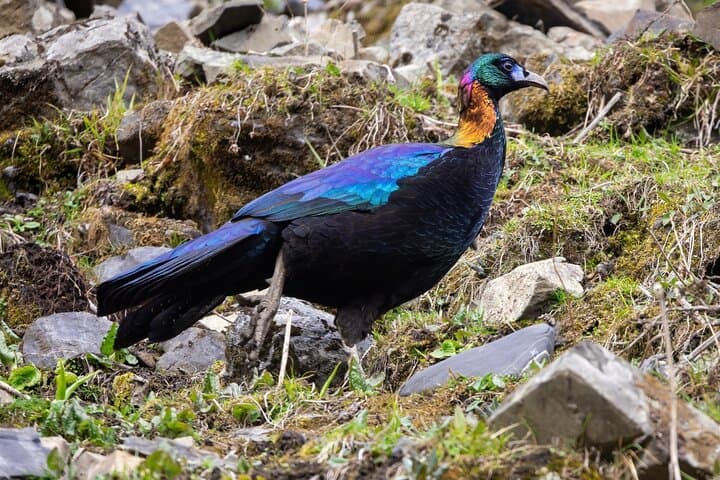


Dawn arrives as a thin ribbon of cloud threads through the firs on Balang Mountain; your driver arrives at 6:00 a.m. and the road bends upward, taking you into that vertical climate where alpine meadows meet primeval forest. Mornings here belong to birds — the iridescent Chinese Monal flashes across a slope, golden pheasants call from understory tangles, and blood pheasants probe mossy rocks.
Dawn arrives as a thin ribbon of cloud threads through the firs on Balang Mountain; your driver arrives at 6:00 a.m. and the road bends upward, taking you into that vertical climate where alpine meadows meet primeval forest. Mornings here belong to birds — the iridescent Chinese Monal flashes across a slope, golden pheasants call from understory tangles, and blood pheasants probe mossy rocks.
The route links Wolong’s high-altitude habitats to the historic passes once used on the Tea‑Horse Road, a trade artery used for centuries between Tibetan regions and lowland Sichuan. Geology is immediate: steep elevation gradients create microclimates from forested valleys to >3,500 m scree where Tibetan Snowcock circles. The area sits within the Aba Tibetan and Qiang Autonomous Prefecture, and local culture is visible in roadside prayer flags, pastoral grazing, and small mountain lodges.
Practically, the tour follows a steady rhythm — pre-dawn pick-ups, a mid-morning return to the hotel platform for rest and observation, and afternoon stakeouts at different hotspots. Expect early starts, cold mornings even in summer, and long sightlines where patience pays. The package includes two nights’ hotel, meals, hand-ground coffee, and an English species guide; the driver doubles as your onsite support (note: not an English-speaking naturalist).
Bring optics, layer for swift temperature swings, and practice quiet field etiquette: move slowly, keep distance, and leave no trace. Best viewing windows are May–June for breeding plumage and Sept–Oct for comfortable weather — both reward the effort with memorable sightings and alpine light.