THE ADVENTURE COLLECTIVE® · Independent discovery and booking for outdoor travel

Leave Reykjavík’s glow behind and join a small private search for the aurora. This 3–5 hour tour pairs local forecasting know-how with short drives to dark sky pockets, plus hot chocolate and a re-use ticket if the sky stays stubborn.
Leave Reykjavík’s glow behind and join a small private search for the aurora. This 3–5 hour tour pairs local forecasting know-how with short drives to dark sky pockets, plus hot chocolate and a re-use ticket if the sky stays stubborn.
The van pulls away from the sodium-lit streets of Reykjavík and the city sighs behind you. Cold air slips under your collar and the guide, friendly and pragmatic, hands out steaming cups of hot chocolate and biscuits while scanning the sky. You feel the smallness of your group—maximum eight people—against the wide Icelandic night; the landscape ahead is an open sheet of black lava fields and low rolling hills that refuse to hold the light.
Verified experiences and guided adventures in the surrounding area.
Operated by David The Guide · Reykjavík, Capital Region
The van pulls away from the sodium-lit streets of Reykjavík and the city sighs behind you. Cold air slips under your collar and the guide, friendly and pragmatic, hands out steaming cups of hot chocolate and biscuits while scanning the sky. You feel the smallness of your group—maximum eight people—against the wide Icelandic night; the landscape ahead is an open sheet of black lava fields and low rolling hills that refuse to hold the light.
This is a search, not a guarantee. The aurora is solar wind made visible: charged particles meeting Earth’s magnetic field and coaxing the upper atmosphere into color. For centuries northern peoples read the lights as omens and stories—today locals treat them like weather: a product of forecasts, cloud cover, and patience. Guides in Reykjavík learned to read coastal fog and clear inland valleys the same way a sailor reads the sea.
Geology shapes the hunt. Iceland’s volcanic plains and low ridgelines create nearby dark pockets of sky within an hour’s drive from the city; those black sand flats and moss-streaked lava flows make excellent foregrounds when the curtains of green begin to move. Culturally, the aurora sits between science and folklore—an outdoor spectacle that has become central to Iceland’s winter tourism economy and to a growing conversation about preserving dark-sky access.
Practicalities matter on a night like this. Tours run seasonally and are weather-dependent: departures vary by month (September and March departures are later; October through February typically start around 9:00 PM) and pickup begins roughly 30 minutes prior. The operator evaluates conditions by 5:00 PM and will cancel if chances are low; a second-use ticket is available for two years if your night yields only stars.
Expect to stand on cold ground and wait—dressing in layers is non-negotiable. Vehicles are private, sanitized, and equipped with onboard Wi‑Fi; guides will drive to multiple locations if necessary and will help with basic photography. Bring a fully charged camera or phone, a tripod if you have one, and an insulating layer for long stillness.
For travelers, the value is in the hunt: the intimate group size, the local knowledge that reduces driving time, and the small comforts—hot drinks, hand sanitizer, and a guide who knows when to stop and simply watch. If the sky decides to perform, you’ll find yourself doing the same—breath held, colors unfurling, and the night momentarily claiming your attention.
easy.
3–5 hours.
Suitable for most fitness levels; you should be comfortable standing outdoors for stretches and walking short distances on uneven ground.
No—auroras are a natural phenomenon and cannot be guaranteed; the operator only runs tours when forecasted chances are high and offers a re-use ticket valid for two years if you don’t see them.
Pickup starts about 30 minutes before departure. Times vary seasonally: September and March departures are around 10:00 PM; October–February typically depart about 9:00 PM.
Tours run approximately 3–5 hours depending on driving time and conditions as guides move to the best dark-sky locations.
Guides choose locations outside Reykjavík with the least light pollution—sites vary by cloud cover and aurora activity and may include coastal headlands or inland valleys within an hour’s drive.
Yes; the tour is suitable for all fitness levels, though standing in cold conditions can be challenging—dress warmly and inform the operator of special requirements when booking.
Yes—if guides take photos of you with the aurora they will send the pictures after the tour; bring your own camera if you want full control of your images.
Icelandic communities have long interpreted the aurora in folklore and song; modern sightings are now part of winter tourism, combining scientific forecasts with local guiding traditions.
Light pollution reduces aurora visibility—support local dark-sky practices, stay on designated roads and parking areas, and pack out all waste to minimize impact.
David The Guide operates guided outdoor trips and adventures with an emphasis on safety, stewardship, and memorable experiences.
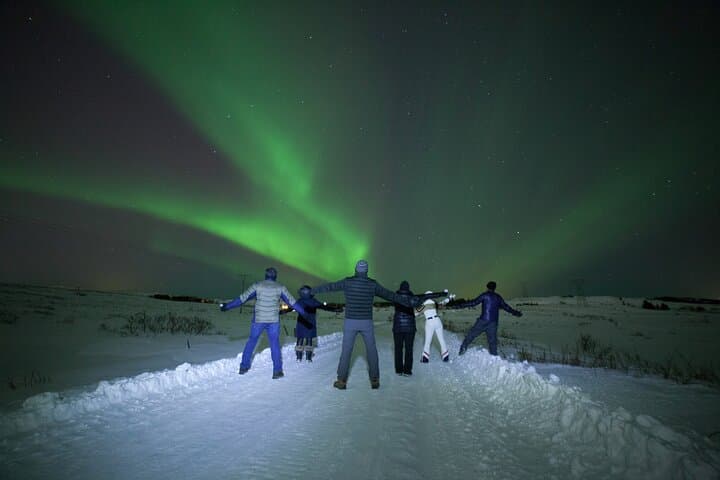


The van pulls away from the sodium-lit streets of Reykjavík and the city sighs behind you. Cold air slips under your collar and the guide, friendly and pragmatic, hands out steaming cups of hot chocolate and biscuits while scanning the sky. You feel the smallness of your group—maximum eight people—against the wide Icelandic night; the landscape ahead is an open sheet of black lava fields and low rolling hills that refuse to hold the light.
The van pulls away from the sodium-lit streets of Reykjavík and the city sighs behind you. Cold air slips under your collar and the guide, friendly and pragmatic, hands out steaming cups of hot chocolate and biscuits while scanning the sky. You feel the smallness of your group—maximum eight people—against the wide Icelandic night; the landscape ahead is an open sheet of black lava fields and low rolling hills that refuse to hold the light.
This is a search, not a guarantee. The aurora is solar wind made visible: charged particles meeting Earth’s magnetic field and coaxing the upper atmosphere into color. For centuries northern peoples read the lights as omens and stories—today locals treat them like weather: a product of forecasts, cloud cover, and patience. Guides in Reykjavík learned to read coastal fog and clear inland valleys the same way a sailor reads the sea.
Geology shapes the hunt. Iceland’s volcanic plains and low ridgelines create nearby dark pockets of sky within an hour’s drive from the city; those black sand flats and moss-streaked lava flows make excellent foregrounds when the curtains of green begin to move. Culturally, the aurora sits between science and folklore—an outdoor spectacle that has become central to Iceland’s winter tourism economy and to a growing conversation about preserving dark-sky access.
Practicalities matter on a night like this. Tours run seasonally and are weather-dependent: departures vary by month (September and March departures are later; October through February typically start around 9:00 PM) and pickup begins roughly 30 minutes prior. The operator evaluates conditions by 5:00 PM and will cancel if chances are low; a second-use ticket is available for two years if your night yields only stars.
Expect to stand on cold ground and wait—dressing in layers is non-negotiable. Vehicles are private, sanitized, and equipped with onboard Wi‑Fi; guides will drive to multiple locations if necessary and will help with basic photography. Bring a fully charged camera or phone, a tripod if you have one, and an insulating layer for long stillness.
For travelers, the value is in the hunt: the intimate group size, the local knowledge that reduces driving time, and the small comforts—hot drinks, hand sanitizer, and a guide who knows when to stop and simply watch. If the sky decides to perform, you’ll find yourself doing the same—breath held, colors unfurling, and the night momentarily claiming your attention.