THE ADVENTURE COLLECTIVE® · Independent discovery and booking for outdoor travel

Walk Charleston after dark with a licensed guide who blends architectural detail, local lore, and Lowcountry history. This 80-minute guided walk moves through cobbled streets and harborfront squares, revealing the city's past and present under gaslight and moon.
Walk Charleston after dark with a licensed guide who blends architectural detail, local lore, and Lowcountry history. This 80-minute guided walk moves through cobbled streets and harborfront squares, revealing the city's past and present under gaslight and moon.
The harbor wind dares you as you step off King Street into lamp-lit alleys and the hush of the Battery. Spanish moss brushes the sidewalks; the city’s colonial bones—brick, Charleston single houses, ironwork—appear softer at night but speak with the same blunt history. Guides move you through narrow lanes and broad squares, pointing out plaques, old house numbers, and the hush where the harbor keeps its own counsel.
Verified experiences and guided adventures in the surrounding area.
The harbor wind dares you as you step off King Street into lamp-lit alleys and the hush of the Battery. Spanish moss brushes the sidewalks; the city’s colonial bones—brick, Charleston single houses, ironwork—appear softer at night but speak with the same blunt history. Guides move you through narrow lanes and broad squares, pointing out plaques, old house numbers, and the hush where the harbor keeps its own counsel.
Charleston grew from a 1670 port to a 19th-century Atlantic hub; the stones underfoot remember mercantile bustle, enslaved labor, and Civil War mobilization. Geologically, the Lowcountry rests on coastal plain sediments—marsh and tidal creeks that shaped trade, defense, and the city's grid. Culturally, the Gullah-Geechee influence threads through food, speech, and public memory; many guides fold local stories, not only architecture, into their narratives.
Expect 80 minutes of mostly flat walking on cobblestone, brick, and sidewalk—some uneven stretches and a few steps at entryways. The route emphasizes historic district sites: manor facades, battery views, and churchyards that take on a different character by lantern glow. Bring a light jacket, sturdy shoes, and a curiosity for folklore and sourced history.
Practical: tours typically cover 1–1.5 miles at an easy pace but can feel longer on uneven stone. Night tours reveal quieter streets and cooler temperatures—ideal for avoiding midday heat—but check weather and book early; groups are often capped. Tip your guide, carry water, and expect rich storytelling balanced with precise historical context.
easy.
1–1.5 hours.
Good for most people who can walk 1–2 miles on uneven pavement; minimal elevation but some standing.
The tour runs about 80 minutes and covers roughly 1–1.5 miles over mostly flat, but sometimes uneven, surfaces.
Older children who can handle the distance and stay close are fine; cobbles and narrow sidewalks make strollers challenging in places.
Light rain may not cancel a tour—check the operator's policy; heavy storms or unsafe conditions usually lead to rescheduling or refunds.
Yes, guides are city-licensed and typically trained to present factual history, including difficult topics such as slavery and the Civil War, while balancing storytelling and context.
Charleston began as a 1670 port and expanded into a major 18th- and 19th-century Atlantic trade center; its built environment reflects colonial, antebellum, and Reconstruction eras.
The historic district is actively preserved through local ordinances and nonprofits; rising seas and coastal erosion are ongoing concerns that shape preservation and tour narratives.
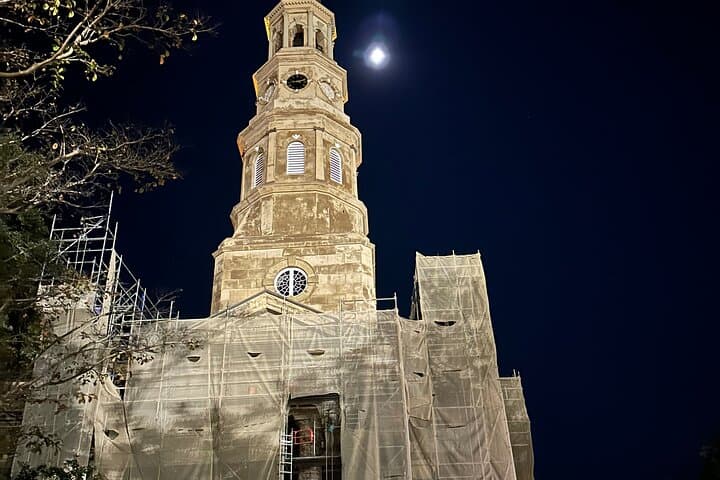
The harbor wind dares you as you step off King Street into lamp-lit alleys and the hush of the Battery. Spanish moss brushes the sidewalks; the city’s colonial bones—brick, Charleston single houses, ironwork—appear softer at night but speak with the same blunt history. Guides move you through narrow lanes and broad squares, pointing out plaques, old house numbers, and the hush where the harbor keeps its own counsel.
The harbor wind dares you as you step off King Street into lamp-lit alleys and the hush of the Battery. Spanish moss brushes the sidewalks; the city’s colonial bones—brick, Charleston single houses, ironwork—appear softer at night but speak with the same blunt history. Guides move you through narrow lanes and broad squares, pointing out plaques, old house numbers, and the hush where the harbor keeps its own counsel.
Charleston grew from a 1670 port to a 19th-century Atlantic hub; the stones underfoot remember mercantile bustle, enslaved labor, and Civil War mobilization. Geologically, the Lowcountry rests on coastal plain sediments—marsh and tidal creeks that shaped trade, defense, and the city's grid. Culturally, the Gullah-Geechee influence threads through food, speech, and public memory; many guides fold local stories, not only architecture, into their narratives.
Expect 80 minutes of mostly flat walking on cobblestone, brick, and sidewalk—some uneven stretches and a few steps at entryways. The route emphasizes historic district sites: manor facades, battery views, and churchyards that take on a different character by lantern glow. Bring a light jacket, sturdy shoes, and a curiosity for folklore and sourced history.
Practical: tours typically cover 1–1.5 miles at an easy pace but can feel longer on uneven stone. Night tours reveal quieter streets and cooler temperatures—ideal for avoiding midday heat—but check weather and book early; groups are often capped. Tip your guide, carry water, and expect rich storytelling balanced with precise historical context.