THE ADVENTURE COLLECTIVE® · Independent discovery and booking for outdoor travel

Walk the Mall, stand at Bethesda Terrace, and end at Strawberry Fields on a focused 75–90 minute guided tour of Central Park. This practical guide outlines what to expect—terrain, history, timing, and tips—to make the most of a short urban hike.
Walk the Mall, stand at Bethesda Terrace, and end at Strawberry Fields on a focused 75–90 minute guided tour of Central Park. This practical guide outlines what to expect—terrain, history, timing, and tips—to make the most of a short urban hike.
You step under a tunnel of American elms on the Mall, the leaves whispering above while the city hums beyond the trees. The guide gestures toward Bethesda Terrace and the fountain — a stone stage facing the lake — and points out Bow Bridge’s low, graceful arch where film crews often linger. The walk threads past the Dairy, along scenic lanes, and finishes at Strawberry Fields and the John Lennon “Imagine” memorial.
Verified experiences and guided adventures in the surrounding area.
You step under a tunnel of American elms on the Mall, the leaves whispering above while the city hums beyond the trees. The guide gestures toward Bethesda Terrace and the fountain — a stone stage facing the lake — and points out Bow Bridge’s low, graceful arch where film crews often linger. The walk threads past the Dairy, along scenic lanes, and finishes at Strawberry Fields and the John Lennon “Imagine” memorial.
Central Park is a planned 19th-century landscape by Frederick Law Olmsted and Calvert Vaux, carved from varied glacial deposits and Manhattan schist to create intentional hills, meadows, and water features. The park’s design blends constructed vistas and naturalistic rock outcrops; its structures—bridges, terraces, and eateries like Tavern on the Green—trace New York’s social life across generations. Culturally the park is both public commons and cinematic backdrop: expect buskers, chess players, and seasonal events that reflect the city’s rhythms.
Practical guidance: expect a mostly flat, urban-walking route of roughly 1.5–2 miles with under 100 ft of gentle elevation change; the guided duration is about 75–90 minutes. Wear comfortable walking shoes—paved and packed dirt paths predominate—and bring water and a compact camera or phone for low-light, shadowed terraces. Morning slots reduce crowds and improve light for photos; late afternoons can be busy around Bethesda and Strawberry Fields. Access is straightforward by subway to multiple entrances; allow time for crossing streets and brief stops for photos and commentary. The tour gives a focused, readable cross-section of Central Park’s geography, history, and street-level culture—ideal for first-time visitors who want more than a passing view.
easy.
1.25–1.5 hours.
Suitable for people in light walking shape; minimal stamina required but expect steady standing and short uphill stretches.
The guided tour runs about 75–90 minutes and covers roughly 1.5–2 miles on mostly paved paths with minimal elevation.
Much of Central Park has paved promenades, but some historic steps and unpaved paths may not be accessible; check with the operator for an accessible-route option.
Public restrooms and seasonal concession stands exist near Bethesda Terrace and the Loeb Boathouse; bring water especially in summer.
Early morning or late afternoon offers softer light and fewer crowds—aim for weeknights or early mornings for the clearest shots.
Central Park was designed in 1858 by Frederick Law Olmsted and Calvert Vaux following the Greensward Plan; it was one of the first major public parks in the United States and shaped urban park design worldwide.
The park is managed by NYC Parks and the Central Park Conservancy; visitors are asked to stay on paths, pack out litter, and avoid feeding wildlife to protect habitats.
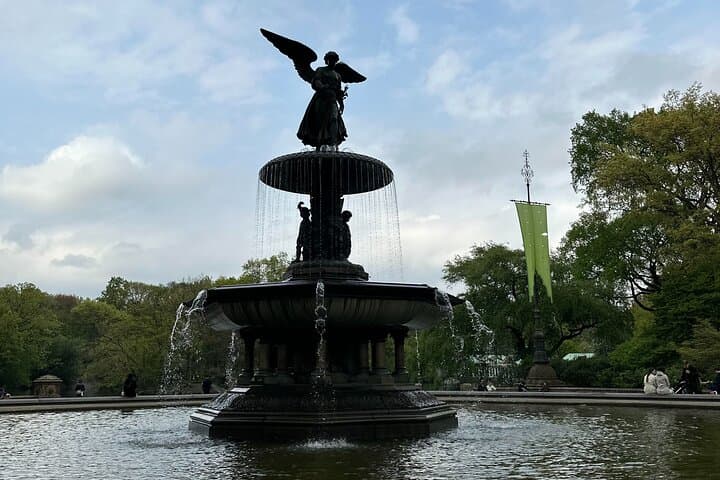
You step under a tunnel of American elms on the Mall, the leaves whispering above while the city hums beyond the trees. The guide gestures toward Bethesda Terrace and the fountain — a stone stage facing the lake — and points out Bow Bridge’s low, graceful arch where film crews often linger. The walk threads past the Dairy, along scenic lanes, and finishes at Strawberry Fields and the John Lennon “Imagine” memorial.
You step under a tunnel of American elms on the Mall, the leaves whispering above while the city hums beyond the trees. The guide gestures toward Bethesda Terrace and the fountain — a stone stage facing the lake — and points out Bow Bridge’s low, graceful arch where film crews often linger. The walk threads past the Dairy, along scenic lanes, and finishes at Strawberry Fields and the John Lennon “Imagine” memorial.
Central Park is a planned 19th-century landscape by Frederick Law Olmsted and Calvert Vaux, carved from varied glacial deposits and Manhattan schist to create intentional hills, meadows, and water features. The park’s design blends constructed vistas and naturalistic rock outcrops; its structures—bridges, terraces, and eateries like Tavern on the Green—trace New York’s social life across generations. Culturally the park is both public commons and cinematic backdrop: expect buskers, chess players, and seasonal events that reflect the city’s rhythms.
Practical guidance: expect a mostly flat, urban-walking route of roughly 1.5–2 miles with under 100 ft of gentle elevation change; the guided duration is about 75–90 minutes. Wear comfortable walking shoes—paved and packed dirt paths predominate—and bring water and a compact camera or phone for low-light, shadowed terraces. Morning slots reduce crowds and improve light for photos; late afternoons can be busy around Bethesda and Strawberry Fields. Access is straightforward by subway to multiple entrances; allow time for crossing streets and brief stops for photos and commentary. The tour gives a focused, readable cross-section of Central Park’s geography, history, and street-level culture—ideal for first-time visitors who want more than a passing view.