THE ADVENTURE COLLECTIVE® · Independent discovery and booking for outdoor travel

See Central Park’s major landmarks without the mileage: a 90-minute guided pedicab tour steers you to Bethesda Terrace, Bow Bridge, Strawberry Fields and hidden corners with local commentary. Learn when to go, what to expect, and how to get the best photos.
See Central Park’s major landmarks without the mileage: a 90-minute guided pedicab tour steers you to Bethesda Terrace, Bow Bridge, Strawberry Fields and hidden corners with local commentary. Learn when to go, what to expect, and how to get the best photos.
You pull up to the corner of West 58th and Broadway, the pedicab’s canopy unfurling like a small, mobile theater. The city’s noise folds around you as the driver steers into Central Park and the trees begin to claim the streetlight’s edges. In 90 minutes you’ll move through broad promenades, under iron bridges and past plazas where history and film minutes are frozen in stone.
Verified experiences and guided adventures in the surrounding area.
Operated by Central Park Attractions · New York, NY
You pull up to the corner of West 58th and Broadway, the pedicab’s canopy unfurling like a small, mobile theater. The city’s noise folds around you as the driver steers into Central Park and the trees begin to claim the streetlight’s edges. In 90 minutes you’ll move through broad promenades, under iron bridges and past plazas where history and film minutes are frozen in stone.
Central Park was laid out by Frederick Law Olmsted and Calvert Vaux in the mid-19th century as a carefully designed public landscape; its rock outcrops are ancient Manhattan schist, the same bedrock that holds up the city. Culture here is visible—museum facades, historic hotels, and the park’s memorials—layered over recreational space used by locals year-round. The pedicab driver doubles as a guide and translator (English, Spanish, French, Russian are common), pointing out movie locations, the Bethesda Terrace, Bow Bridge and lesser-trafficked corners like the Chess & Checkers House.
Practically: expect frequent stops for photos and short walks; the route covers a compact cross-section of the park rather than a full circuit. Pedicabs are wheelchair- and stroller-accessible, and tours are suitable for most fitness levels since you remain seated. Bring a light jacket—wind moves fast across the open Mall—and a charged phone for photos. Tip in cash or card if accepted; drivers rely on gratuities. For quieter visuals, schedule morning slots on weekdays; for people-watching and street performers, late afternoon is best. The pedicab is an efficient, low-effort way to sample Central Park’s landmarks with local commentary—quick, personable, and easy to fold into a broader New York City day plan.
easy.
1.5 hours.
Suitable for most fitness levels; minimal exertion required since the tour is seated with short walks at stops.
Most pedicabs seat up to three passengers comfortably; confirm group size when booking to reserve the right vehicle.
Yes—pedicabs and routes are listed as wheelchair-accessible, but notify the operator at booking to arrange the appropriate vehicle and pickup location.
Tours commonly offer English, Spanish, French and Russian; language options should be selected during booking if needed.
Full refunds are typically available if you cancel at least 24 hours before the scheduled start time; check your booking confirmation for specifics.
Central Park was designed in the 1850s by Olmsted and Vaux as one of the first major landscaped public parks in the United States, sculpting paths and lakes into Manhattan schist outcrops.
The Central Park Conservancy manages most care in partnership with NYC Parks—stick to paths, pack out trash, and avoid feeding wildlife to minimize impact.
Central Park Attractions operates guided outdoor trips and adventures with an emphasis on safety, stewardship, and memorable experiences.


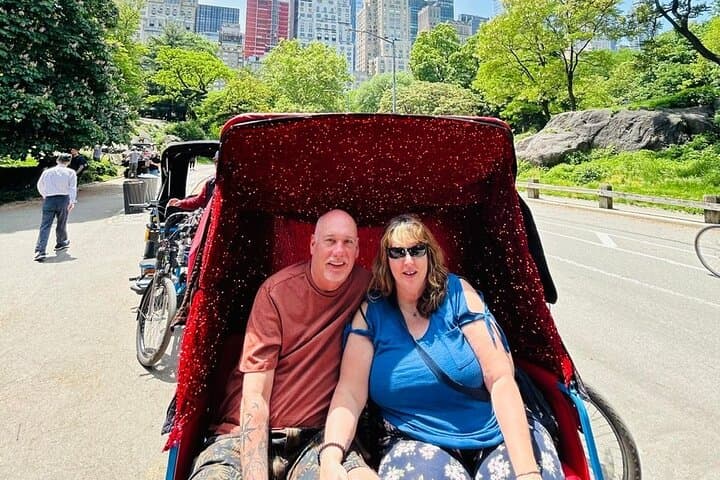

You pull up to the corner of West 58th and Broadway, the pedicab’s canopy unfurling like a small, mobile theater. The city’s noise folds around you as the driver steers into Central Park and the trees begin to claim the streetlight’s edges. In 90 minutes you’ll move through broad promenades, under iron bridges and past plazas where history and film minutes are frozen in stone.
You pull up to the corner of West 58th and Broadway, the pedicab’s canopy unfurling like a small, mobile theater. The city’s noise folds around you as the driver steers into Central Park and the trees begin to claim the streetlight’s edges. In 90 minutes you’ll move through broad promenades, under iron bridges and past plazas where history and film minutes are frozen in stone.
Central Park was laid out by Frederick Law Olmsted and Calvert Vaux in the mid-19th century as a carefully designed public landscape; its rock outcrops are ancient Manhattan schist, the same bedrock that holds up the city. Culture here is visible—museum facades, historic hotels, and the park’s memorials—layered over recreational space used by locals year-round. The pedicab driver doubles as a guide and translator (English, Spanish, French, Russian are common), pointing out movie locations, the Bethesda Terrace, Bow Bridge and lesser-trafficked corners like the Chess & Checkers House.
Practically: expect frequent stops for photos and short walks; the route covers a compact cross-section of the park rather than a full circuit. Pedicabs are wheelchair- and stroller-accessible, and tours are suitable for most fitness levels since you remain seated. Bring a light jacket—wind moves fast across the open Mall—and a charged phone for photos. Tip in cash or card if accepted; drivers rely on gratuities. For quieter visuals, schedule morning slots on weekdays; for people-watching and street performers, late afternoon is best. The pedicab is an efficient, low-effort way to sample Central Park’s landmarks with local commentary—quick, personable, and easy to fold into a broader New York City day plan.