THE ADVENTURE COLLECTIVE® · Independent discovery and booking for outdoor travel

Descend into two of the Yucatán’s most striking cenotes—The Pit and Nicte Ha—on a guided, two-dive trip from Playa del Carmen. Expect deep vertical profiles, haloclines, cavern ceilings, and required advanced certification.
Descend into two of the Yucatán’s most striking cenotes—The Pit and Nicte Ha—on a guided, two-dive trip from Playa del Carmen. Expect deep vertical profiles, haloclines, cavern ceilings, and required advanced certification.
A single shaft of sunlight slices the cenote’s mouth and paints the water with a pale column that seems to reach for the surface. In The Pit, that column narrows as you descend; below, a cloud of hydrogen sulfide marks a deep, quiet horizon. At Nicte Ha the world opens into a crescent well, its ceiling heavy and carved with fossilized ridges that feel older than time.
Verified experiences and guided adventures in the surrounding area.
Operated by Diversland Mexico · Playa del Carmen, Quintana Roo
A single shaft of sunlight slices the cenote’s mouth and paints the water with a pale column that seems to reach for the surface. In The Pit, that column narrows as you descend; below, a cloud of hydrogen sulfide marks a deep, quiet horizon. At Nicte Ha the world opens into a crescent well, its ceiling heavy and carved with fossilized ridges that feel older than time.
These cenotes sit in the Yucatán’s limestone plateau, where collapsed sinkholes expose passages of freshwater and haloclines—layers of differing salinity—that shimmer when light crosses them. Cenotes were vital to Maya communities: sources of potable water and sites of ritual. Geologically, they’re the visible mouths of a vast karst system that includes Mexico’s longest underwater cave networks; divers come for the clear visibility, complex caves, and distinctive formations.
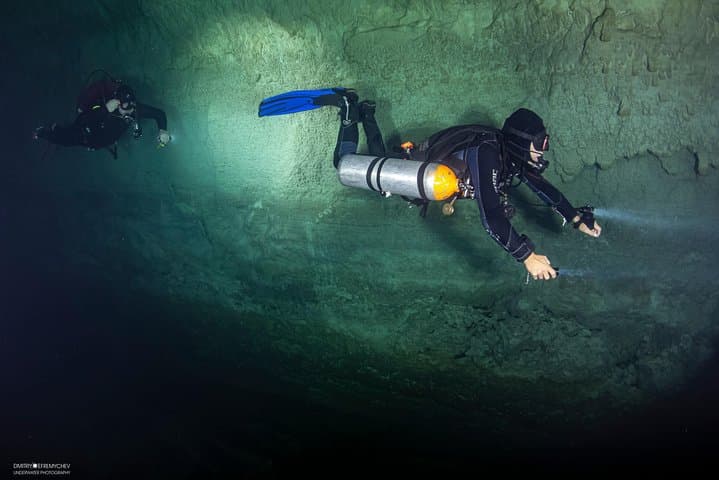
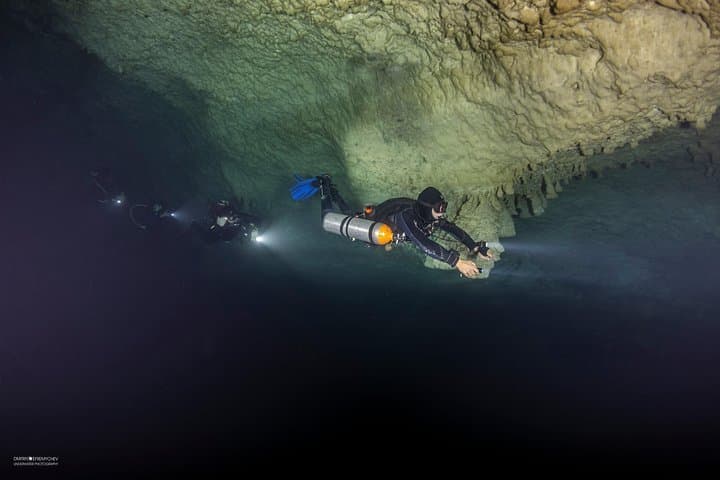
Expect a technical day: two guided dives, boat or short surface approaches, and cavern-style navigation. The Pit delivers dramatic vertical profiles and deep haloclines; Nicte Ha offers cavern ceilings, stalactites, and fossil-rich walls. Local guides emphasize low-impact practices—no sunscreen, slow finning—because these systems are fragile and visibility depends on careful behavior.
Practical notes: this tour requires Advanced Open Water (or equivalent), basic cave/cavern skills, and a health declaration. Bring your certification card, dive computer, and a backup light; a 3–5 mm wetsuit is usually sufficient. Allow at least 24 hours after diving before flying. The operation typically supplies tanks, weights, belts, bottled water, and transport from Playa del Carmen; still, pack snacks, dry clothes, and patience—the cenotes reward disciplined divers with extraordinary underwater clarity and forms that feel alive under your beams.
challenging.
4–6 hours (tour time ~5 hours).
Moderate cardiovascular fitness with comfort in confined underwater spaces; ability to carry basic gear and follow safety briefings.
Advanced Open Water Diver (PADI or equivalent) is required; operators may also require proof of experience in deep or cavern dives.
The Pit reaches 25–32 meters where a sulfide cloud forms; depths can be greater in the Dos Ojos system—expect deep profiles and appropriate depth planning.
Operators typically provide tanks, weights, and belts; bring or rent a dive computer, torch, and personal exposure suit if not included.
Yes—hotel pickup in Playa del Carmen center and Playacar is usually included in the tour.
Cenotes were central to Maya life—sources of water and ceremonial sites—and many near Tulum and Playa del Carmen contain archaeological and fossil deposits.
These aquifers are fragile; avoid sunscreens, minimize disturbance of sediments, and follow guides’ low-impact rules to protect water clarity and formations.
Diversland Mexico operates guided outdoor trips and adventures with an emphasis on safety, stewardship, and memorable experiences.
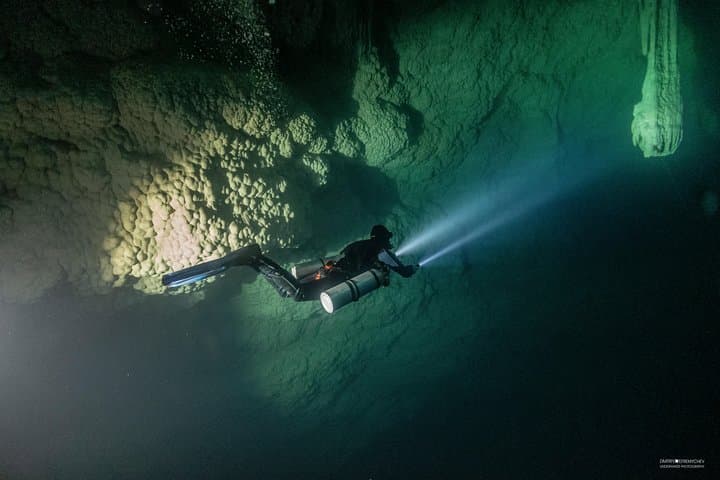
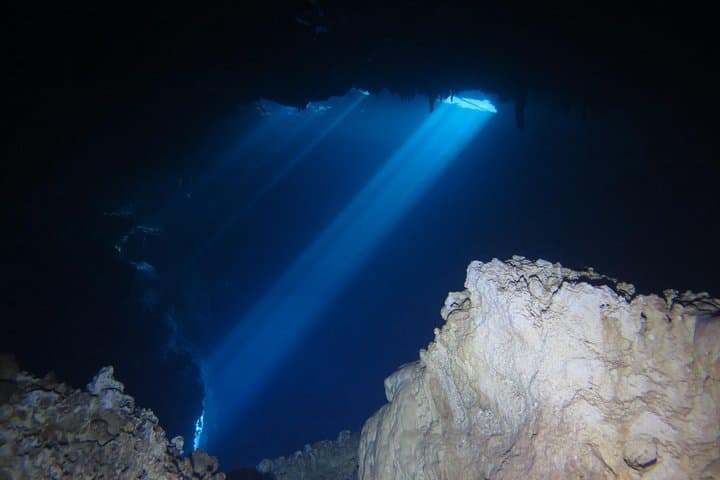
A single shaft of sunlight slices the cenote’s mouth and paints the water with a pale column that seems to reach for the surface. In The Pit, that column narrows as you descend; below, a cloud of hydrogen sulfide marks a deep, quiet horizon. At Nicte Ha the world opens into a crescent well, its ceiling heavy and carved with fossilized ridges that feel older than time.
A single shaft of sunlight slices the cenote’s mouth and paints the water with a pale column that seems to reach for the surface. In The Pit, that column narrows as you descend; below, a cloud of hydrogen sulfide marks a deep, quiet horizon. At Nicte Ha the world opens into a crescent well, its ceiling heavy and carved with fossilized ridges that feel older than time.
These cenotes sit in the Yucatán’s limestone plateau, where collapsed sinkholes expose passages of freshwater and haloclines—layers of differing salinity—that shimmer when light crosses them. Cenotes were vital to Maya communities: sources of potable water and sites of ritual. Geologically, they’re the visible mouths of a vast karst system that includes Mexico’s longest underwater cave networks; divers come for the clear visibility, complex caves, and distinctive formations.
Expect a technical day: two guided dives, boat or short surface approaches, and cavern-style navigation. The Pit delivers dramatic vertical profiles and deep haloclines; Nicte Ha offers cavern ceilings, stalactites, and fossil-rich walls. Local guides emphasize low-impact practices—no sunscreen, slow finning—because these systems are fragile and visibility depends on careful behavior.
Practical notes: this tour requires Advanced Open Water (or equivalent), basic cave/cavern skills, and a health declaration. Bring your certification card, dive computer, and a backup light; a 3–5 mm wetsuit is usually sufficient. Allow at least 24 hours after diving before flying. The operation typically supplies tanks, weights, belts, bottled water, and transport from Playa del Carmen; still, pack snacks, dry clothes, and patience—the cenotes reward disciplined divers with extraordinary underwater clarity and forms that feel alive under your beams.