THE ADVENTURE COLLECTIVE® · Independent discovery and booking for outdoor travel

A guided two‑hour stroll through Carmel‑by‑the‑Sea connects you to its artist colony roots, fairytale cottages, and hidden courtyards. Expect compact streets, local lore about builders and film stars, and plenty of gallery stops.
A guided two‑hour stroll through Carmel‑by‑the‑Sea connects you to its artist colony roots, fairytale cottages, and hidden courtyards. Expect compact streets, local lore about builders and film stars, and plenty of gallery stops.
You step off Ocean Avenue into a village that keeps its own time: salt on the air, cypress leaning like curious audience members, and the quiet chatter of dogs striding beside their people.
Verified experiences and guided adventures in the surrounding area.
Operated by California Legacy Tours · Carmel-by-the-Sea, California
You step off Ocean Avenue into a village that keeps its own time: salt on the air, cypress leaning like curious audience members, and the quiet chatter of dogs striding beside their people.
Over two hours a local guide threads you through narrow lanes and secret courtyards, pausing beneath the immense Live Oak in Devendorf Park and in front of the small, slate‑roofed Church of the Wayfarer. The walk stitches together the stories that made Carmel—an early 20th‑century artist colony that incorporated in 1916—and points out landmarks like the Golden Bough theater site and the European‑style L'Auberge Carmel.
Geology and coast shape the experience: the Monterey Peninsula’s rocky headlands and sandy coves are the visible edges of tectonic uplift and wave‑cut action, and those forces help explain why an artist village grew where it did—dramatic light, dramatic land.
The cultural rhythm is intimate: independent galleries, a long‑running Art Association, and a town that famously celebrates dogs. You’ll hear local lore—about a teenage builder turned master craftsman, about film stars who left civic marks—and see the quirky civic humor that colors daily life here.
Practical guidance: meet at the Pine Inn garden courtyard (Ocean & Lincoln); the route covers mostly paved village streets and short garden paths, suitable for most fitness levels. Wear comfortable walking shoes, layer for coastal breeze, and bring water and a camera. Tours run in small groups (up to ~16), so mornings and weekdays generally feel less crowded. The guide’s stories are the map—follow them and let the town reveal its architecture, art, and oddities.
easy.
2 hours.
Basic walking fitness; able to stand and walk up to 2 miles with short pauses.
The tour starts in the Garden Courtyard of the Pine Inn at Ocean Avenue & Lincoln Street and ends in front of the Carmel Art Association on Dolores Street.
The tour is stroller accessible and service animals are allowed; many visitors bring dogs, though check with the guide about narrow passages.
It’s an easy, mostly paved route with short garden paths and optional brief steps—suitable for most ages and fitness levels.
Guides point out galleries and studios and may pause outside; extended gallery visits are limited by the tour schedule but you can return afterward.
Carmel grew from an early 1900s artist colony and formally incorporated in 1916; its civic life was shaped by artists, theater founders, and occasional film personalities who left architectural marks.
Carmel manages fragile coastal habitat through dune restoration and strict development controls; visitors are asked to stay on paths, pack out trash, and respect protected plant communities.
California Legacy Tours operates guided outdoor trips and adventures with an emphasis on safety, stewardship, and memorable experiences.


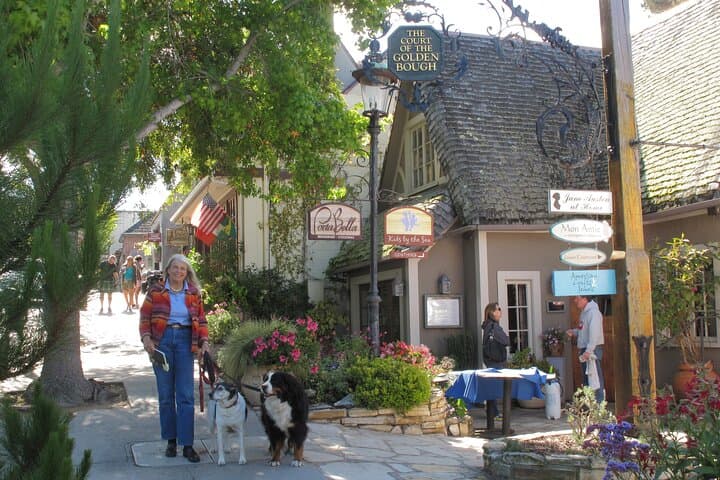

You step off Ocean Avenue into a village that keeps its own time: salt on the air, cypress leaning like curious audience members, and the quiet chatter of dogs striding beside their people.
You step off Ocean Avenue into a village that keeps its own time: salt on the air, cypress leaning like curious audience members, and the quiet chatter of dogs striding beside their people.
Over two hours a local guide threads you through narrow lanes and secret courtyards, pausing beneath the immense Live Oak in Devendorf Park and in front of the small, slate‑roofed Church of the Wayfarer. The walk stitches together the stories that made Carmel—an early 20th‑century artist colony that incorporated in 1916—and points out landmarks like the Golden Bough theater site and the European‑style L'Auberge Carmel.
Geology and coast shape the experience: the Monterey Peninsula’s rocky headlands and sandy coves are the visible edges of tectonic uplift and wave‑cut action, and those forces help explain why an artist village grew where it did—dramatic light, dramatic land.
The cultural rhythm is intimate: independent galleries, a long‑running Art Association, and a town that famously celebrates dogs. You’ll hear local lore—about a teenage builder turned master craftsman, about film stars who left civic marks—and see the quirky civic humor that colors daily life here.
Practical guidance: meet at the Pine Inn garden courtyard (Ocean & Lincoln); the route covers mostly paved village streets and short garden paths, suitable for most fitness levels. Wear comfortable walking shoes, layer for coastal breeze, and bring water and a camera. Tours run in small groups (up to ~16), so mornings and weekdays generally feel less crowded. The guide’s stories are the map—follow them and let the town reveal its architecture, art, and oddities.