THE ADVENTURE COLLECTIVE® · Independent discovery and booking for outdoor travel

A focused 2–3 hour guided walk through Carara National Park highlights a rare transition from dry to wet tropical forest and offers reliable wildlife viewing, including scarlet macaws. Expect flat trails, expert interpretation, and quick tropical showers.
A focused 2–3 hour guided walk through Carara National Park highlights a rare transition from dry to wet tropical forest and offers reliable wildlife viewing, including scarlet macaws. Expect flat trails, expert interpretation, and quick tropical showers.
Early morning in Carara feels like the forest waking with purpose: a chorus of branches, the distant screech of a scarlet macaw and humid air that clings to your jacket. The trailhead opens onto flat, looping paths where dry-tropical ridges press up against wetter, denser lowland forest — a visible ecological seam that makes this park exceptional.
Verified experiences and guided adventures in the surrounding area.
Operated by G&R Adventures · Tárcoles, Puntarenas
Early morning in Carara feels like the forest waking with purpose: a chorus of branches, the distant screech of a scarlet macaw and humid air that clings to your jacket. The trailhead opens onto flat, looping paths where dry-tropical ridges press up against wetter, denser lowland forest — a visible ecological seam that makes this park exceptional.
Carara was set aside in the late 1970s to protect one of the last extensive patches of Pacific lowland forest in the region. Geologically the park sits on coastal alluvium and old river terraces, which combined with seasonal rainfall creates distinct bands of vegetation. Culturally, the area has long been used by nearby coastal communities for fishing and small-scale agriculture; today ecotourism supports local guides and conservation efforts.
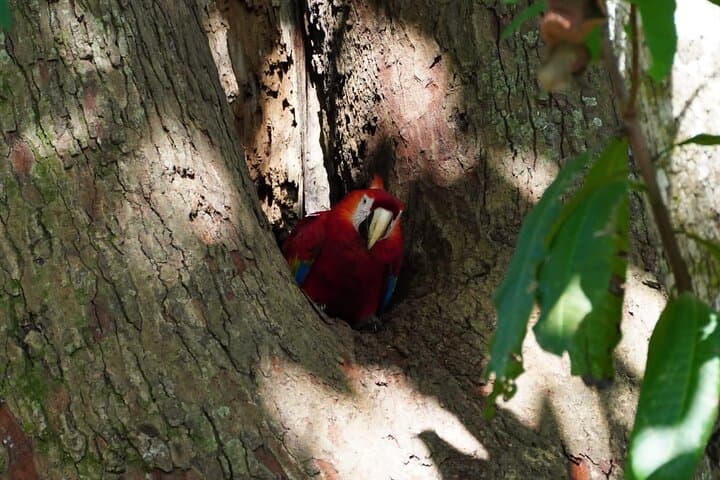
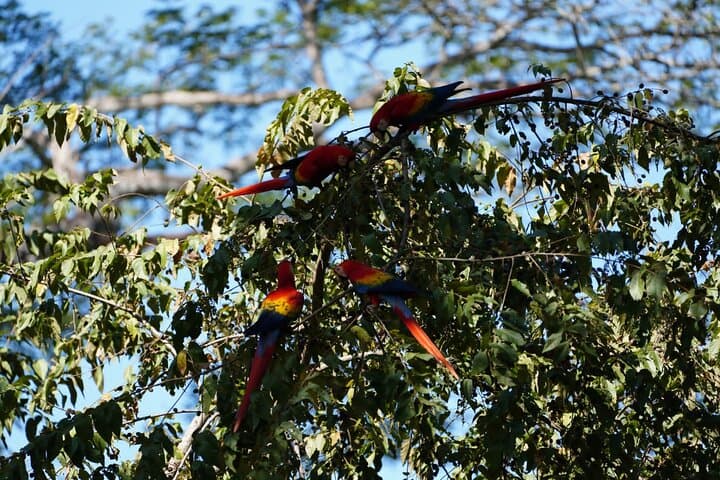
On a guided 2–3 hour visit expect close birdwatching — scarlet macaws are often a highlight — plus monkey sightings, snake records in leaf litter and the constant movement of smaller passerines. The guide will point out plants, explain why the dry-to-wet transition matters, and position you for the best light for photos.
Practical tips: walk steady but slow, keep to the trail, and bring lightweight rain protection — showers can come fast. Binoculars and a telephoto lens pay off; the telescopes provided at the meeting point are a bonus. The route is generally flat and accessible, suitable for most fitness levels, but muddy patches and roots are common after rain. Leave no trace and respect wildlife-distance guidelines so the park stays wild for the next party of travelers.
easy.
2–3 hours.
Suitable for most people who can walk on uneven ground for a couple of hours; minimal elevation change.
Yes—the tour price includes the park entrance ticket and a telescope for distant viewing.
The route is generally flat and indicated as wheelchair accessible at the park entrance, but muddy or root-covered sections can be encountered after rain.
Early morning visits during the dry season (roughly December–April) tend to offer the best early activity and clearer viewing conditions.
Most travelers combine the short drive from Jaco (approx. 30–45 minutes) or a 1.5–2 hour drive from San José; organized tours and local shuttles are common options.
Carara was declared a national park in the late 1970s to protect one of the last coastal lowland forest remnants on Costa Rica’s central Pacific coast.
The park is important for connecting fragmented habitats along the Pacific slope; visitors help by staying on trails, not feeding wildlife and following guide instructions.
G&R Adventures operates guided outdoor trips and adventures with an emphasis on safety, stewardship, and memorable experiences.
Early morning in Carara feels like the forest waking with purpose: a chorus of branches, the distant screech of a scarlet macaw and humid air that clings to your jacket. The trailhead opens onto flat, looping paths where dry-tropical ridges press up against wetter, denser lowland forest — a visible ecological seam that makes this park exceptional.
Early morning in Carara feels like the forest waking with purpose: a chorus of branches, the distant screech of a scarlet macaw and humid air that clings to your jacket. The trailhead opens onto flat, looping paths where dry-tropical ridges press up against wetter, denser lowland forest — a visible ecological seam that makes this park exceptional.
Carara was set aside in the late 1970s to protect one of the last extensive patches of Pacific lowland forest in the region. Geologically the park sits on coastal alluvium and old river terraces, which combined with seasonal rainfall creates distinct bands of vegetation. Culturally, the area has long been used by nearby coastal communities for fishing and small-scale agriculture; today ecotourism supports local guides and conservation efforts.
On a guided 2–3 hour visit expect close birdwatching — scarlet macaws are often a highlight — plus monkey sightings, snake records in leaf litter and the constant movement of smaller passerines. The guide will point out plants, explain why the dry-to-wet transition matters, and position you for the best light for photos.
Practical tips: walk steady but slow, keep to the trail, and bring lightweight rain protection — showers can come fast. Binoculars and a telephoto lens pay off; the telescopes provided at the meeting point are a bonus. The route is generally flat and accessible, suitable for most fitness levels, but muddy patches and roots are common after rain. Leave no trace and respect wildlife-distance guidelines so the park stays wild for the next party of travelers.