THE ADVENTURE COLLECTIVE® · Independent discovery and booking for outdoor travel

Two days in Cappadocia condense geology, history and craft into a single loop: Uçhisar and Zelve’s chimneys, a pottery demo in Avanos, a river hike through Ihlara Canyon and the eerie comfort of an underground city. This guide tells you what to expect and how to prepare.
Two days in Cappadocia condense geology, history and craft into a single loop: Uçhisar and Zelve’s chimneys, a pottery demo in Avanos, a river hike through Ihlara Canyon and the eerie comfort of an underground city. This guide tells you what to expect and how to prepare.
Morning light in Cappadocia does its own slow reveal: low clouds lift off the plateaus, and a bruised-pink sky exposes rows of carved cones and mushroom-topped chimneys that look as if someone stacked a cathedral on a forest of candles. On this two-day Red and Green loop you move through that strange geology like a reader turning chapters — each stop rewrites what you thought you knew about landscape, history and human adaptability.
Verified experiences and guided adventures in the surrounding area.
Operated by Stoneland Travel · Göreme, Nevşehir
Morning light in Cappadocia does its own slow reveal: low clouds lift off the plateaus, and a bruised-pink sky exposes rows of carved cones and mushroom-topped chimneys that look as if someone stacked a cathedral on a forest of candles. On this two-day Red and Green loop you move through that strange geology like a reader turning chapters — each stop rewrites what you thought you knew about landscape, history and human adaptability.
Day one threads Uçhisar’s rock-hewn castle and the sharp pinnacles of Zelve Open Air Museum before dropping you into Çavuşin, where a near-deserted Greek village and the Church of John the Baptist look out over Rose Valley. Pasabag delivers the classic three-headed chimneys; Devrent offers playful, almost sculptural forms. Midday brings a pottery demonstration in Avanos, where red Kızılırmak clay and millennia of craft converge in a spinning wheel’s rhythm.
On day two the tour turns green: Göreme Panorama first, then underground. The subterranean city you visit was a refuge and pantry, carved to hide whole communities from invasion. From there, the Melendiz River has cut Ihlara Valley into an 80-meter-deep gorge over millions of years; your guided 3.5 km hike follows a channel of poplars and painted cave churches — about 1 hour 15 minutes of easy to moderate walking — before lunch beside the river. The route finishes at Selime Monastery, a multi-level complex that reads like a rock-bound citadel.
Geology here is blunt and readable: soft tufa from volcanic ash erodes fast, while harder caps resist, giving the fairy chimneys their hats. Culture sits inside that geology — pigeon houses carved into slopes were practical fertilizer systems, and carpets and pottery carry local stories in knot and glaze.
Practical edge: this itinerary is compact but paced, with hotel pickup and professional English guide included, and lunches served at local restaurants. Expect uneven paths, short stair climbs in carved interiors, and cool underground temperatures in caves and cities. Bring sturdy footwear, a layered jacket for early mornings and canyon shade, and cash for small museum fees or an extra tea in Avanos.
Timing tips: start your day early for soft light at panoramas, and save energy for the stair climbs at Selime. Respect fragile formations — don’t climb on fragile chimneys — and leave space for local craft demonstrations; they’re not only tourist theater but living traditions.
This two-day loop covers the geological headlines of Cappadocia while threading in hands-on culture and a sustained river hike — an efficient, tactile way to grasp why people settled here and how the land continues to shape daily life.
moderate.
2 days (approx. 15 hours total).
Suitable for travelers who can walk 3–4 km on uneven terrain and manage short stair climbs; not strenuous but requires steady footing.
Yes — hotel pickup and drop-off are included; pickup windows vary by town (Göreme around 09:30, Uçhisar later). Provide your hotel details at booking.
Some sites include admission as noted by the guide; expect to pay for a few entrances or museum fees not covered by the operator and bring cash just in case.
Yes — the supplier allows switching the sequence of the two-day tours if needed; note this in your booking details.
Families can join; infants may ride in strollers where paths allow, but many sites have steps and uneven ground, so plan for carrying young children at some points.
The guided section is approximately 3.5 km and takes about 1 hour 15 minutes along riverside trails with some mild elevation change.
Underground cities and cave churches are cooler and often damp — wear closed-toe shoes and a light layer to stay comfortable underground.
The region’s tufa formations were shaped by volcanic eruptions and later used by Hittites and Byzantine Christians; underground cities served as refuges during invasions.
Erosion and foot traffic threaten fragile tufa formations; stick to marked paths, avoid climbing on chimneys, and support local conservation-minded guides and artisans.
Stoneland Travel operates guided outdoor trips and adventures with an emphasis on safety, stewardship, and memorable experiences.
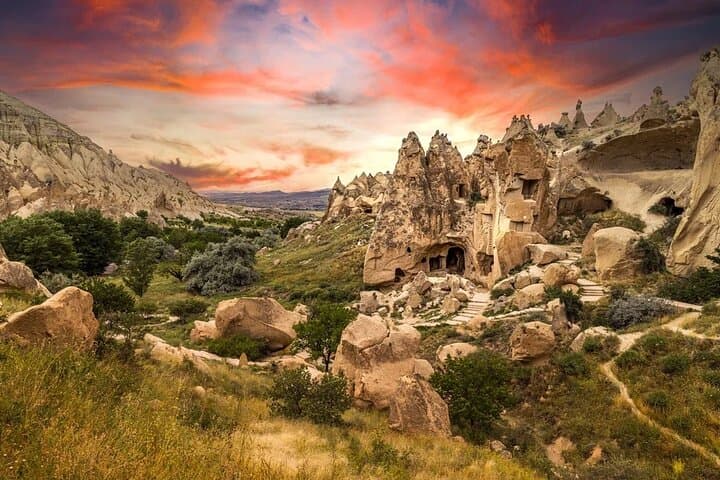


Morning light in Cappadocia does its own slow reveal: low clouds lift off the plateaus, and a bruised-pink sky exposes rows of carved cones and mushroom-topped chimneys that look as if someone stacked a cathedral on a forest of candles. On this two-day Red and Green loop you move through that strange geology like a reader turning chapters — each stop rewrites what you thought you knew about landscape, history and human adaptability.
Morning light in Cappadocia does its own slow reveal: low clouds lift off the plateaus, and a bruised-pink sky exposes rows of carved cones and mushroom-topped chimneys that look as if someone stacked a cathedral on a forest of candles. On this two-day Red and Green loop you move through that strange geology like a reader turning chapters — each stop rewrites what you thought you knew about landscape, history and human adaptability.
Day one threads Uçhisar’s rock-hewn castle and the sharp pinnacles of Zelve Open Air Museum before dropping you into Çavuşin, where a near-deserted Greek village and the Church of John the Baptist look out over Rose Valley. Pasabag delivers the classic three-headed chimneys; Devrent offers playful, almost sculptural forms. Midday brings a pottery demonstration in Avanos, where red Kızılırmak clay and millennia of craft converge in a spinning wheel’s rhythm.
On day two the tour turns green: Göreme Panorama first, then underground. The subterranean city you visit was a refuge and pantry, carved to hide whole communities from invasion. From there, the Melendiz River has cut Ihlara Valley into an 80-meter-deep gorge over millions of years; your guided 3.5 km hike follows a channel of poplars and painted cave churches — about 1 hour 15 minutes of easy to moderate walking — before lunch beside the river. The route finishes at Selime Monastery, a multi-level complex that reads like a rock-bound citadel.
Geology here is blunt and readable: soft tufa from volcanic ash erodes fast, while harder caps resist, giving the fairy chimneys their hats. Culture sits inside that geology — pigeon houses carved into slopes were practical fertilizer systems, and carpets and pottery carry local stories in knot and glaze.
Practical edge: this itinerary is compact but paced, with hotel pickup and professional English guide included, and lunches served at local restaurants. Expect uneven paths, short stair climbs in carved interiors, and cool underground temperatures in caves and cities. Bring sturdy footwear, a layered jacket for early mornings and canyon shade, and cash for small museum fees or an extra tea in Avanos.
Timing tips: start your day early for soft light at panoramas, and save energy for the stair climbs at Selime. Respect fragile formations — don’t climb on fragile chimneys — and leave space for local craft demonstrations; they’re not only tourist theater but living traditions.
This two-day loop covers the geological headlines of Cappadocia while threading in hands-on culture and a sustained river hike — an efficient, tactile way to grasp why people settled here and how the land continues to shape daily life.