THE ADVENTURE COLLECTIVE® · Independent discovery and booking for outdoor travel

Train with a professional capoeira teacher in Abrantes, Bahia, then build and play your own berimbau at a local factory. This private 4-hour experience combines physical practice with hands-on cultural learning.
Train with a professional capoeira teacher in Abrantes, Bahia, then build and play your own berimbau at a local factory. This private 4-hour experience combines physical practice with hands-on cultural learning.
Feet find the floor before the first call-and-response; the berimbau hums like a single-stringed compass pointing toward the roda. At Capoeira Engenho in Abrantes, students move through warm-up, stretching and acrobatic sequences beneath an open-air roof while the Atlantic breeze skims the training space.
Verified experiences and guided adventures in the surrounding area.
Operated by BAHIA VACATION DAY TOURS · Salvador, Bahia
Feet find the floor before the first call-and-response; the berimbau hums like a single-stringed compass pointing toward the roda. At Capoeira Engenho in Abrantes, students move through warm-up, stretching and acrobatic sequences beneath an open-air roof while the Atlantic breeze skims the training space.
This is Bahia — the cradle of capoeira. Brought to Brazil by enslaved West Africans, capoeira evolved here into a disguised combat art that doubled as music, dance and social resistance. The day pairs physical instruction with cultural context: you learn kicks, balance and flow, then travel to a local berimbau workshop where you build and learn to play the instrument that directs the roda’s rhythm.
Expect a practical, hands-on schedule: 2 hours of guided practice, a short break, and the factory excursion; optional evening participation in a community training on select days. The training is energetic and repetitive — practice will tax core strength, hip mobility and cardiovascular fitness more than technical gymnastics. Trainers accommodate beginners and non-Portuguese speakers; a translator can be arranged.
Plan logistics around heat and humidity — morning or late-afternoon sessions are cooler. Wear breathable athletic clothing, bring water and a small towel. Note medical restrictions: not recommended for pregnant visitors or those with serious back or heart conditions. Cancellation is allowed up to 24 hours in advance. Leave the roda with a new rhythm in your step, a handmade berimbau to take home, and a clearer sense of how place, history and movement are braided together in Bahian life.
moderate.
4 hours.
Moderate fitness: able to perform repeated bodyweight movements, basic cardio and bending/twisting without pain
No. The class is suitable for beginners and focuses on fundamentals; instructors adapt drills to each student’s level.
Yes — the workshop includes materials and instruction so you leave with a playable berimbau and basic techniques.
A translator can be arranged on request; many instructors also teach in English or use demonstrations to bridge language gaps.
The activity is not recommended for pregnant visitors or those with serious back or cardiovascular conditions; disclose any concerns at booking.
Capoeira developed in Bahia among enslaved Africans as a disguised martial art and has remained central to Afro-Brazilian cultural identity in Salvador and surrounding towns.
Support local teachers and workshops to keep cultural traditions viable; avoid single-use plastics and respect training spaces and local neighborhoods.
BAHIA VACATION DAY TOURS operates guided outdoor trips and adventures with an emphasis on safety, stewardship, and memorable experiences.
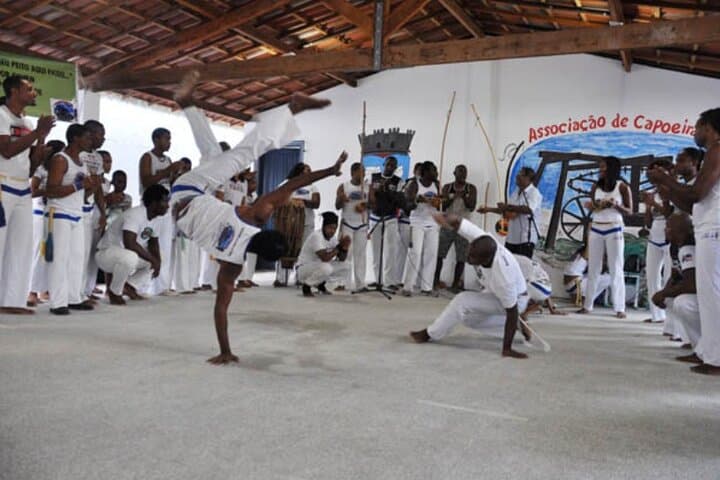


Feet find the floor before the first call-and-response; the berimbau hums like a single-stringed compass pointing toward the roda. At Capoeira Engenho in Abrantes, students move through warm-up, stretching and acrobatic sequences beneath an open-air roof while the Atlantic breeze skims the training space.
Feet find the floor before the first call-and-response; the berimbau hums like a single-stringed compass pointing toward the roda. At Capoeira Engenho in Abrantes, students move through warm-up, stretching and acrobatic sequences beneath an open-air roof while the Atlantic breeze skims the training space.
This is Bahia — the cradle of capoeira. Brought to Brazil by enslaved West Africans, capoeira evolved here into a disguised combat art that doubled as music, dance and social resistance. The day pairs physical instruction with cultural context: you learn kicks, balance and flow, then travel to a local berimbau workshop where you build and learn to play the instrument that directs the roda’s rhythm.
Expect a practical, hands-on schedule: 2 hours of guided practice, a short break, and the factory excursion; optional evening participation in a community training on select days. The training is energetic and repetitive — practice will tax core strength, hip mobility and cardiovascular fitness more than technical gymnastics. Trainers accommodate beginners and non-Portuguese speakers; a translator can be arranged.
Plan logistics around heat and humidity — morning or late-afternoon sessions are cooler. Wear breathable athletic clothing, bring water and a small towel. Note medical restrictions: not recommended for pregnant visitors or those with serious back or heart conditions. Cancellation is allowed up to 24 hours in advance. Leave the roda with a new rhythm in your step, a handmade berimbau to take home, and a clearer sense of how place, history and movement are braided together in Bahian life.