THE ADVENTURE COLLECTIVE® · Independent discovery and booking for outdoor travel

Walk from Constitution Avenue to the Capitol Dome with timed docent tickets to the US Capitol and Library of Congress. This three-hour guided tour pairs close-up architecture with artifacts like Jefferson’s library and an original Gutenberg Bible.
Walk from Constitution Avenue to the Capitol Dome with timed docent tickets to the US Capitol and Library of Congress. This three-hour guided tour pairs close-up architecture with artifacts like Jefferson’s library and an original Gutenberg Bible.
You step off the sidewalk at 1st Street NE and Constitution Avenue and the city changes scale: the Capitol Dome rises like a white compass, columns catching light while street-level vendors and reporters move with purpose. The guide threads the group through press lines and ceremonial plazas, pausing so the dome’s shadow can be read in relation to the Capitol’s four quadrants.
Verified experiences and guided adventures in the surrounding area.
Operated by DC by Foot · Washington, District of Columbia
You step off the sidewalk at 1st Street NE and Constitution Avenue and the city changes scale: the Capitol Dome rises like a white compass, columns catching light while street-level vendors and reporters move with purpose. The guide threads the group through press lines and ceremonial plazas, pausing so the dome’s shadow can be read in relation to the Capitol’s four quadrants.
This walk stitches together moments of American history — from the 1814 Burning of Washington to the late-19th-century flourish of the Library of Congress’s Thomas Jefferson Building, which houses an original Gutenberg Bible and Jefferson’s personal collection. Geologically the Mall sits on the Atlantic Coastal Plain; shallow soils and landscaped terraces shaped how the city expanded eastward and how monuments were sited.
Culturally, Capitol Hill is a working neighborhood where legislative ritual collides with daily life: clerks, tourists, students, and lobbyists all share the carved stairways. The tour’s inclusion of docent-led access to the Capitol Visitor Center and inside the Library of Congress lets visitors see artifacts and architectural details usually behind velvet ropes.
Practicalities matter: arrive 15 minutes early, carry minimal gear (security screens all bags), and plan for at least three hours with walking on paved surfaces and intermittent standing. Public transit is the easiest option; restrooms are limited until the tour reaches indoor stops. Bring layers, a small water bottle you can empty at security if required, and a charged phone for the guide’s check-in text. The route rewards attention — lean in to the stories and the stonework, and you’ll leave with a clearer picture of how place and power overlap on Capitol Hill.
easy.
3 hours.
Suitable for most fitness levels; requires walking on paved surfaces and some standing
No ID is required for most visitors, but all guests must pass federal security screening and follow bag restrictions; bring ID if you prefer.
There are no restrooms during the first hour; facilities are available once the tour reaches indoor stops like the Library of Congress and the Capitol Visitor Center.
Parts of the route and indoor stops are accessible, but guests should notify the operator in advance to confirm accommodations and timing.
Photography is allowed in many public areas but may be restricted near certain artifacts or during security-sensitive moments; follow the guide’s directions.
The Capitol’s dome and the Library of Congress reflect different eras of civic ambition — the Capitol rebuilt after the 1814 Burning of Washington and the Jefferson Building completed in the 1890s to showcase a national collection.
High visitor numbers and strict protection of artifacts mean sticking to marked paths and not touching displays; choose public transit and pack out waste to reduce your footprint.
DC by Foot operates guided outdoor trips and adventures with an emphasis on safety, stewardship, and memorable experiences.
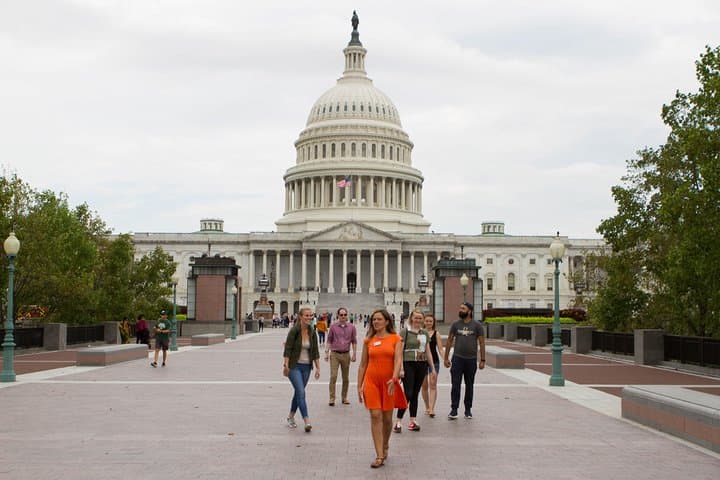


You step off the sidewalk at 1st Street NE and Constitution Avenue and the city changes scale: the Capitol Dome rises like a white compass, columns catching light while street-level vendors and reporters move with purpose. The guide threads the group through press lines and ceremonial plazas, pausing so the dome’s shadow can be read in relation to the Capitol’s four quadrants.
You step off the sidewalk at 1st Street NE and Constitution Avenue and the city changes scale: the Capitol Dome rises like a white compass, columns catching light while street-level vendors and reporters move with purpose. The guide threads the group through press lines and ceremonial plazas, pausing so the dome’s shadow can be read in relation to the Capitol’s four quadrants.
This walk stitches together moments of American history — from the 1814 Burning of Washington to the late-19th-century flourish of the Library of Congress’s Thomas Jefferson Building, which houses an original Gutenberg Bible and Jefferson’s personal collection. Geologically the Mall sits on the Atlantic Coastal Plain; shallow soils and landscaped terraces shaped how the city expanded eastward and how monuments were sited.
Culturally, Capitol Hill is a working neighborhood where legislative ritual collides with daily life: clerks, tourists, students, and lobbyists all share the carved stairways. The tour’s inclusion of docent-led access to the Capitol Visitor Center and inside the Library of Congress lets visitors see artifacts and architectural details usually behind velvet ropes.
Practicalities matter: arrive 15 minutes early, carry minimal gear (security screens all bags), and plan for at least three hours with walking on paved surfaces and intermittent standing. Public transit is the easiest option; restrooms are limited until the tour reaches indoor stops. Bring layers, a small water bottle you can empty at security if required, and a charged phone for the guide’s check-in text. The route rewards attention — lean in to the stories and the stonework, and you’ll leave with a clearer picture of how place and power overlap on Capitol Hill.