THE ADVENTURE COLLECTIVE® · Independent discovery and booking for outdoor travel

Stand where Canadian units fought and fell across Somme and Flanders on this focused two-day tour from Lille or Arras. Visit Tyne Cot, Vimy Ridge, Lochnagar Crater and the Menin Gate with a professional guide and private transport.
Stand where Canadian units fought and fell across Somme and Flanders on this focused two-day tour from Lille or Arras. Visit Tyne Cot, Vimy Ridge, Lochnagar Crater and the Menin Gate with a professional guide and private transport.
The day begins on a cool Belgian road as the van slips away from Lille toward low, flat fields where poppies still flare in summer. On the first evening visitors stand under the Menin Gate in Ypres, the bronze echoes of the Last Post rolling across cobbled squares while the town’s medieval cloth hall watches. By the second day the group is on the chalk of Vimy Ridge, descending into the Grange Tunnel and walking the line where trenches cut the horizon.
Verified experiences and guided adventures in the surrounding area.
Operated by Ploegsteert Sector Battlefield Experience · Lille, Hauts-de-France
The day begins on a cool Belgian road as the van slips away from Lille toward low, flat fields where poppies still flare in summer. On the first evening visitors stand under the Menin Gate in Ypres, the bronze echoes of the Last Post rolling across cobbled squares while the town’s medieval cloth hall watches. By the second day the group is on the chalk of Vimy Ridge, descending into the Grange Tunnel and walking the line where trenches cut the horizon.
This two-day itinerary threads Canadian battle sites from Tyne Cot Cemetery and Passchendaele to the shell-scarred Somme: Lochnagar Crater, Thiepval and Beaumont-Hamel. Geology matters here — the soft Flanders clay and chalky Arras ridges shaped trench systems and tunneling tactics; the landscape’s flatness made artillery and observation decisive.
Culture and memory are constant companions: Commonwealth War Graves Commission cemeteries with their regimented headstones, small Flemish towns that revive ration-era stories, and the daily rituals such as Ypres’ Last Post. Guides contextualize unit movements, casualty lists and poems like John McCrae’s “In Flanders Fields.”
Practicalities are straightforward: this is a private, vehicle-supported tour with hotel pickup and drop-off, bottled water and lunch provided. Expect moderate walking over uneven ground and short stints in museums or tunnels. Wear sturdy shoes, dress in layers and plan to be silent and respectful at cemeteries. Aim for the Last Post in Ypres for the most memorable moment, and allow time between stops — the roads, weather and emotions slow a good day down.
moderate.
2 days.
Suitable for travelers able to walk short to moderate distances (200–800 m) on uneven ground several times a day; occasional steps and tunnels.
Most memorial sites and cemeteries are free; some museums (like larger WWI museums) may charge entry—your guide will note included admissions.
Yes—the tour offers pickup from Lille or Arras as specified at booking; confirm your pickup point in advance.
Families are welcome; infants can ride in strollers and infants must sit on laps where seating is limited—expect a moderate pace and emotionally heavy sites.
It requires moderate fitness: repeated short walks, steps into tunnels and some standing during ceremonies; help is available from the guide and vehicle between stops.
Canadian divisions played pivotal roles at Vimy Ridge (1917) and during Somme offensives (1916); memorials here commemorate soldiers with no known grave.
CWGC and local authorities maintain cemeteries and battlefields—stay on paths, avoid disturbing flora, and follow guidance to protect fragile archaeological remains.
Ploegsteert Sector Battlefield Experience operates guided outdoor trips and adventures with an emphasis on safety, stewardship, and memorable experiences.


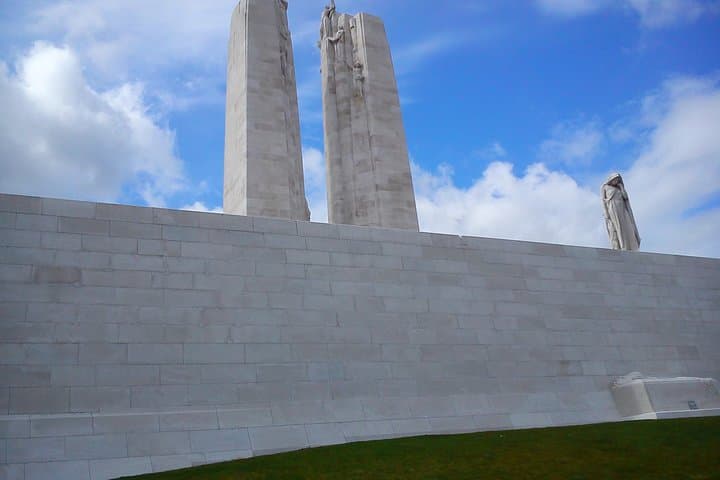
The day begins on a cool Belgian road as the van slips away from Lille toward low, flat fields where poppies still flare in summer. On the first evening visitors stand under the Menin Gate in Ypres, the bronze echoes of the Last Post rolling across cobbled squares while the town’s medieval cloth hall watches. By the second day the group is on the chalk of Vimy Ridge, descending into the Grange Tunnel and walking the line where trenches cut the horizon.
The day begins on a cool Belgian road as the van slips away from Lille toward low, flat fields where poppies still flare in summer. On the first evening visitors stand under the Menin Gate in Ypres, the bronze echoes of the Last Post rolling across cobbled squares while the town’s medieval cloth hall watches. By the second day the group is on the chalk of Vimy Ridge, descending into the Grange Tunnel and walking the line where trenches cut the horizon.
This two-day itinerary threads Canadian battle sites from Tyne Cot Cemetery and Passchendaele to the shell-scarred Somme: Lochnagar Crater, Thiepval and Beaumont-Hamel. Geology matters here — the soft Flanders clay and chalky Arras ridges shaped trench systems and tunneling tactics; the landscape’s flatness made artillery and observation decisive.
Culture and memory are constant companions: Commonwealth War Graves Commission cemeteries with their regimented headstones, small Flemish towns that revive ration-era stories, and the daily rituals such as Ypres’ Last Post. Guides contextualize unit movements, casualty lists and poems like John McCrae’s “In Flanders Fields.”
Practicalities are straightforward: this is a private, vehicle-supported tour with hotel pickup and drop-off, bottled water and lunch provided. Expect moderate walking over uneven ground and short stints in museums or tunnels. Wear sturdy shoes, dress in layers and plan to be silent and respectful at cemeteries. Aim for the Last Post in Ypres for the most memorable moment, and allow time between stops — the roads, weather and emotions slow a good day down.