THE ADVENTURE COLLECTIVE® · Independent discovery and booking for outdoor travel

Walk a metal catwalk bolted to limestone walls, cross a hanging bridge and trace a century-old hydroelectric legacy — all on a 2½-hour guided tour of Caminito del Rey. Here’s what to expect, how to prepare and where to point your camera.
Walk a metal catwalk bolted to limestone walls, cross a hanging bridge and trace a century-old hydroelectric legacy — all on a 2½-hour guided tour of Caminito del Rey. Here’s what to expect, how to prepare and where to point your camera.
You step onto the narrow boardwalk and the gorge rearranges your sense of scale: the Guadalhorce River threads below, pale limestone walls rise like pages of geological history, and a group of helmeted travelers follows a guide whose voice carries stories as easily as it carries instructions. Wind finds the canyon and hurries your breath; griffon vultures circle above, curious about the human procession clinging to the cliff face.
Verified experiences and guided adventures in the surrounding area.
Operated by Tours in Malaga · Álora, Andalusia
You step onto the narrow boardwalk and the gorge rearranges your sense of scale: the Guadalhorce River threads below, pale limestone walls rise like pages of geological history, and a group of helmeted travelers follows a guide whose voice carries stories as easily as it carries instructions. Wind finds the canyon and hurries your breath; griffon vultures circle above, curious about the human procession clinging to the cliff face.
The Caminito del Rey’s story is half-industry, half-daring showpiece. Built in the early 20th century to service the hydroelectric dams and the railway that tamed Andalusia’s water, the pathway later earned a reputation for lethality before a major restoration reopened it to the public in 2015. Geologically, you walk through layers of Jurassic limestone scoured by millennia of river action; narrow side gorges and hanging bridges reveal how water and time carved the Gaitanes and Gaitanejos cliffs.
This group tour condenses that sweep into a tidy 2½-hour experience. The linear route spans roughly 7.7 km including approach trails; the cliffside boardwalk itself is about 2.9 km. Elevation change is modest — the trail follows the river’s drop rather than climbing steeply — but the exposure is dramatic: sections of the walkway hang over 100 meters above the river. Terrain alternates between renovated metal catwalks bolted to rock, gravel approach tracks and short stair sections near access points. The guide pauses at interpretive points: the old power station, the hanging bridge, the Ribera viewpoint, and the narrow Hoyo valley where light falls like a spotlight.
Practicalities matter: helmets and an entry ticket are included; walking sticks are not allowed; sport shoes and moderate fitness are required. The tour starts from the Kiosko area with a shuttle option and finishes at El Chorro — it’s a point-to-point route, so plan your return. Weather or safety closures are not uncommon; the Caminito board can shut access at short notice for security reasons and refunds or alternatives are handled case-by-case.
For photography, aim for early morning light or late afternoon to avoid harsh midday shadows and crowds. Hydration, layered clothing for canyon wind, and sun protection are non-negotiable. With careful planning this guided walk delivers more than views: it hands you a readable landscape, where industrial history, rugged geology and a healthy dose of adrenaline meet along a narrow path carved into rock.
moderate.
2–3 hours.
Moderate fitness: able to walk 7–8 km on uneven terrain and handle exposed sections without dizziness.
The full point-to-point experience including approaches is about 7.7 km; the guided portion typically takes 2–3 hours.
Yes — helmets are included in the tour price and must be worn on the walkway for safety.
Children are allowed from age 8, but they must carry ID to verify age and be accompanied by an adult.
The Caminito board may close access for safety; the operator will offer alternatives, rescheduling or refunds according to their policy.
No — walking sticks and trekking poles are not permitted on the walkway for safety and space reasons.
The route finishes at El Chorro parking; local shuttle or public buses run between endpoints for a small fee, or arrange private return transport.
Originally built (1901–1905) to service hydroelectric projects and a railway, the path later fell into ruin and was fully restored and reopened in 2015.
Visitor numbers are controlled to protect cliffside nesting birds and fragile limestone vegetation; stay on the walkway and pack out any trash.
Tours in Malaga operates guided outdoor trips and adventures with an emphasis on safety, stewardship, and memorable experiences.
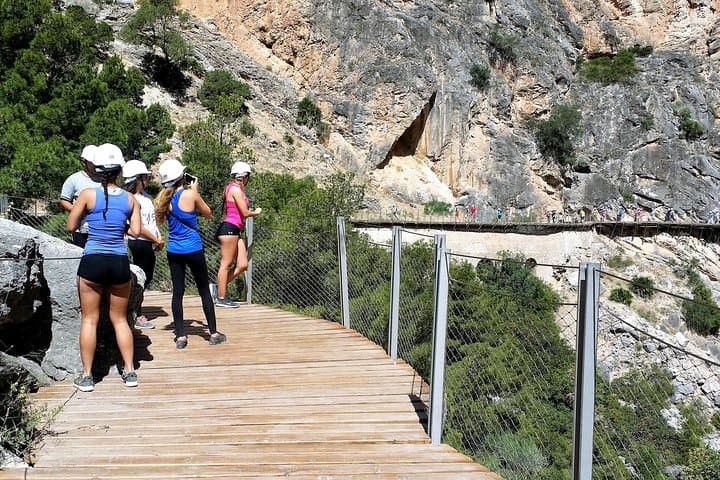
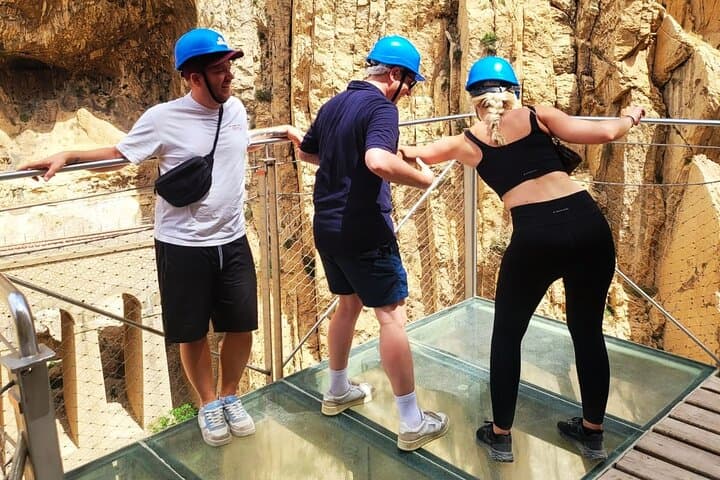
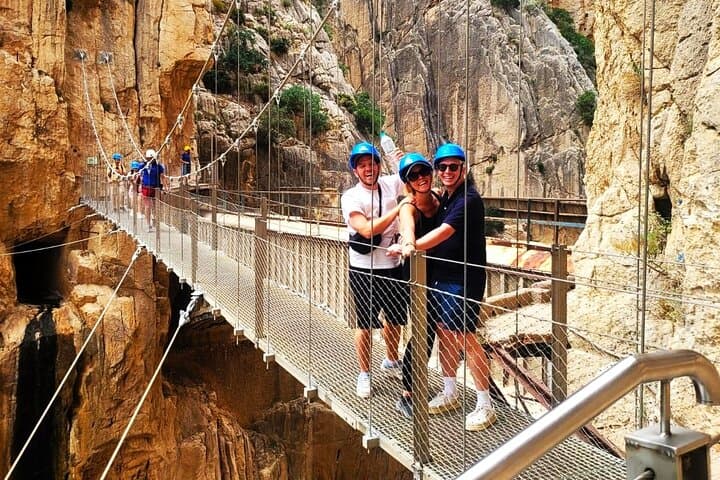
You step onto the narrow boardwalk and the gorge rearranges your sense of scale: the Guadalhorce River threads below, pale limestone walls rise like pages of geological history, and a group of helmeted travelers follows a guide whose voice carries stories as easily as it carries instructions. Wind finds the canyon and hurries your breath; griffon vultures circle above, curious about the human procession clinging to the cliff face.
You step onto the narrow boardwalk and the gorge rearranges your sense of scale: the Guadalhorce River threads below, pale limestone walls rise like pages of geological history, and a group of helmeted travelers follows a guide whose voice carries stories as easily as it carries instructions. Wind finds the canyon and hurries your breath; griffon vultures circle above, curious about the human procession clinging to the cliff face.
The Caminito del Rey’s story is half-industry, half-daring showpiece. Built in the early 20th century to service the hydroelectric dams and the railway that tamed Andalusia’s water, the pathway later earned a reputation for lethality before a major restoration reopened it to the public in 2015. Geologically, you walk through layers of Jurassic limestone scoured by millennia of river action; narrow side gorges and hanging bridges reveal how water and time carved the Gaitanes and Gaitanejos cliffs.
This group tour condenses that sweep into a tidy 2½-hour experience. The linear route spans roughly 7.7 km including approach trails; the cliffside boardwalk itself is about 2.9 km. Elevation change is modest — the trail follows the river’s drop rather than climbing steeply — but the exposure is dramatic: sections of the walkway hang over 100 meters above the river. Terrain alternates between renovated metal catwalks bolted to rock, gravel approach tracks and short stair sections near access points. The guide pauses at interpretive points: the old power station, the hanging bridge, the Ribera viewpoint, and the narrow Hoyo valley where light falls like a spotlight.
Practicalities matter: helmets and an entry ticket are included; walking sticks are not allowed; sport shoes and moderate fitness are required. The tour starts from the Kiosko area with a shuttle option and finishes at El Chorro — it’s a point-to-point route, so plan your return. Weather or safety closures are not uncommon; the Caminito board can shut access at short notice for security reasons and refunds or alternatives are handled case-by-case.
For photography, aim for early morning light or late afternoon to avoid harsh midday shadows and crowds. Hydration, layered clothing for canyon wind, and sun protection are non-negotiable. With careful planning this guided walk delivers more than views: it hands you a readable landscape, where industrial history, rugged geology and a healthy dose of adrenaline meet along a narrow path carved into rock.