THE ADVENTURE COLLECTIVE® · Independent discovery and booking for outdoor travel

A dramatic day trip from Seville along 300-meter cliffs: Caminito del Rey pairs exposed boardwalks and river-carved limestone with local history and guided insight. Book ahead—visitor numbers are limited.
A dramatic day trip from Seville along 300-meter cliffs: Caminito del Rey pairs exposed boardwalks and river-carved limestone with local history and guided insight. Book ahead—visitor numbers are limited.
You step onto wood planks bolted to limestone that has been wearing its grooves for millennia. Below, the Guadalhorce squeezes through the Desfiladero de los Gaitanes, a narrow gorge whose walls lean toward one another like old neighbors exchanging secrets. Wind moves through the canyon with intent; the boardwalk shivers lightly underfoot, and the sense of altitude—up to 300 meters above the river—registers not as a number but as a steady, clarifying pressure.
Verified experiences and guided adventures in the surrounding area.
Operated by Discovering Spain · Ardales, Andalusia
You step onto wood planks bolted to limestone that has been wearing its grooves for millennia. Below, the Guadalhorce squeezes through the Desfiladero de los Gaitanes, a narrow gorge whose walls lean toward one another like old neighbors exchanging secrets. Wind moves through the canyon with intent; the boardwalk shivers lightly underfoot, and the sense of altitude—up to 300 meters above the river—registers not as a number but as a steady, clarifying pressure.
The route known today as Caminito del Rey began life as a practical path for workers building early 20th-century hydropower projects; King Alfonso XIII’s royal crossing in 1921 gave the place its name. Decades of neglect turned it into an adrenaline lure until a major restoration reopened a safe, managed walkway in 2015, preserving both the route’s dramatic exposure and the geology that carved it: thick, jagged limestone seamed by the river’s patient erosions.
The walk threads between the towns of Álora, Ardales and Antequera, across a landscape of scrub oak, almond groves and whitewashed villages whose histories are tied to Moorish irrigation and later industrial waterworks. Local guides knit that context into the hike—pointing out abandoned service tunnels, old railway bridges and the human ingenuity that reshaped this canyon.
Practically, this is a day trip from Seville. The semi-private transfer collects travelers in the city (commonly from a central meeting point such as Eurostars Torre Sevilla) and returns the same evening. Expect roughly 4–5 hours door-to-door on this tour: about two hours of round-trip driving each way and two hours exploring the trail and viewpoints. The walk itself is non-technical—boardwalks, metal staircases and secured paths—but exposure and narrow sections mean a moderate level of fitness and steady nerves are helpful.
Book well in advance: visitor numbers are strictly limited and children under eight are not allowed. Bring sun protection, at least 1–1.5 liters of water, and closed-toe shoes with good grip; stick to the guide’s route and timing—access is strictly regulated for safety and conservation.
Weather can close the path for maintenance or safety, and operators are typically clear about refund and reschedule options. The payoff is undeniable: long canyon faces changing color as the sun moves, the river daring you from below, and views back to Andalusian ridgelines where villages sit like punctuation marks on the horizon. It’s a compact day of geology, history and exposure that rewards careful planning with sustained, wilder-than-expected panoramas.
moderate.
4–5 hours (including transfers).
Moderate fitness—able to walk 2–3 hours over inclines and stairs and handle exposure.
The managed route and approaches total about 7–8 km, with roughly 2–3 hours spent on the trail portions; the tour from Seville runs about 4–5 hours including transfers.
Children under 8 are not permitted on the walkway; older children must be supervised and able to handle heights and stairs.
No technical climbing is required—the path is boardwalk and secured trail, but there are stairs and exposed sections that require sure footing.
Yes—management can close the path for safety or maintenance; in such cases tickets are refunded and operators will communicate alternatives for the transfer portion.
Pickup is typically from a central meeting point in Seville (commonly in front of Eurostars Torre Sevilla) as noted by the operator—confirm your exact meeting point when booking.
Yes—the semi-private option includes an official, specialised guide who explains the history, geology and safety rules during the visit.
Originally a maintenance path for dam and railway workers in the early 20th century, the route gained fame after King Alfonso XIII crossed it; it was fully restored and reopened in 2015.
Access is regulated to protect fragile limestone slopes and nesting raptors; stick to paths and follow guide instructions to minimize impact.
Discovering Spain operates guided outdoor trips and adventures with an emphasis on safety, stewardship, and memorable experiences.
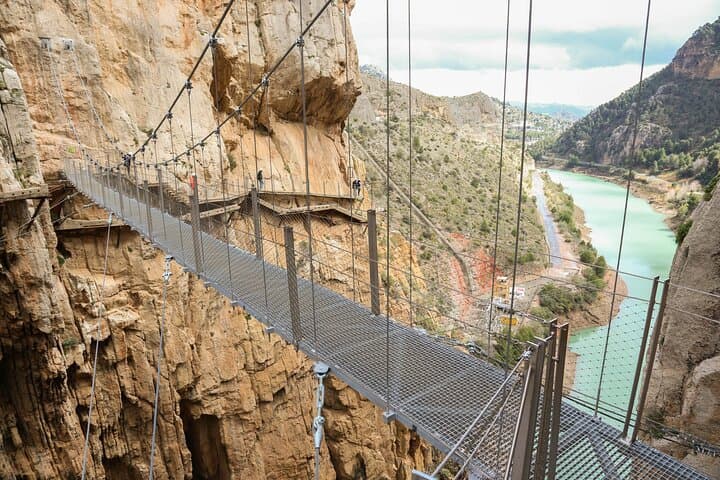
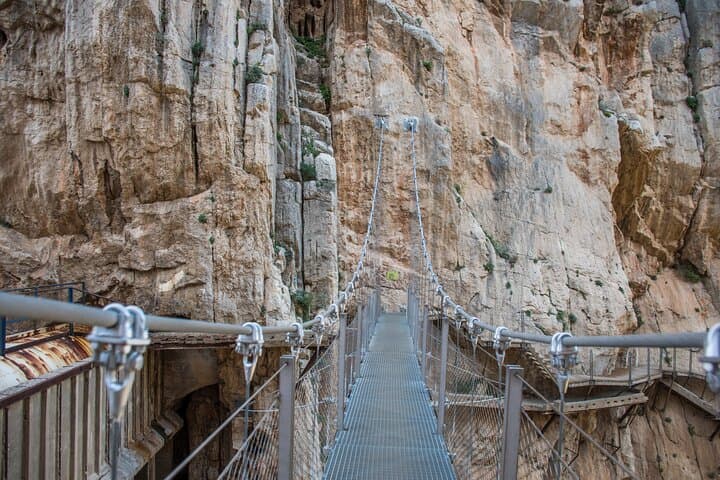
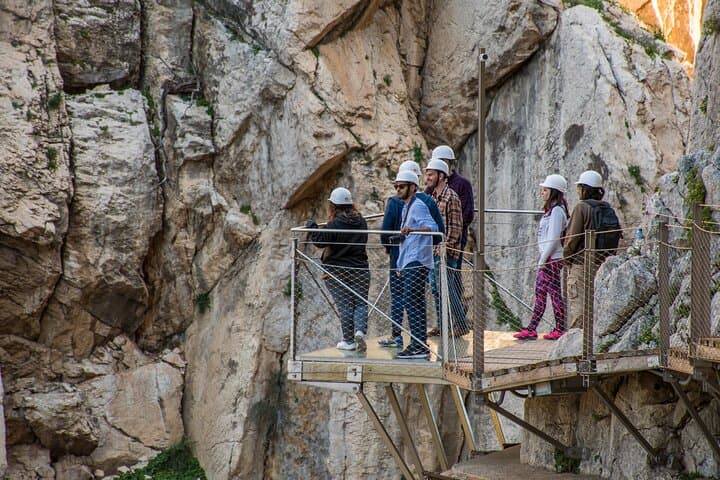
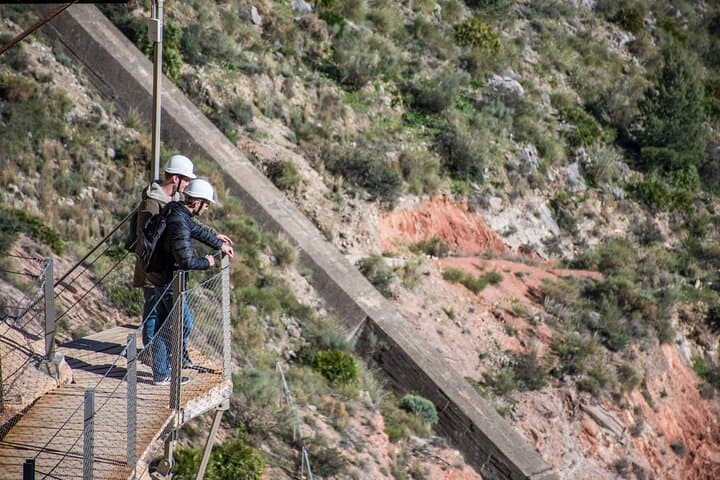
You step onto wood planks bolted to limestone that has been wearing its grooves for millennia. Below, the Guadalhorce squeezes through the Desfiladero de los Gaitanes, a narrow gorge whose walls lean toward one another like old neighbors exchanging secrets. Wind moves through the canyon with intent; the boardwalk shivers lightly underfoot, and the sense of altitude—up to 300 meters above the river—registers not as a number but as a steady, clarifying pressure.
You step onto wood planks bolted to limestone that has been wearing its grooves for millennia. Below, the Guadalhorce squeezes through the Desfiladero de los Gaitanes, a narrow gorge whose walls lean toward one another like old neighbors exchanging secrets. Wind moves through the canyon with intent; the boardwalk shivers lightly underfoot, and the sense of altitude—up to 300 meters above the river—registers not as a number but as a steady, clarifying pressure.
The route known today as Caminito del Rey began life as a practical path for workers building early 20th-century hydropower projects; King Alfonso XIII’s royal crossing in 1921 gave the place its name. Decades of neglect turned it into an adrenaline lure until a major restoration reopened a safe, managed walkway in 2015, preserving both the route’s dramatic exposure and the geology that carved it: thick, jagged limestone seamed by the river’s patient erosions.
The walk threads between the towns of Álora, Ardales and Antequera, across a landscape of scrub oak, almond groves and whitewashed villages whose histories are tied to Moorish irrigation and later industrial waterworks. Local guides knit that context into the hike—pointing out abandoned service tunnels, old railway bridges and the human ingenuity that reshaped this canyon.
Practically, this is a day trip from Seville. The semi-private transfer collects travelers in the city (commonly from a central meeting point such as Eurostars Torre Sevilla) and returns the same evening. Expect roughly 4–5 hours door-to-door on this tour: about two hours of round-trip driving each way and two hours exploring the trail and viewpoints. The walk itself is non-technical—boardwalks, metal staircases and secured paths—but exposure and narrow sections mean a moderate level of fitness and steady nerves are helpful.
Book well in advance: visitor numbers are strictly limited and children under eight are not allowed. Bring sun protection, at least 1–1.5 liters of water, and closed-toe shoes with good grip; stick to the guide’s route and timing—access is strictly regulated for safety and conservation.
Weather can close the path for maintenance or safety, and operators are typically clear about refund and reschedule options. The payoff is undeniable: long canyon faces changing color as the sun moves, the river daring you from below, and views back to Andalusian ridgelines where villages sit like punctuation marks on the horizon. It’s a compact day of geology, history and exposure that rewards careful planning with sustained, wilder-than-expected panoramas.