THE ADVENTURE COLLECTIVE® · Independent discovery and booking for outdoor travel

Trade the medina’s bustle for slow-moving camels and the shade of the Palmeraie. This private camel ride gives you an easy, atmospheric way to experience Marrakech’s palm groves with low exertion and high photographic payoff.
Trade the medina’s bustle for slow-moving camels and the shade of the Palmeraie. This private camel ride gives you an easy, atmospheric way to experience Marrakech’s palm groves with low exertion and high photographic payoff.
The sun leans across a flat horizon as a line of camels rises from the shade of the palm groves. Dust lifts in pale curtains and the animals step with slow, practiced rhythm—each sway giving a different angle on Marrakech’s outlying palms and ochre earth. A one-hour camel trek through the Palmeraie compresses the city’s noise into a distant hum and trades it for the cadence of hooves and open sky.
Verified experiences and guided adventures in the surrounding area.
Operated by Mustapha Moufid · Marrakech, Marrakech-Safi
The sun leans across a flat horizon as a line of camels rises from the shade of the palm groves. Dust lifts in pale curtains and the animals step with slow, practiced rhythm—each sway giving a different angle on Marrakech’s outlying palms and ochre earth. A one-hour camel trek through the Palmeraie compresses the city’s noise into a distant hum and trades it for the cadence of hooves and open sky.
The Palmeraie is a human-shaped oasis: centuries of irrigation and planting turned semi-arid ground into a working palm belt where Berber and Arab cultures met caravan routes. Geologically, the plain is sandy alluvium at the foothills of the High Atlas—flat, sandy, and punctuated by irrigation channels and clusters of age-old date palms. The local villages you pass still show handcrafted mudbrick architecture and the informal economy of palm-frond weaving and small farms.
Practically, expect a gentle, accessible ride suitable for novice riders. Tours typically include private transport from central Marrakech and a short introduction to camel handling. Bring sun protection and a small bottle of water; the pace is slow but exposed. Camera straps and a lightweight scarf will help with dust and bright light. Respect handlers’ guidance—camels are trained but large—and choose a provider that limits group size for a quieter experience.
Timing matters: early morning or late afternoon delivers cooler temperatures and better light for photos. If you have back issues, ask for alternatives; these rides involve rising and sitting on tall saddles. With basic preparation, the Palmeraie camel ride is an easy, evocative way to step beyond the medina and feel the desert’s margins without deep trekking.
easy.
2–3 hours (includes transport; camel ride ~1 hour).
Suitable for most fitness levels; basic mobility needed to mount/dismount from a saddle.
Children can usually participate; infants must sit on an adult’s lap per provider policy—confirm age limits and safety arrangements when booking.
The advertised product includes private transport and a shared camel ride; the full experience with transfer is about 2–3 hours while the camel segment is roughly 45–60 minutes.
Not recommended for travelers with spinal injuries or serious back problems—the mounting and saddle position can be uncomfortable for some.
Full refunds are typically available if you cancel at least 24 hours before departure; check your booking confirmation for exact terms.
The Palmeraie developed as a managed palm belt serving Marrakech—date palms have been cultivated here for centuries to stabilize sand and supply fruit and building materials.
The Palmeraie faces pressure from development and water demand; choose operators that limit group sizes and respect local irrigation channels to reduce impact.
Mustapha Moufid operates guided outdoor trips and adventures with an emphasis on safety, stewardship, and memorable experiences.
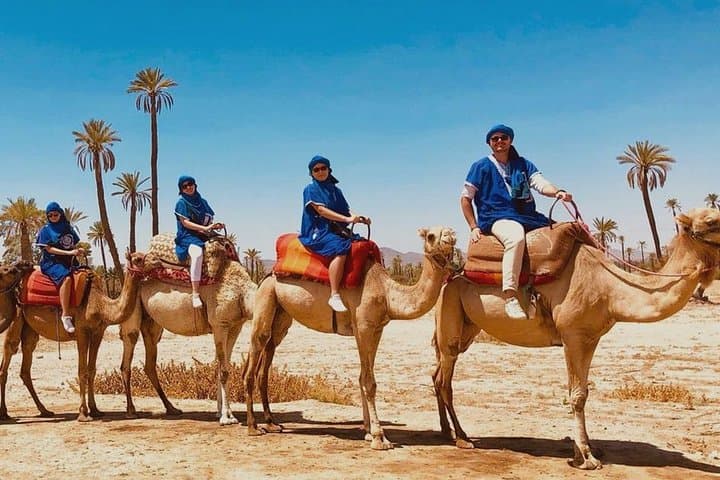
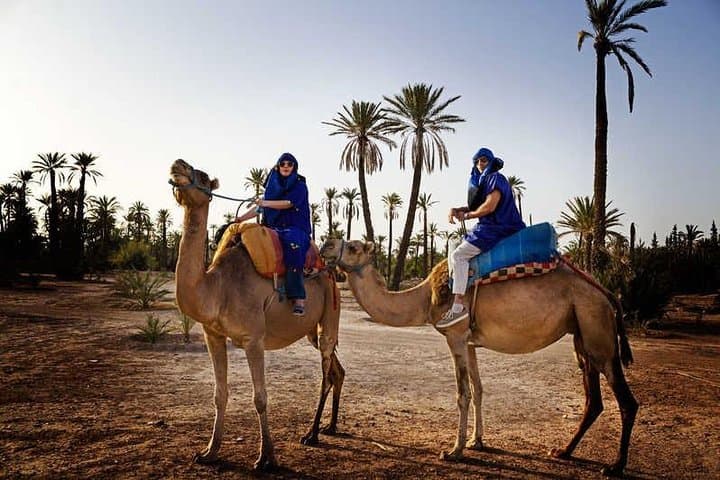
The sun leans across a flat horizon as a line of camels rises from the shade of the palm groves. Dust lifts in pale curtains and the animals step with slow, practiced rhythm—each sway giving a different angle on Marrakech’s outlying palms and ochre earth. A one-hour camel trek through the Palmeraie compresses the city’s noise into a distant hum and trades it for the cadence of hooves and open sky.
The sun leans across a flat horizon as a line of camels rises from the shade of the palm groves. Dust lifts in pale curtains and the animals step with slow, practiced rhythm—each sway giving a different angle on Marrakech’s outlying palms and ochre earth. A one-hour camel trek through the Palmeraie compresses the city’s noise into a distant hum and trades it for the cadence of hooves and open sky.
The Palmeraie is a human-shaped oasis: centuries of irrigation and planting turned semi-arid ground into a working palm belt where Berber and Arab cultures met caravan routes. Geologically, the plain is sandy alluvium at the foothills of the High Atlas—flat, sandy, and punctuated by irrigation channels and clusters of age-old date palms. The local villages you pass still show handcrafted mudbrick architecture and the informal economy of palm-frond weaving and small farms.
Practically, expect a gentle, accessible ride suitable for novice riders. Tours typically include private transport from central Marrakech and a short introduction to camel handling. Bring sun protection and a small bottle of water; the pace is slow but exposed. Camera straps and a lightweight scarf will help with dust and bright light. Respect handlers’ guidance—camels are trained but large—and choose a provider that limits group size for a quieter experience.
Timing matters: early morning or late afternoon delivers cooler temperatures and better light for photos. If you have back issues, ask for alternatives; these rides involve rising and sitting on tall saddles. With basic preparation, the Palmeraie camel ride is an easy, evocative way to step beyond the medina and feel the desert’s margins without deep trekking.