THE ADVENTURE COLLECTIVE® · Independent discovery and booking for outdoor travel

Ride a well-trained camel across Aghroud’s dunes and eucalyptus groves, then pause at the Souss River to watch flamingos and migratory birds. This two-hour shared activity from Agadir pairs a brief cultural briefing with mint tea and local cakes.
Ride a well-trained camel across Aghroud’s dunes and eucalyptus groves, then pause at the Souss River to watch flamingos and migratory birds. This two-hour shared activity from Agadir pairs a brief cultural briefing with mint tea and local cakes.
The sand shifts under the camel’s slow, rocking gait as the Atlantic breathes cool air across your face. Minutes from Agadir, riders set off from a small ranch and cross low dunes, eucalyptus groves, and the shadowed banks of the Souss River, where pink flocks wheel and reedbeds whisper.
Verified experiences and guided adventures in the surrounding area.
Operated by Agatrips · Agadir, Souss-Massa
The sand shifts under the camel’s slow, rocking gait as the Atlantic breathes cool air across your face. Minutes from Agadir, riders set off from a small ranch and cross low dunes, eucalyptus groves, and the shadowed banks of the Souss River, where pink flocks wheel and reedbeds whisper.
This stretch of Morocco sits at the edge of the Souss Valley, long a corridor for Amazigh communities and coastal trade. Geologically, the coastal plain is recent alluvium where river and ocean meet—soft dunes, packed beach sand, and pockets of planted eucalyptus that local farmers introduced in the 20th century to stabilize soil.
Culturally the ride is gentle: guides explain basic camel handling, offer mint tea and cakes, and point out migratory birds that stop at the estuary. The experience blends simple pastoral life with the coastal birding that gives the Souss mouth its quiet importance.
Practical guidance: the full activity runs about two hours, with roughly an hour in the saddle on mostly flat terrain and minimal elevation change. Expect sandy tracks and short stretches through a village; moderate fitness is recommended for mounting and dismounting camels.
Bring sun protection, a reusable water bottle, and closed-toe shoes. Weight and health restrictions are common—check booking requirements—and plans usually include hotel pickup from Agadir.
This is a low-impact way to see coastal Morocco from a different angle: slow-paced, accessible, and best in the cooler morning or late-afternoon light for photos and bird activity.
moderate.
2 hours.
Moderate fitness—able to mount/dismount a camel and walk short sandy stretches.
The full tour is about two hours; expect roughly 45–75 minutes in the saddle within that timeframe, plus briefing, tea, and transfers.
Yes—families frequently join; operators note infants must sit on laps and specialized seats may be available. Confirm age limits and safety rules when booking.
Yes, the tour typically includes hotel pickup and drop-off from central Agadir accommodations—confirm your pickup point during booking.
The Souss estuary attracts migratory birds such as flamingos and herons; sightings depend on season and water levels but are common during migration windows.
The Souss plain has long been a crossroads for Amazigh communities and coastal trade; the river estuary has supported local fishing and seasonal agriculture for centuries.
The estuary is important for migratory birds—stick to marked paths, avoid disturbing nests, and respect local guides who protect sensitive reedbeds.
Agatrips operates guided outdoor trips and adventures with an emphasis on safety, stewardship, and memorable experiences.


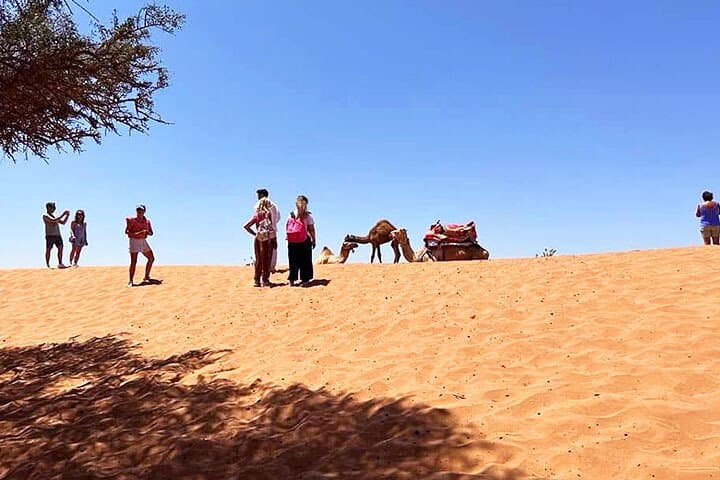
The sand shifts under the camel’s slow, rocking gait as the Atlantic breathes cool air across your face. Minutes from Agadir, riders set off from a small ranch and cross low dunes, eucalyptus groves, and the shadowed banks of the Souss River, where pink flocks wheel and reedbeds whisper.
The sand shifts under the camel’s slow, rocking gait as the Atlantic breathes cool air across your face. Minutes from Agadir, riders set off from a small ranch and cross low dunes, eucalyptus groves, and the shadowed banks of the Souss River, where pink flocks wheel and reedbeds whisper.
This stretch of Morocco sits at the edge of the Souss Valley, long a corridor for Amazigh communities and coastal trade. Geologically, the coastal plain is recent alluvium where river and ocean meet—soft dunes, packed beach sand, and pockets of planted eucalyptus that local farmers introduced in the 20th century to stabilize soil.
Culturally the ride is gentle: guides explain basic camel handling, offer mint tea and cakes, and point out migratory birds that stop at the estuary. The experience blends simple pastoral life with the coastal birding that gives the Souss mouth its quiet importance.
Practical guidance: the full activity runs about two hours, with roughly an hour in the saddle on mostly flat terrain and minimal elevation change. Expect sandy tracks and short stretches through a village; moderate fitness is recommended for mounting and dismounting camels.
Bring sun protection, a reusable water bottle, and closed-toe shoes. Weight and health restrictions are common—check booking requirements—and plans usually include hotel pickup from Agadir.
This is a low-impact way to see coastal Morocco from a different angle: slow-paced, accessible, and best in the cooler morning or late-afternoon light for photos and bird activity.