THE ADVENTURE COLLECTIVE® · Independent discovery and booking for outdoor travel

Walk the Giza Plateau and tour the Grand Egyptian Museum in a single private day: panoramic pyramid views, the Sphinx, and a curated collection of ancient treasures. Practical timing, gear and local tips to make the most of your visit.
Walk the Giza Plateau and tour the Grand Egyptian Museum in a single private day: panoramic pyramid views, the Sphinx, and a curated collection of ancient treasures. Practical timing, gear and local tips to make the most of your visit.
You step out of an air-conditioned vehicle and the plateau opens — a low sea of pale stone with the three great pyramids rising like measured cliffs against Cairo’s haze. Sand brushes your ankles and the sun lays a steady hand on your shoulders as the guide points to the Great Pyramid, the Sphinx, and the distant slab of the modern city beyond.
Verified experiences and guided adventures in the surrounding area.
Operated by Aqua Egypt Tours · Giza, Giza
You step out of an air-conditioned vehicle and the plateau opens — a low sea of pale stone with the three great pyramids rising like measured cliffs against Cairo’s haze. Sand brushes your ankles and the sun lays a steady hand on your shoulders as the guide points to the Great Pyramid, the Sphinx, and the distant slab of the modern city beyond.
The Giza complex dates to Egypt’s Fourth Dynasty (around 2600–2500 BCE); the Great Pyramid was built for Khufu and the Sphinx likely for Khafre. Geologically it’s Miocene-aged limestone bedrock capped by softer sands, which both protects and erodes the monuments. Nearby, the Grand Egyptian Museum (GEM) collects artifacts from across millennia — including the full Tutankhamun assemblage — centralizing fragile treasures away from direct exposure.
Expect a mix of open, dusty walking and short stops at panoramic viewpoints, the Sphinx enclosure and the GEM galleries. Distances are modest — most highlights lie within 1–2 kilometres across the plateau — but surface is uneven, with loose gravel and carved stone underfoot.
Practical edge: arrive early to beat heat and crowds, carry at least 1–2 litres of water, and wear sturdy closed shoes with good soles. Security screens and bag checks are standard at both sites; have ID and any tickets ready on your phone. If you opt for a camel photo, negotiate price beforehand and treat animals and handlers with respect. The combined day balances outdoor exposure with museum shelter, giving a full narrative arc from monuments to museum conservation.
easy.
3–8 hours.
Suitable for most fitness levels; requires standing and walking on uneven ground for multiple short stretches.
Not always — confirm at booking; many private tours include transfers and guide fees but may list site admission separately.
Access inside pyramids is limited, often requires a separate ticket and can be closed for conservation; the Sphinx interior is not open to the public.
The GEM opened sections progressively; check current opening status and galleries in advance as some exhibits may still rotate or be in transition.
Tipping is customary in Egypt; bring small bills and plan to tip guides, drivers, and local helpers for attentive service.
The Giza monuments were built during the Fourth Dynasty (circa 2600–2500 BCE); the GEM consolidates artifacts removed from open-air exposure to improve preservation.
The GEM and site authorities aim to reduce visitor wear by centralizing sensitive collections indoors and managing access; stay on marked paths and avoid touching stone surfaces.
Aqua Egypt Tours operates guided outdoor trips and adventures with an emphasis on safety, stewardship, and memorable experiences.


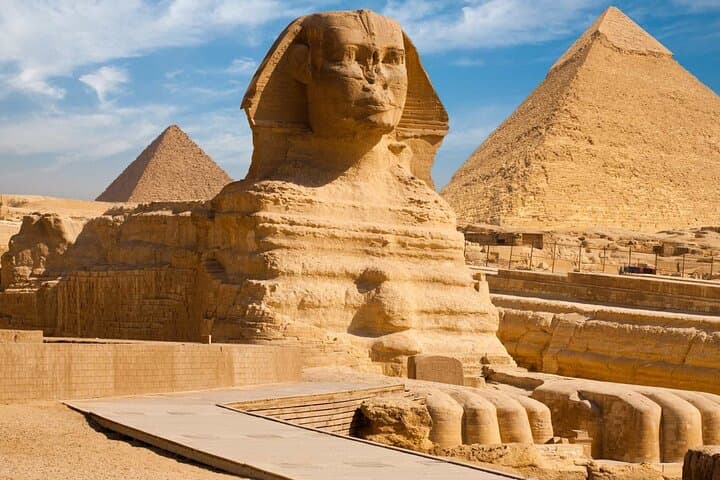

You step out of an air-conditioned vehicle and the plateau opens — a low sea of pale stone with the three great pyramids rising like measured cliffs against Cairo’s haze. Sand brushes your ankles and the sun lays a steady hand on your shoulders as the guide points to the Great Pyramid, the Sphinx, and the distant slab of the modern city beyond.
You step out of an air-conditioned vehicle and the plateau opens — a low sea of pale stone with the three great pyramids rising like measured cliffs against Cairo’s haze. Sand brushes your ankles and the sun lays a steady hand on your shoulders as the guide points to the Great Pyramid, the Sphinx, and the distant slab of the modern city beyond.
The Giza complex dates to Egypt’s Fourth Dynasty (around 2600–2500 BCE); the Great Pyramid was built for Khufu and the Sphinx likely for Khafre. Geologically it’s Miocene-aged limestone bedrock capped by softer sands, which both protects and erodes the monuments. Nearby, the Grand Egyptian Museum (GEM) collects artifacts from across millennia — including the full Tutankhamun assemblage — centralizing fragile treasures away from direct exposure.
Expect a mix of open, dusty walking and short stops at panoramic viewpoints, the Sphinx enclosure and the GEM galleries. Distances are modest — most highlights lie within 1–2 kilometres across the plateau — but surface is uneven, with loose gravel and carved stone underfoot.
Practical edge: arrive early to beat heat and crowds, carry at least 1–2 litres of water, and wear sturdy closed shoes with good soles. Security screens and bag checks are standard at both sites; have ID and any tickets ready on your phone. If you opt for a camel photo, negotiate price beforehand and treat animals and handlers with respect. The combined day balances outdoor exposure with museum shelter, giving a full narrative arc from monuments to museum conservation.