THE ADVENTURE COLLECTIVE® · Independent discovery and booking for outdoor travel

Travel from Busan to Jinhae on a focused, photo-ready day tour through Korea’s most famous cherry blossom corridors. This private, eight-hour route combines seaside viewpoints, market stops, and the iconic Yeojwacheon pink avenue.
Travel from Busan to Jinhae on a focused, photo-ready day tour through Korea’s most famous cherry blossom corridors. This private, eight-hour route combines seaside viewpoints, market stops, and the iconic Yeojwacheon pink avenue.
A pale pink corridor unfolds as your private vehicle slides out of Busan toward Jinhae: cherry trees arch over narrow canals, petals drifting like light snow. The tour moves at the tempo of spring—short walks through Yeojwacheon’s famed “pinky way,” a climb up Dalmaji Hill with ocean vistas, and a stop in a hillside village whose painted houses recall distant ruins and recent history.
Verified experiences and guided adventures in the surrounding area.
Operated by Kangsan Travel Service Co.,Ltd · Busan, Busan
A pale pink corridor unfolds as your private vehicle slides out of Busan toward Jinhae: cherry trees arch over narrow canals, petals drifting like light snow. The tour moves at the tempo of spring—short walks through Yeojwacheon’s famed “pinky way,” a climb up Dalmaji Hill with ocean vistas, and a stop in a hillside village whose painted houses recall distant ruins and recent history.
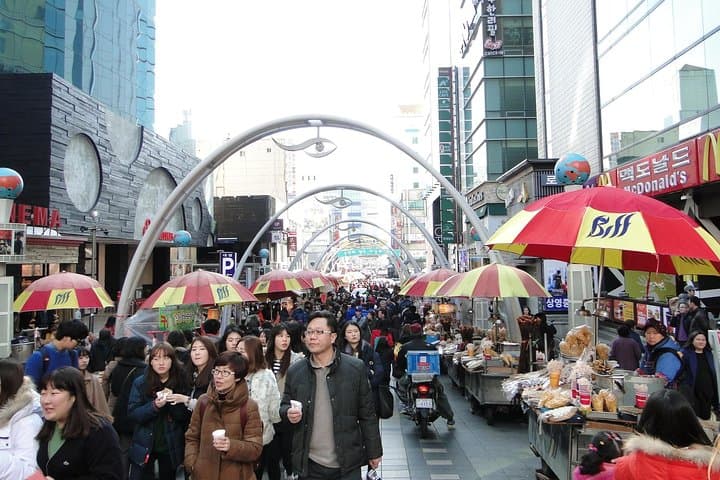
Jinhae’s blossoms are the local clock of Korea’s modern memory: the festival grew from naval commemorations into a nationwide spectacle. Geologically the coastline between Busan and Changwon is a mix of low granite headlands and reclaimed plains; those slopes make for viewpoints that pair city skylines with the open sea. Culturally, Busan balances maritime markets and film-industry flare—BIFF Square offers street-food flavors that contrast the quiet alleys of Jinhae.
Expect mostly paved paths and short, easy inclines (Dalmaji road has steeper sections but no technical scrambling). Photography stops and market breaks are built into an eight-hour schedule, so plan for repeated on-off walking and lots of standing.
Practical guidance: wear comfortable walking shoes with good traction, layer for coastal wind, and bring a compact daypack for snacks, water, and camera gear. Cash helps at smaller stalls. Time your visit for mid-mornings on weekdays if you want to avoid the densest crowds during the festival peak.
easy.
8 hours.
Suitable for most fitness levels; expect multiple short walks and some uphill pavement sections.
The tour is about eight hours with short, easy walks at each stop and time for photos and market visits.
Most sites visited have paved access and the tour lists wheelchair and stroller accessibility; notify the operator of needs at booking.
No festival ticket is required for general viewing; this private tour handles transportation and timing to avoid the worst crowds.
Bottled water is provided; street food and other meals are not included but there are planned market stops where you can buy local snacks.
Jinhae’s modern spring festival grew from naval commemorations after the Korean War; Busan’s BIFF Square became a cultural hub following the rise of the Busan International Film Festival in the late 20th century.
High foot traffic during cherry blossom season stresses pedestrian corridors—stick to paved routes and avoid picking flowers; support local vendors who use sustainable packaging when possible.
Kangsan Travel Service Co.,Ltd operates guided outdoor trips and adventures with an emphasis on safety, stewardship, and memorable experiences.
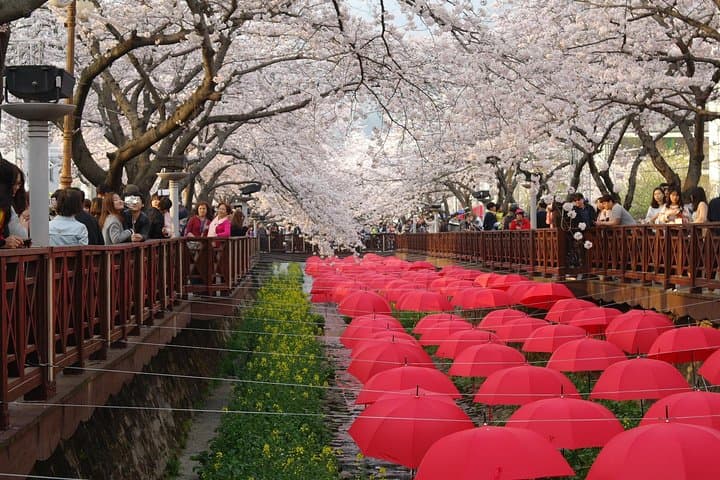
A pale pink corridor unfolds as your private vehicle slides out of Busan toward Jinhae: cherry trees arch over narrow canals, petals drifting like light snow. The tour moves at the tempo of spring—short walks through Yeojwacheon’s famed “pinky way,” a climb up Dalmaji Hill with ocean vistas, and a stop in a hillside village whose painted houses recall distant ruins and recent history.
A pale pink corridor unfolds as your private vehicle slides out of Busan toward Jinhae: cherry trees arch over narrow canals, petals drifting like light snow. The tour moves at the tempo of spring—short walks through Yeojwacheon’s famed “pinky way,” a climb up Dalmaji Hill with ocean vistas, and a stop in a hillside village whose painted houses recall distant ruins and recent history.
Jinhae’s blossoms are the local clock of Korea’s modern memory: the festival grew from naval commemorations into a nationwide spectacle. Geologically the coastline between Busan and Changwon is a mix of low granite headlands and reclaimed plains; those slopes make for viewpoints that pair city skylines with the open sea. Culturally, Busan balances maritime markets and film-industry flare—BIFF Square offers street-food flavors that contrast the quiet alleys of Jinhae.
Expect mostly paved paths and short, easy inclines (Dalmaji road has steeper sections but no technical scrambling). Photography stops and market breaks are built into an eight-hour schedule, so plan for repeated on-off walking and lots of standing.
Practical guidance: wear comfortable walking shoes with good traction, layer for coastal wind, and bring a compact daypack for snacks, water, and camera gear. Cash helps at smaller stalls. Time your visit for mid-mornings on weekdays if you want to avoid the densest crowds during the festival peak.