THE ADVENTURE COLLECTIVE® · Independent discovery and booking for outdoor travel

Ascend to the top of the world's tallest building and take in Dubai from 124 to 154 floors up. This guide explains which level to choose, the best times to visit, and practical tips for a smooth outing.
Ascend to the top of the world's tallest building and take in Dubai from 124 to 154 floors up. This guide explains which level to choose, the best times to visit, and practical tips for a smooth outing.
The elevator doors whisper closed and, in less than a minute, the city peels away beneath you — a grid of light, the curving coastline, and the desert's pale edge. From the observation levels of the Burj Khalifa the urban fabric of Dubai folds into geometry: highways become ribbons, glass towers glitter like sequins, and the Dubai Fountain draws a steady crowd below.
Verified experiences and guided adventures in the surrounding area.
Operated by Tours By Rafiq Tourism LLC · Dubai, Dubai
The elevator doors whisper closed and, in less than a minute, the city peels away beneath you — a grid of light, the curving coastline, and the desert's pale edge. From the observation levels of the Burj Khalifa the urban fabric of Dubai folds into geometry: highways become ribbons, glass towers glitter like sequins, and the Dubai Fountain draws a steady crowd below.
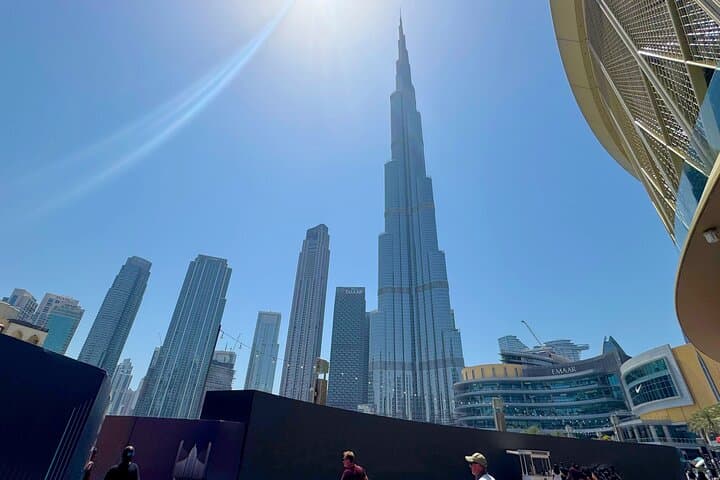
Opened in 2010 and designed by Adrian Smith of Skidmore, Owings & Merrill, the Burj Khalifa stands at 828 meters and redefined modern high-rise engineering. Its reinforced concrete core and piled foundation anchor a slender spire rising from Downtown Dubai’s man-made lake, a project born of rapid economic growth and an ambition to create a new city center at the edge of the desert.
Culturally, a visit is as much about spectacle as it is sight — the tower is a focal point for national celebrations and an emblem of Dubai’s global identity. Nearby, the Dubai Fountain and the older Al Fahidi district offer contrasting slices of the emirate’s past and present.
Practical guidance: choose levels 124/125 for classic panoramic viewing, level 148 for fewer crowds and a premium lounge, or the limited 154th level for the highest public vantage. Book prime-time slots for sunset; non-prime hours save money and reduce queues. Arrive early if you plan photos or want to explore the interactive exhibits. Security screening is strict: sharp objects and outside food are prohibited. Public transport (Burj Khalifa/Dubai Mall Metro) or optional private transfers simplify logistics. The site is wheelchair-accessible and suitable for most fitness levels — expect minimal walking but bring sun protection if you plan rooftop or terrace time.
easy.
1–4 hours.
Minimal fitness required; mostly elevator access and short walking between exhibits and viewing terraces.
Allow 60–240 minutes depending on level chosen, time spent at exhibits, and whether you combine it with the Dubai Mall or Fountain shows.
Transfers are optional—book private round-trip transfers when you want door-to-door convenience across Dubai.
Yes—All observation areas and public spaces are wheelchair accessible; staff assistance and infant seats are available on request.
Tickets are valid for the selected level and time slot; upgrades may be possible subject to availability but are not guaranteed on arrival.
Completed in 2010, the Burj Khalifa was built as a center-piece for Downtown Dubai and remains the world’s tallest structure, symbolizing a rapid era of development.
Visitor management and waste-reduction measures are in place around the tower and Dubai Mall—stick to marked paths, dispose of waste properly, and use public transport when possible.
Tours By Rafiq Tourism LLC operates guided outdoor trips and adventures with an emphasis on safety, stewardship, and memorable experiences.
The elevator doors whisper closed and, in less than a minute, the city peels away beneath you — a grid of light, the curving coastline, and the desert's pale edge. From the observation levels of the Burj Khalifa the urban fabric of Dubai folds into geometry: highways become ribbons, glass towers glitter like sequins, and the Dubai Fountain draws a steady crowd below.
The elevator doors whisper closed and, in less than a minute, the city peels away beneath you — a grid of light, the curving coastline, and the desert's pale edge. From the observation levels of the Burj Khalifa the urban fabric of Dubai folds into geometry: highways become ribbons, glass towers glitter like sequins, and the Dubai Fountain draws a steady crowd below.
Opened in 2010 and designed by Adrian Smith of Skidmore, Owings & Merrill, the Burj Khalifa stands at 828 meters and redefined modern high-rise engineering. Its reinforced concrete core and piled foundation anchor a slender spire rising from Downtown Dubai’s man-made lake, a project born of rapid economic growth and an ambition to create a new city center at the edge of the desert.
Culturally, a visit is as much about spectacle as it is sight — the tower is a focal point for national celebrations and an emblem of Dubai’s global identity. Nearby, the Dubai Fountain and the older Al Fahidi district offer contrasting slices of the emirate’s past and present.
Practical guidance: choose levels 124/125 for classic panoramic viewing, level 148 for fewer crowds and a premium lounge, or the limited 154th level for the highest public vantage. Book prime-time slots for sunset; non-prime hours save money and reduce queues. Arrive early if you plan photos or want to explore the interactive exhibits. Security screening is strict: sharp objects and outside food are prohibited. Public transport (Burj Khalifa/Dubai Mall Metro) or optional private transfers simplify logistics. The site is wheelchair-accessible and suitable for most fitness levels — expect minimal walking but bring sun protection if you plan rooftop or terrace time.