THE ADVENTURE COLLECTIVE® · Independent discovery and booking for outdoor travel

Ascend to 456 meters for sweeping 360° views from Levels 124 and 125 of the Burj Khalifa. This guide explains what to expect—high-speed elevators, outdoor terraces, VR experiences—and how to time your visit for the best light and fewer crowds.
Ascend to 456 meters for sweeping 360° views from Levels 124 and 125 of the Burj Khalifa. This guide explains what to expect—high-speed elevators, outdoor terraces, VR experiences—and how to time your visit for the best light and fewer crowds.
You step out of the elevator and the city rearranges itself beneath you: a lattice of glass, roads, and the slow shimmer of the desert meeting the Persian Gulf. At Level 125—about 456 meters above the ground—the deck opens into a spacious viewing room edged with Arabic mashrabiya motifs and panoramic sightlines that make the skyline feel tactile.
Verified experiences and guided adventures in the surrounding area.
You step out of the elevator and the city rearranges itself beneath you: a lattice of glass, roads, and the slow shimmer of the desert meeting the Persian Gulf. At Level 125—about 456 meters above the ground—the deck opens into a spacious viewing room edged with Arabic mashrabiya motifs and panoramic sightlines that make the skyline feel tactile.
The Burj Khalifa rose from Dubai’s development boom and opened in 2010 as the world’s tallest tower, designed by Adrian Smith of SOM and built on a deep reinforced concrete raft to anchor it against desert sands and wind. The skyscraper is part engineering feat, part urban magnet—Downtown Dubai, the Dubai Fountain, and the Dubai Mall form a compact cultural and retail hub at its base.
Expect dual thrills: high-speed double-deck elevators that climb at roughly 10 m/s, and the outdoor terrace on Level 124 where wind and light play across the skyline. Level 125 offers VR and green-screen photo options for a different perspective, while high-powered telescopes on Level 124 bring the city’s geometry into close focus.
Practicalities matter: tickets are timed (prime hours 15:00–18:30), security screening is standard, and visits typically run 30–120 minutes. Go late afternoon for softer light and manageable heat in summer, or early evening for illuminated cityscapes. Bring a camera, a light layer for the terrace breeze, and allow extra time to move through Downtown Dubai if you’re combining this with the mall or fountain shows.
The visit is straightforward but unforgettable—a metropolitan vantage point that rewards planning as much as presence.
easy.
30–120 minutes.
Low; requires short periods of standing and walking on level surfaces and stairs at entrances.
Yes—tickets are issued for specific entry times. Arrive at least 20–30 minutes early to pass security and reach the elevators without rushing.
Level 124 includes a public outdoor observation terrace; Level 125 is an indoor deck with VR and photography features.
Yes—there are elevators and accessible routes to the observation decks; inform staff if you need assistance or space for mobility devices.
Tripods are generally restricted; small cameras and smartphones are fine. Check with venue staff for any professional photography policies.
Completed in 2010 and designed by Adrian Smith of Skidmore, Owings & Merrill, the Burj Khalifa became a focal point of Dubai’s rapid urban development and record-breaking architecture.
The tower and Downtown Dubai manage large visitor flows—follow marked paths, dispose of waste properly, and respect restricted zones to minimize impact on the urban environment.
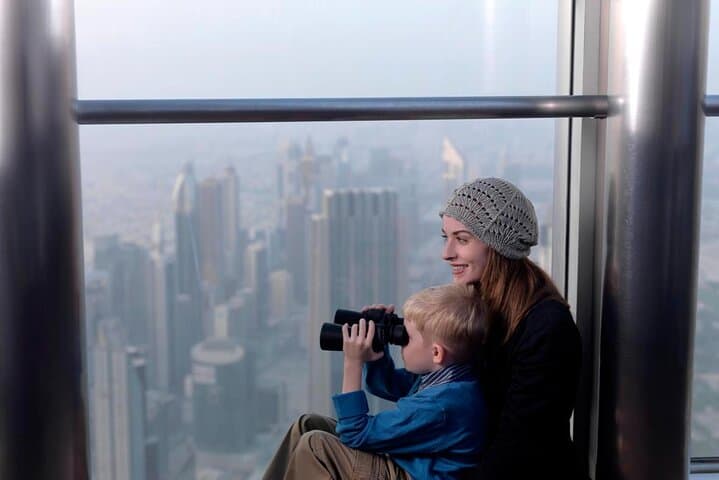
You step out of the elevator and the city rearranges itself beneath you: a lattice of glass, roads, and the slow shimmer of the desert meeting the Persian Gulf. At Level 125—about 456 meters above the ground—the deck opens into a spacious viewing room edged with Arabic mashrabiya motifs and panoramic sightlines that make the skyline feel tactile.
You step out of the elevator and the city rearranges itself beneath you: a lattice of glass, roads, and the slow shimmer of the desert meeting the Persian Gulf. At Level 125—about 456 meters above the ground—the deck opens into a spacious viewing room edged with Arabic mashrabiya motifs and panoramic sightlines that make the skyline feel tactile.
The Burj Khalifa rose from Dubai’s development boom and opened in 2010 as the world’s tallest tower, designed by Adrian Smith of SOM and built on a deep reinforced concrete raft to anchor it against desert sands and wind. The skyscraper is part engineering feat, part urban magnet—Downtown Dubai, the Dubai Fountain, and the Dubai Mall form a compact cultural and retail hub at its base.
Expect dual thrills: high-speed double-deck elevators that climb at roughly 10 m/s, and the outdoor terrace on Level 124 where wind and light play across the skyline. Level 125 offers VR and green-screen photo options for a different perspective, while high-powered telescopes on Level 124 bring the city’s geometry into close focus.
Practicalities matter: tickets are timed (prime hours 15:00–18:30), security screening is standard, and visits typically run 30–120 minutes. Go late afternoon for softer light and manageable heat in summer, or early evening for illuminated cityscapes. Bring a camera, a light layer for the terrace breeze, and allow extra time to move through Downtown Dubai if you’re combining this with the mall or fountain shows.
The visit is straightforward but unforgettable—a metropolitan vantage point that rewards planning as much as presence.