THE ADVENTURE COLLECTIVE® · Independent discovery and booking for outdoor travel

Climb from Ui Station to Baegundae—the highest point in Seoul—on a focused four-hour route that trades the usual six-hour circuit for a steeper, faster line. This guided Summit Course combines rope-assisted ridgeline moves, granite slabs, and historic fortress fragments with practical safety coaching.
Climb from Ui Station to Baegundae—the highest point in Seoul—on a focused four-hour route that trades the usual six-hour circuit for a steeper, faster line. This guided Summit Course combines rope-assisted ridgeline moves, granite slabs, and historic fortress fragments with practical safety coaching.
On a clear Seoul morning the city loosens its grip: the subway spits you out at Ui Station and, within ten minutes, the pavement becomes a steep forest stair. The trees here are blunt-armed pines and squat chestnut, and the granite spine of Bukhansan rises like an old wall, all cracks and handholds. The trail for the Summit Course slices straight up—an aggressive 600 meters of elevation in just 2.1 kilometers—so your breathing will set the rhythm as much as the trail does.
Verified experiences and guided adventures in the surrounding area.
Operated by Sam LEE · Seoul, Seoul
On a clear Seoul morning the city loosens its grip: the subway spits you out at Ui Station and, within ten minutes, the pavement becomes a steep forest stair. The trees here are blunt-armed pines and squat chestnut, and the granite spine of Bukhansan rises like an old wall, all cracks and handholds. The trail for the Summit Course slices straight up—an aggressive 600 meters of elevation in just 2.1 kilometers—so your breathing will set the rhythm as much as the trail does.
Bukhansan’s highest point, Baegundae (836 m / 2,743 ft), has guarded Seoul for centuries. The ridgeline was once part of the Bukhansanseong fortress system built during the Joseon dynasty; pieces of the old stone walls still peer from the pines, reminders that these trails are as much cultural corridors as they are exercise routes. The mountain’s granite faces are the result of intrusive igneous activity; the exposed blocks, smoothed and cracked by frost, make for steep, knobby scrambling that alternates with mosquito-dotted forest.
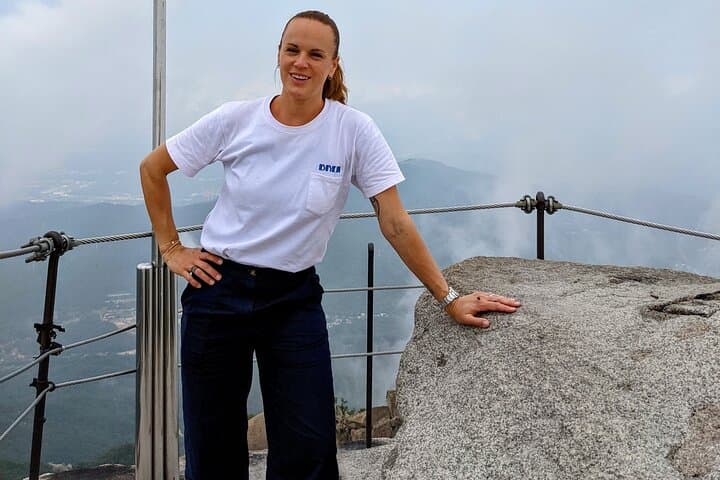
Locals come here seasonally—the mountain changes its mood across the year: spring bursts with azaleas and swollen streams; summer brings dense green and sudden downpours; fall rims the skyline in bright maples; winter scours the ridgeline with wind and occasional ice. Because Bukhansan sits on Seoul’s edge, the views from Baegundae swap green for a startling urban grid: you can see Seoul folding outward in every direction.
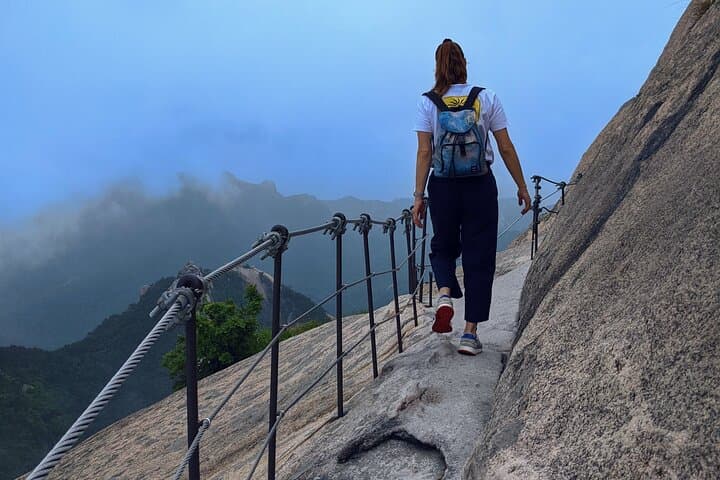
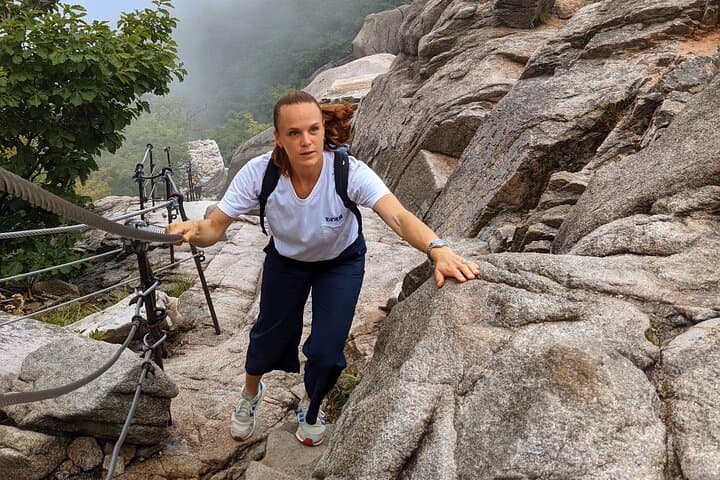
This Summit Course is built for speed and safety. The operator researched the quickest line to the top and shaves a typical six-hour circuit down to roughly four by taking a direct ascent and a guided descent. Expect a sustained climb—much of it on stone steps and steep slabs—and a rope-assisted section on the final ridge where grades hit 25–45 degrees. Guides rig fixed ropes and coach step-by-step moves; if heights unsettle you, that segment can be staged with breaks.
Practical essentials: start early (meet at Exit 2, Ui Station, by 8:00 AM), wear sturdy hiking shoes with good grip, and bring 1–1.5 liters of water plus a light, fast-dry lunch. Trekking poles are available on request but must be reserved in advance. Check weather and don’t skimp on layers—temperatures can drop quickly above tree line.
Rescue teams respond here every year; the route is popular and deceptively strenuous. Travel with a guide if you want a compact, efficient summit push and a clear plan for the tricky ridgeline. Finish with an optional Korean lunch in a nearby village and you’ll return to the city tired in the best way—breathing easier, seeing farther.
moderate.
4 hours (approx).
A moderate level of fitness—able to climb stairs continuously for 5+ minutes and manage short scrambling sections.
You should have a moderate fitness level—able to climb stairs continuously for at least five minutes and sustain uphill hiking; the guide will set a manageable pace.
Outside Exit 2 of Ui Station at 8:00 AM; the group leaves promptly and will wait only until 8:15 AM.
Poles can be rented if you request them before the trip; they are not automatically provided on the day of the hike.
Yes — ropes are fixed and guides coach participants; however, the final ridge is exposed and can be skipped with rest stops if you have a fear of heights.
The operator cancels for severe weather; the tour is marked as all sales final, so check conditions and contact the provider if they cancel due to weather.
Public restrooms are available at the trailhead and near park entrances, but none are on the steep ascent—use facilities before you start.
The slopes of Bukhansan include remnants of Joseon-era fortress walls (Bukhansanseong) built to guard approaches to Seoul; the area has long been both strategic and sacred.
High visitor numbers make erosion and trail impact a real issue—stick to marked trails, pack out trash, and avoid feeding wildlife to protect the park.
Sam LEE operates guided outdoor trips and adventures with an emphasis on safety, stewardship, and memorable experiences.
On a clear Seoul morning the city loosens its grip: the subway spits you out at Ui Station and, within ten minutes, the pavement becomes a steep forest stair. The trees here are blunt-armed pines and squat chestnut, and the granite spine of Bukhansan rises like an old wall, all cracks and handholds. The trail for the Summit Course slices straight up—an aggressive 600 meters of elevation in just 2.1 kilometers—so your breathing will set the rhythm as much as the trail does.
On a clear Seoul morning the city loosens its grip: the subway spits you out at Ui Station and, within ten minutes, the pavement becomes a steep forest stair. The trees here are blunt-armed pines and squat chestnut, and the granite spine of Bukhansan rises like an old wall, all cracks and handholds. The trail for the Summit Course slices straight up—an aggressive 600 meters of elevation in just 2.1 kilometers—so your breathing will set the rhythm as much as the trail does.
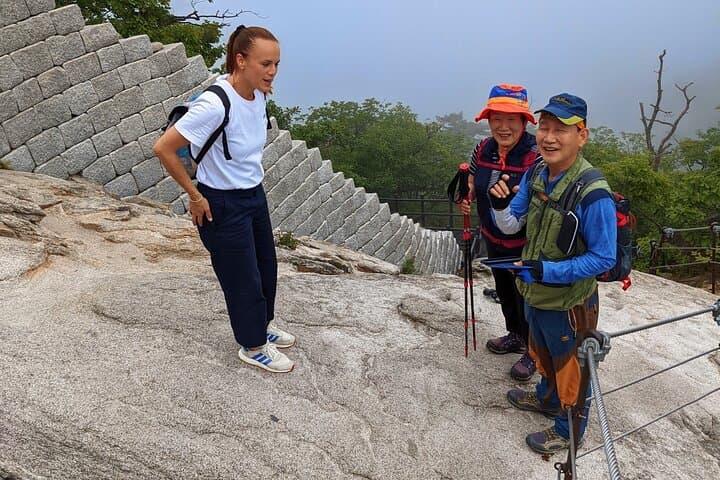
Bukhansan’s highest point, Baegundae (836 m / 2,743 ft), has guarded Seoul for centuries. The ridgeline was once part of the Bukhansanseong fortress system built during the Joseon dynasty; pieces of the old stone walls still peer from the pines, reminders that these trails are as much cultural corridors as they are exercise routes. The mountain’s granite faces are the result of intrusive igneous activity; the exposed blocks, smoothed and cracked by frost, make for steep, knobby scrambling that alternates with mosquito-dotted forest.
Locals come here seasonally—the mountain changes its mood across the year: spring bursts with azaleas and swollen streams; summer brings dense green and sudden downpours; fall rims the skyline in bright maples; winter scours the ridgeline with wind and occasional ice. Because Bukhansan sits on Seoul’s edge, the views from Baegundae swap green for a startling urban grid: you can see Seoul folding outward in every direction.
This Summit Course is built for speed and safety. The operator researched the quickest line to the top and shaves a typical six-hour circuit down to roughly four by taking a direct ascent and a guided descent. Expect a sustained climb—much of it on stone steps and steep slabs—and a rope-assisted section on the final ridge where grades hit 25–45 degrees. Guides rig fixed ropes and coach step-by-step moves; if heights unsettle you, that segment can be staged with breaks.
Practical essentials: start early (meet at Exit 2, Ui Station, by 8:00 AM), wear sturdy hiking shoes with good grip, and bring 1–1.5 liters of water plus a light, fast-dry lunch. Trekking poles are available on request but must be reserved in advance. Check weather and don’t skimp on layers—temperatures can drop quickly above tree line.
Rescue teams respond here every year; the route is popular and deceptively strenuous. Travel with a guide if you want a compact, efficient summit push and a clear plan for the tricky ridgeline. Finish with an optional Korean lunch in a nearby village and you’ll return to the city tired in the best way—breathing easier, seeing farther.