THE ADVENTURE COLLECTIVE® · Independent discovery and booking for outdoor travel

See Bucharest’s major monuments by car, then explore the historical center on foot. This private four-hour tour balances quick panoramic views with close-up walks through Revolution Square, Calea Victoriei, and Old Town courtyards.
See Bucharest’s major monuments by car, then explore the historical center on foot. This private four-hour tour balances quick panoramic views with close-up walks through Revolution Square, Calea Victoriei, and Old Town courtyards.
You step into an air-conditioned Mercedes and the city opens up in broad, deliberate frames: the massive silhouette of the Palace of the Parliament sliding by, the Dâmbovița River threading under stone bridges, and avenues that narrate Bucharest’s shifts from Ottoman frontier town to 19th-century “Little Paris” and late-20th-century upheaval.
Verified experiences and guided adventures in the surrounding area.
Operated by One Day Romania · Bucharest, Bucharest
You step into an air-conditioned Mercedes and the city opens up in broad, deliberate frames: the massive silhouette of the Palace of the Parliament sliding by, the Dâmbovița River threading under stone bridges, and avenues that narrate Bucharest’s shifts from Ottoman frontier town to 19th-century “Little Paris” and late-20th-century upheaval.
The four-hour route pairs a panoramic car circuit with a focused walking segment through the historical core. From the road you’ll register Romania’s modern political weight at the Parliament Palace and the soaring profile of the national cathedral; on foot you’ll move through Calea Victoriei, past Revolution Square and the concert-hall façade of the Romanian Athenaeum, and toward pockets where interwar architecture and communist-era blocks meet.
Geology here is gentle—low-lying plains shaped by the Dâmbovița valley—so the day’s effort is urban navigation, not alpine strain. Culturally, Bucharest is layered: royal courts and coffee houses from the 1800s, 20th-century industrial and ideological projects, and a resurgent café and arts scene reclaiming old bank basements and arcades.
Practical guidance: schedule your tour mid-morning to avoid the densest traffic, bring comfortable walking shoes for cobblestones, and keep a small bottle of water and a light layer for changing weather. Expect several photo stops and short walks of 10–30 minutes; the guide handles logistics and local stories. For a compact introduction to Bucharest’s political monuments, grand boulevards, and hidden courtyards, this mixed car-and-walking format efficiently delivers both perspective and proximity.
easy.
4 hours.
Suitable for most fitness levels; expect multiple short walks on uneven pavement
Yes — the tour includes hotel pickup and drop-off within the Bucharest area as stated in the inclusions.
Expect several short walks of 10–30 minutes at key sites in the historical center; the bulk of transit between distant sights is by car.
Most major landmarks are viewed from outside on this itinerary; where admission is possible it will be noted, but this standard tour focuses on exterior visits and guided commentary.
The tour is private; guides generally adapt commentary to group interests, though the published itinerary highlights specific stops and timing.
Bucharest’s center combines 19th-century bourgeois boulevards and interwar architecture with heavy imprint from the communist era—Revolution Square marks the 1989 demonstrations that ended Nicolae Ceaușescu’s rule.
Historic façades and parks are sensitive to foot traffic and pollution; small-group private tours reduce crowds, and guides should discourage littering and encourage respect for protected sites.
One Day Romania operates guided outdoor trips and adventures with an emphasis on safety, stewardship, and memorable experiences.


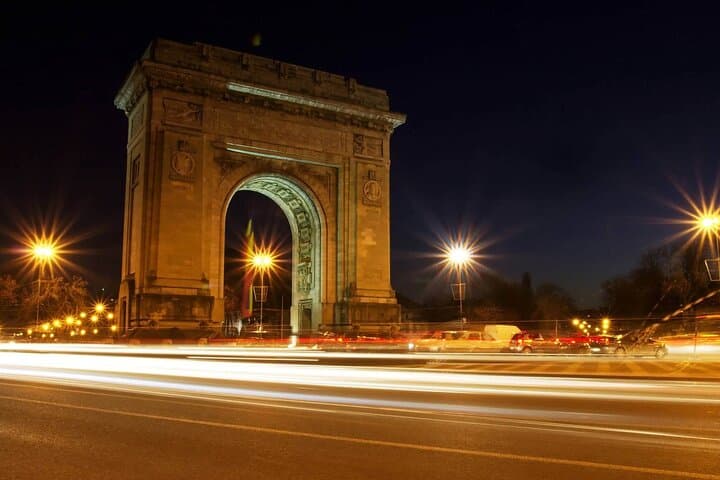
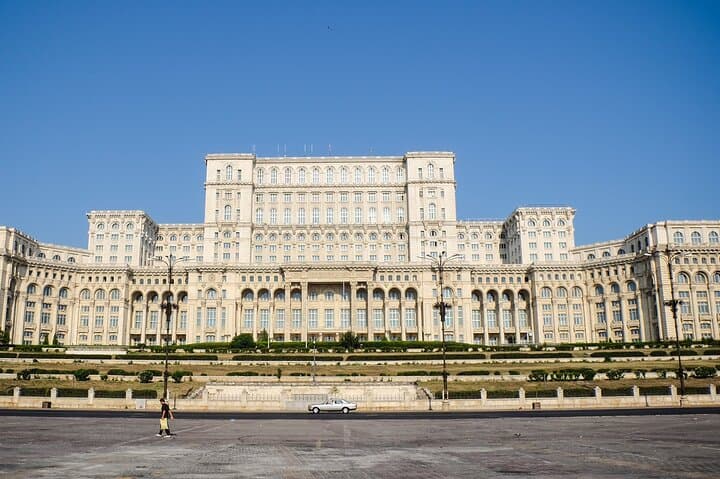
You step into an air-conditioned Mercedes and the city opens up in broad, deliberate frames: the massive silhouette of the Palace of the Parliament sliding by, the Dâmbovița River threading under stone bridges, and avenues that narrate Bucharest’s shifts from Ottoman frontier town to 19th-century “Little Paris” and late-20th-century upheaval.
You step into an air-conditioned Mercedes and the city opens up in broad, deliberate frames: the massive silhouette of the Palace of the Parliament sliding by, the Dâmbovița River threading under stone bridges, and avenues that narrate Bucharest’s shifts from Ottoman frontier town to 19th-century “Little Paris” and late-20th-century upheaval.
The four-hour route pairs a panoramic car circuit with a focused walking segment through the historical core. From the road you’ll register Romania’s modern political weight at the Parliament Palace and the soaring profile of the national cathedral; on foot you’ll move through Calea Victoriei, past Revolution Square and the concert-hall façade of the Romanian Athenaeum, and toward pockets where interwar architecture and communist-era blocks meet.
Geology here is gentle—low-lying plains shaped by the Dâmbovița valley—so the day’s effort is urban navigation, not alpine strain. Culturally, Bucharest is layered: royal courts and coffee houses from the 1800s, 20th-century industrial and ideological projects, and a resurgent café and arts scene reclaiming old bank basements and arcades.
Practical guidance: schedule your tour mid-morning to avoid the densest traffic, bring comfortable walking shoes for cobblestones, and keep a small bottle of water and a light layer for changing weather. Expect several photo stops and short walks of 10–30 minutes; the guide handles logistics and local stories. For a compact introduction to Bucharest’s political monuments, grand boulevards, and hidden courtyards, this mixed car-and-walking format efficiently delivers both perspective and proximity.