THE ADVENTURE COLLECTIVE® · Independent discovery and booking for outdoor travel

Turn Bucharest’s Old Town into a solvable mystery with a self-guided smartphone game. Walk 3.5 km of Lipscani’s streets, unlock local stories, and find a hidden treasure at your own pace.
Turn Bucharest’s Old Town into a solvable mystery with a self-guided smartphone game. Walk 3.5 km of Lipscani’s streets, unlock local stories, and find a hidden treasure at your own pace.
The cobbles of Lipscani wake underfoot as you start the hunt: a narrow lane, a glass-covered arcade that catches the morning light, and a set of riddles that push you toward a hidden prize. Streets that once ferried carts now dare you to read their plaques and follow clues through courtyards and storefronts.
Verified experiences and guided adventures in the surrounding area.
Operated by Questo · Bucharest, București
The cobbles of Lipscani wake underfoot as you start the hunt: a narrow lane, a glass-covered arcade that catches the morning light, and a set of riddles that push you toward a hidden prize. Streets that once ferried carts now dare you to read their plaques and follow clues through courtyards and storefronts.
Bucharest’s Old Town (Centru Vechi) is the city’s commercial heart for centuries — tanners and traders gave Lipscani its name, while 19th- and early-20th-century façades earned parts of the city the nickname "Little Paris." The Dâmbovița River’s nearby course shaped settlement and trade, and surviving Ottoman, Byzantine and Belle Époque details mark a layered urban geology rather than a natural one. Local culture is palpable: Orthodox churches, bohemian cafés, and bookshops occupy buildings that survived fires and reconstruction.
The game covers about 3.5 km and typically takes 1.5–2 hours. It’s self-guided via smartphone, available in English, German and Romanian, and designed to be played offline after you receive the access code. Expect cobblestones, narrow alleys, occasional café queues, and courtyard gates that open onto small surprises.
Practical guidance: start early to avoid crowds and afternoon heat; bring a charged phone and a portable charger; wear supportive shoes for uneven surfaces; pause for a coffee at Macca-Vilacrosse Passage if you need a breather. The route is wheelchair- and stroller-accessible in many sections, but some historic thresholds and surfaces can be uneven—move at a comfortable pace and enjoy the clues that unlock the city’s hidden stories.
easy.
1.5–2 hours.
Suitable for most fitness levels; mainly walking on urban surfaces for up to 3.5 km
No — the tour provides offline play after you receive the access code, though initial activation may require a connection to download materials.
Many streets and passages are wheelchair- and stroller-accessible, but some historic thresholds and cobbles may be uneven; plan accordingly.
The route is about 3.5 km and typically takes 1.5–2 hours, but there is no time limit — players can pause for breaks, food, or photos.
The exploration game is available in English, German and Romanian.
Lipscani was Bucharest’s medieval commercial quarter where leather tanners and merchants worked; later 19th-century architecture and covered passages turned parts of it into a fashionable district.
Restoration efforts focus on preserving façades and limiting intrusive signage; visitors are encouraged to respect private courtyards and avoid littering to protect fragile historic fabric.
Questo operates guided outdoor trips and adventures with an emphasis on safety, stewardship, and memorable experiences.



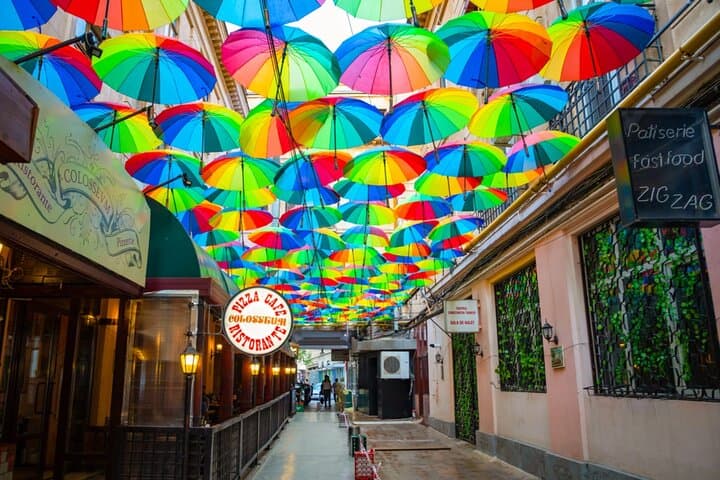
The cobbles of Lipscani wake underfoot as you start the hunt: a narrow lane, a glass-covered arcade that catches the morning light, and a set of riddles that push you toward a hidden prize. Streets that once ferried carts now dare you to read their plaques and follow clues through courtyards and storefronts.
The cobbles of Lipscani wake underfoot as you start the hunt: a narrow lane, a glass-covered arcade that catches the morning light, and a set of riddles that push you toward a hidden prize. Streets that once ferried carts now dare you to read their plaques and follow clues through courtyards and storefronts.
Bucharest’s Old Town (Centru Vechi) is the city’s commercial heart for centuries — tanners and traders gave Lipscani its name, while 19th- and early-20th-century façades earned parts of the city the nickname "Little Paris." The Dâmbovița River’s nearby course shaped settlement and trade, and surviving Ottoman, Byzantine and Belle Époque details mark a layered urban geology rather than a natural one. Local culture is palpable: Orthodox churches, bohemian cafés, and bookshops occupy buildings that survived fires and reconstruction.
The game covers about 3.5 km and typically takes 1.5–2 hours. It’s self-guided via smartphone, available in English, German and Romanian, and designed to be played offline after you receive the access code. Expect cobblestones, narrow alleys, occasional café queues, and courtyard gates that open onto small surprises.
Practical guidance: start early to avoid crowds and afternoon heat; bring a charged phone and a portable charger; wear supportive shoes for uneven surfaces; pause for a coffee at Macca-Vilacrosse Passage if you need a breather. The route is wheelchair- and stroller-accessible in many sections, but some historic thresholds and surfaces can be uneven—move at a comfortable pace and enjoy the clues that unlock the city’s hidden stories.