THE ADVENTURE COLLECTIVE® · Independent discovery and booking for outdoor travel

Skip the lines and let an in-app audio guide steer you through the British Museum’s headline objects and lesser-known rooms. This reserved-entry visit highlights the Parthenon sculptures, moai, Viking craft and samurai armor with practical tips for timing your experience.
Skip the lines and let an in-app audio guide steer you through the British Museum’s headline objects and lesser-known rooms. This reserved-entry visit highlights the Parthenon sculptures, moai, Viking craft and samurai armor with practical tips for timing your experience.
You step from Bloomsbury’s grey pavement into a bright, vaulted court where light travels like a visitor, pooling on marble and plaster cast. The Great Court’s glass roof opens the museum to the sky and the day’s pace: school groups cluster, tourists angle for photographs, and a headset hums quietly against the stillness of ancient stone.
Verified experiences and guided adventures in the surrounding area.
You step from Bloomsbury’s grey pavement into a bright, vaulted court where light travels like a visitor, pooling on marble and plaster cast. The Great Court’s glass roof opens the museum to the sky and the day’s pace: school groups cluster, tourists angle for photographs, and a headset hums quietly against the stillness of ancient stone.
Founded from Sir Hans Sloane’s 1753 collection, the British Museum charts civilizations through objects: Parthenon sculptures that argue with time, a moai’s blank-eyed witness from Rapa Nui, and the precise lacquer of samurai armor. Geology and human craft meet in case after case — carved ivories, bronze tools, and the compact order of a Viking ship’s fittings.
The audio tour turns display labels into conversation, guiding you from the Enlightenment Gallery to the quieter Cast Courts and the small, intense room where the Sutton Hoo helmet sits. Cultural context follows: empire-era acquisitions, debates over provenance, and centuries of scholarship that rewrote how Britain reads the world.
Practicalities sharpen the visit: reserved entry trims queue time but arrive early to use quieter morning hours; allow two hours for highlights and more if you linger. Bags may be screened and oversized luggage isn’t allowed; wear comfortable shoes for stone floors and bring a charged phone for the app. Audio narration is self-paced — pause at the Parthenon sculptures and let the tour lead you to lesser-known corners where stories deepen.
This is a museum of objects that still speak: listen closely and the past clicks into place.
easy.
2 hours.
Low; requires standing and moderate walking on hard floors for up to a few hours.
No — most bookings accept a digital confirmation; have your booking reference or app ready for entry and security checks.
Non-flash photography is generally permitted in permanent galleries, but check signage for restricted exhibits and respect object-specific rules.
Yes — the British Museum offers step-free access, lifts, accessible toilets, and wheelchairs on request; inquire ahead for high-support needs.
The guided highlights are self-paced and designed for about 1.5–2 hours; you can pause and resume at any stop in the app.
The museum opened in 1753 from Sir Hans Sloane’s vast collection and grew through donations and imperial acquisitions, becoming a center for global antiquities and scholarly debate.
The museum runs active conservation labs and climate-controlled displays; visitor behavior affects fragile objects, so follow signage, avoid flash photography, and keep food and drink outside galleries.
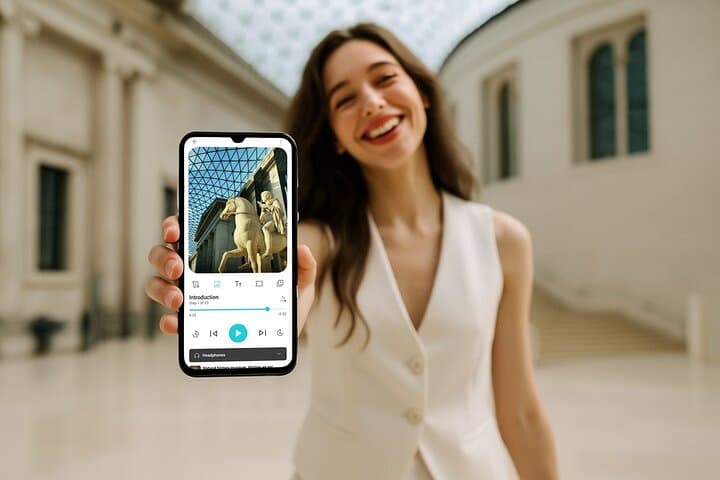
You step from Bloomsbury’s grey pavement into a bright, vaulted court where light travels like a visitor, pooling on marble and plaster cast. The Great Court’s glass roof opens the museum to the sky and the day’s pace: school groups cluster, tourists angle for photographs, and a headset hums quietly against the stillness of ancient stone.
You step from Bloomsbury’s grey pavement into a bright, vaulted court where light travels like a visitor, pooling on marble and plaster cast. The Great Court’s glass roof opens the museum to the sky and the day’s pace: school groups cluster, tourists angle for photographs, and a headset hums quietly against the stillness of ancient stone.
Founded from Sir Hans Sloane’s 1753 collection, the British Museum charts civilizations through objects: Parthenon sculptures that argue with time, a moai’s blank-eyed witness from Rapa Nui, and the precise lacquer of samurai armor. Geology and human craft meet in case after case — carved ivories, bronze tools, and the compact order of a Viking ship’s fittings.
The audio tour turns display labels into conversation, guiding you from the Enlightenment Gallery to the quieter Cast Courts and the small, intense room where the Sutton Hoo helmet sits. Cultural context follows: empire-era acquisitions, debates over provenance, and centuries of scholarship that rewrote how Britain reads the world.
Practicalities sharpen the visit: reserved entry trims queue time but arrive early to use quieter morning hours; allow two hours for highlights and more if you linger. Bags may be screened and oversized luggage isn’t allowed; wear comfortable shoes for stone floors and bring a charged phone for the app. Audio narration is self-paced — pause at the Parthenon sculptures and let the tour lead you to lesser-known corners where stories deepen.
This is a museum of objects that still speak: listen closely and the past clicks into place.